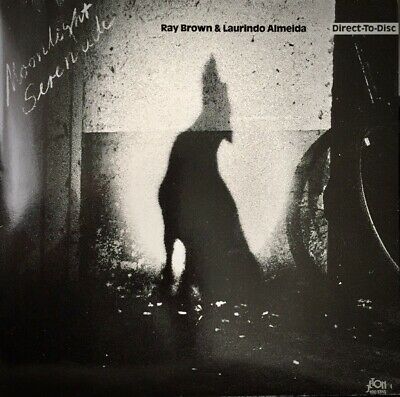
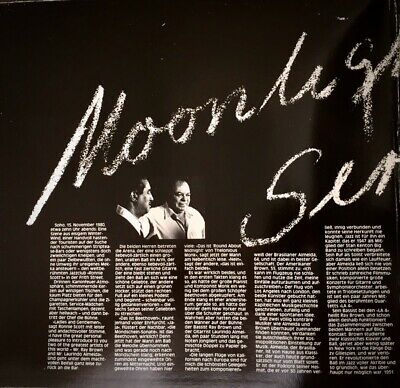
JETON LP 100.3315 Ray Brown & Laurindo Almeida, Moonlight Serenade, 1981 DEU D2D
$
150
$ 150
Sold For
Sep 23, 2020
Sold Date
Apr 11, 2020
Start Date
1
Number Of Bids
USA
Country Of Seller
eBay
Sold at
Favourite Auctions
To save auctions to your favourites, please login
If you don't have an account, please register
Description
****Welcome to our listing, thanks very much for looking!
****See our own website! We have lots of out of print LPs and CDs! Find us on the web at -
hearthedifference.net
****Shipping cost is only an estimate - it depends on the actual weight and size of the package as well as the service required. We do not profit from shipping costs, so if we overcharge, we will refund the difference back to you. It's always best to wait for our invoice before paying for your item. We will combine shipping for multiple items purchased.
****Please see our other listings - new items added daily!
****To access our eBay store click on the little red door at the top right section of any of our eBay listings or, click on -
http://stores.ebay.com/Hear-The-Difference
Background -
The huge and comfortable sound of Ray Brown's bass was a welcome feature on bop-oriented sessions for over a half-century. He played locally in his native Pittsburgh in his early days.Arriving in New York in 1945, on his first day in town Brown met and played with Dizzy Gillespie, Charlie Parker, and Bud Powell. He was hired by Gillespie for his small groups and his big band; "One Bass Hit" and "Two Bass Hit" were early features, and he can be seen with Dizzy Gillespie in the 1947 film Jiving in Bebop. Although not a soloist on the level of an Oscar Pettiford, Brown's quick reflexes and ability to accompany soloists in a swinging fashion put him near the top of his field. After playing with Jazz at the Philharmonic, he married Ella Fitzgerald (their marriage only lasted during 1948-1952), and for a time led his own trio to back the singer. Brown recorded with an early version of the Modern Jazz Quartet (under Milt Jackson's leadership), and then became a permanent member of the Oscar Peterson Trio (1951-1966).
With Peterson, the bassist traveled the world, guested with other top jazz artists, was featured on JATP tours, became famous, and recorded constantly. He began playing cello in the late '50s, and used it on a few of his own dates. After leaving Peterson, Brown settled in Los Angeles, worked in the studios, continued recording jazz, and worked as a manager of several artists (including the Modern Jazz Quartet and Quincy Jones). He played with the L.A. Four starting in 1974, did a great deal to revive the careers of Ernestine Anderson and Gene Harris, and recorded extensively for Pablo and Concord. The Ray Brown Trio featured pianists Gene Harris, Benny Green, and Geoff Keezer, along with drummers Jeff Hamilton and Greg Hutchison, and recorded for Concord and Telarc. He continued touring up until his death, dying in his sleep while napping before a show in Indianapolis on July 2, 2002. His last batch of sessions, working as a trio with pianist Monty Alexander and guitarist Russell Malone, were released that fall. - Scott Yanow
During a long and uncommonly productive career, Brazilian guitarist Laurindo Almeida achieved a ubiquity in popular music that has yet to be fully recognized. Largely responsible for the Brazilian / North American "samba jazz" that would eventually catch on in the form of a musical trend known as bossa nova, he played behind dozens of well-known pop vocalists and improved the overall texture of many a studio production ensemble. One credible estimate states that Almeida contributed to no less than 800 film soundtracks (among them The Old Man and the Sea, How the West Was Won, and Breakfast at Tiffany's), as well as countless TV scores. He also authored a series of guitar instruction books that are still in use worldwide. A master improviser and a skilled arranger as well as a brilliant interpreter of classical repertoire, he left for posterity superb recordings of works by J.S. Bach, Fryderyk Chopin, Claude Debussy, and Joaquín Rodrigo as well as a host of Brazilian composers including Heitor Villa-Lobos, Radamés Gnattali, and Alfredo Vianna. Almeida's own chamber compositions include a concerto for guitar and orchestra.
Laurindo Jose de Araujo Almeida Nobrega Neto was born in the village of Prainha near the Port of Santos in the state of São Paulo, Brazil, on September 2, 1917. He received his first musical instruction from his mother, a classically trained pianist, and credited her fondness for the music of Fryderyk Chopin as a primary influence. After observing his sister being given guitar lessons, "Lindo" borrowed her instrument and retreated to a barn where he taught himself to play entirely by ear, transferring what he'd heard his mother play on the piano to the strings of the guitar. Many years later he would declare his preference for the direct intimacy of the guitar as opposed to the more percussive piano. By the age of nine he had become uncommonly skilled and was well on the way to becoming a guitar virtuoso; it was then that he lost his father to typhoid fever. At 12 he relocated to São Paulo with his brother. He joined the Revolutionary Army at 15 and was wounded in a civil conflagration. While recuperating in a hospital he met Garoto, a nationally respected guitarist who was visiting to perform for the patients. Within a few years, Almeida would perform and record extensively with Garoto.
In 1935 Almeida moved to Rio de Janeiro, where he teamed up with singer and tenor guitarist Nestor Amaral and began working in radio while becoming active as a songwriter, arranger, and multi-instrumentalist and performing regularly at the Casino da Urea. He composed folk songs, fox trots, sambas, choros, waltzes, and comedic airs, and worked with a broad range of artists including choro master Pixinguinha. He also collected 78-rpm jazz records, and was especially fond of the way Fats Waller played the piano. In 1936, at the age of 19, he got a job (playing banjo for the most part so as to be heard) for half a year on the Cuyaba, a cruise ship that docked in every country along the coast of Europe from Spain to Germany. While visiting Paris he was able to hear Django Reinhardt and Stéphane Grappelli in person. In 1941 he played the Casino Copacabana, and switched over to the Casino Balneario da Urca the following year. It was there that he met a Portuguese ballerina named Natalia (Maria Miguelina Ferreira Ribeiro) in 1944 and married her shortly afterwards.
After touring north with Carmen Miranda, Laurindo Almeida moved to Los Angeles in 1947, and was able to do so because of royalties received from the sale of his tune "Johnny Pedlar," made famous as "Johnny Peddler" by popular acts like Jimmy Dorsey, Les Brown, and the Andrews Sisters. He performed in Laguna Beach with Nestor Amaral, José Oliveira, and violinist Elisabeth Waldo and appeared in a variety show with vocalist Dennis Day and comedians Victor Borge and Red Skelton, and in movies with Jimmy Durante and Danny Kaye. What made Almeida so different from anyone else on the scene at the time was his practice of using only his fingers on the guitar strings; everybody else used picks. When asked who his favorite guitarists were, he gave an answer that was emblematic of his entire career: classical virtuoso Andrés Segovia and Oscar Moore of the King Cole Trio. Almeida's film production work brought him to the attention of bandleader Stan Kenton, who hired and featured him while absorbing stylistic elements of the northeast Brazilian baiao, the samba, and the choro. Kenton eventually composed "Lament" especially for the guitarist. Almeida's direct involvement with Kenton's orchestra lasted until 1952. His first album as a solo artist, Concert Creations for Guitar, was released in 1950 by Kenton's host label, Capitol.
Just as Machito, Dizzy Gillespie, and Chano Pozo had enlivened the scene with their Afro-Cuban jazz during the late '40s, Laurindo Almeida's session work during his first decade in the U.S. pollinated the modern jazz scene with rhythms and melodies from Brazil. During the years 1953-1958, he recorded several jazz samba albums with saxophonist Bud Shank that have since come to be regarded as precursors of the bossa nova trend of the late '50s and early '60s. In addition to steady session work with vocalists like June Christy, Rosemary Clooney, Nat King Cole, Bing Crosby, Doris Day, Frankie Laine, Peggy Lee, Robert Mitchum, Connie Russell, Frank Sinatra, Martha Tilton, Mel Tormé, Kitty White, and vocal groups like the Four Freshmen, the Hi-Lo's, and the Platters, Almeida collaborated with bandleader Ray Anthony, pianist George Shearing, multi-instrumentalist Herbie Mann, space age pop music's Juan Garcia Esquivel, Kenton's right-hand man Pete Rugolo, and Hollywood's master of movie music Henry Mancini.
Between 1960 and 1967 Almeida put out no less than nine pop-oriented albums for Capitol; these were in addition to at least as many "classical" titles for that label. When the bossa nova craze really set in, Almeida brought an authentic Brazilian presence to records by Stan Getz, Shorty Rogers, and Cal Tjader; he also assisted with a Harry Belafonte Christmas LP and cut an album with the Modern Jazz Quartet, touring with them throughout all of Europe. While continuing to work with Mancini, he practiced anonymity as a member of Guitars Unlimited and the 50 Guitars of Tommy Garrett, sat in with bandleader Gerald Wilson, backed Dean Martin and Sammy Davis, Jr., and shared a session with trumpeter Rafael Méndez. In 1968 he played on the soundtrack of the film Charly, based upon Flowers for Algernon, a novel by Daniel Keyes.
In 1970 Almeida was one of the musicians backing Phil Ochs on his Greatest Hits album, produced by Van Dyke Parks, who invited the guitarist back to record the album Discover America in 1972. In 1974 Almeida and Bud Shank formed the L.A. 4 with bassist Ray Brown and drummer Shelly Manne (later replaced by Jeff Hamilton); this unit would eventually turn out at least eight albums, mostly for the Concord label, with which Almeida would be closely associated for the rest of his days. During the 1980s he performed with his second wife, Canadian soprano Deltra Ruth Eamon; he also recorded several albums with guitarist Charlie Byrd and led a trio at Disney World in Orlando, FL. In 1988 he formed a three-piece unit called Guitarjam with Sharon Isbin and Larry Coryell. Laurindo Almeida never failed to get behind musicians who earned his respect, and was especially supportive of other guitarists, including fellow Brazilian Baden Powell and classicist Paulo Bellinati. At the age of 74 he cut a live album (Outra Vez) with his trio at a club near San Diego, performing (in addition to his own compositions) works by Antonio Carlos Jobim, Enriqué Granados, Thelonious Monk, Ludwig van Beethoven, Irving Berlin, and Antonin Dvorák. This intriguingly diverse selection was typical of Laurindo Almeida, who passed away on July 26, 1995, in Van Nuys, CA. - Arwulf Arwulf
-
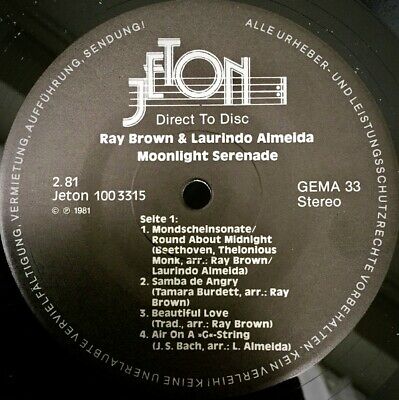
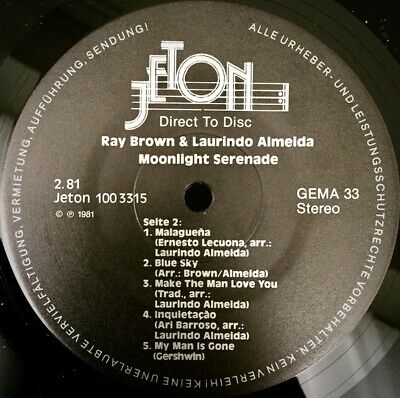
LP made by JETON Records, in GERMANY
-
LP released in 1981
-
LP is recorded in STEREO - a direct to disc recording (D2D)
-
Record Catalog Number: 100.3315
Ray Brown / Laurindo Almeida
LP Title -
Moonlight Serenade
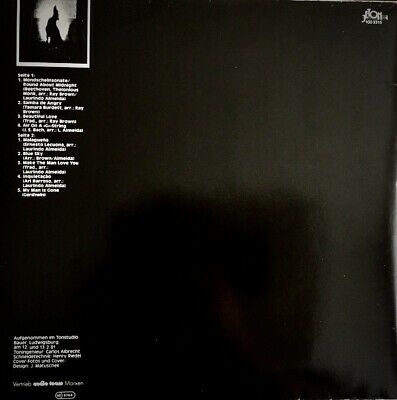
Tracks -A1. Mondscheinsonate/Round About Midnight
A2. Samba De Angry
A3. Beautiful Love
A4. Air On A "G"-String
B1. Malaguena
B2. Blue Sky
B3. Make The Man Love You
B4. Inquietacao
B5. My Man Is Gone
Performers / Credits / Other Information -
• Published By – Jeton Musikverlag
• Recorded and produced 12. to 13. February 1981 at Tonstudio Bauer, Ludwigsburg.
• Bass – Ray Brown
• Guitar – Laurindo Almeida
• Liner Notes – Werner Stiefele
• Liner Notes [Translated By] – Diana Loos
• Recorded By [Engineer] – Carlos Albrecht
CONDITION Details:
The GATE-FOLD LP jacket is in near mint minus overall condition. The jacket is tight and clean, with NO seam splits. The jacket is laminated on the front and back covers. The colors on the jacket are sharp and clean with just some minor shelf wear evident at the corners and seams.
The LP is in near mint minus overall condition! There are no serious marks on the vinyl. There may be some light spider marks on the LP which are caused by sliding the LP in and out of the inner sleeve. Most of the time, these types of marks are not audible, but it really depends on the sensitivity of your audio gear. Considering the vintage of this LP, the vinyl looks superb - it has much of it's original gloss and sheen! However, this is not a new audiophile LP....some extraneous sound is inevitable and should be expected for a vintage LP. There are NO serious spindle marks on the record labels either. LP has some dust on the surfaces so please clean the LP before auditioning it - a superb example of a collector's grade copy!A Short Note About LP GRADING -
- Mint = Only used for sealed items.
- Near Mint = Virtually flawless in every way.
- Near Mint Minus = Item has some minor imperfections, some audible.
- Excellent = Item obviously played and enjoyed with some noise.
- Very Good Plus = Many more imperfections which are noticeable and obtrusive.
For best results, always thoroughly clean your LPs before playing them.
LPs can be audiophile quality pressings (any collector of fine MFSL, half speeds, direct to discs, Japanese/UK pressings etc., can attest to the difference a quality pressing can make to an audio system).
Don't let this rarity slip by!!!price rating