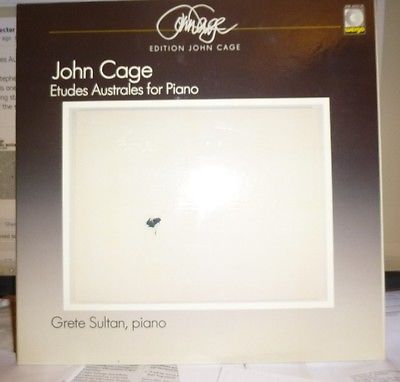
JOHN CAGE "Etudes Australes for Piano" 4LP, WERGO, 1987, Grete Sultan, NM/NM
$
40


Favourite Auctions
To save auctions to your favourites, please login
If you don't have an account, please register
Description
Condition:
AMG Description by "Blue" Gene Tyranny [-]
Like Cage's magnificent piece Atlas Eclipticalis, scored for a soloist on up to an orchestra of soloists, the Etudes Australes are also composed of notes derived from star maps. These thirty two piano etudes, each two pages/eight systems long, are divided into four books. There are two kinds of written notes to be played: completely filled (sometimes attached by a single line like a chord but most often isolated points), or empty circles. The pianist's right hand part is indicated on two staves and the left hand is indicated on another two staves. Both hands play notes that are located over the entire range of the keyboard, including many large jumps between extreme registers. But since there are no tempo or dynamic indications given in the score (these are left to the performer's discretion), a performance may be technically virtuosic or not. Consequently, any apparently expressive or emotional events that occur are created by the performer or a listener's sensibilities (including habits). Concerning an overall tempo and the difficulties of the piece, Cage invites the performer to "shift gears" when necessary, as may sometimes become necessary "when traveling through space".
Diamond-shaped notes or a single note at the beginning of each etude indicate keys which are to be pressed down silently for the entire etude; this is usually accomplished by using rubber wedges to keep the key or keys depressed. The depressed string(s) is affected by the notes played around it, and will produce corresponding harmonics in reaction to them.
" ... the correspondence between space and time should be such that the music 'sounds' as it 'looks'. " The proportions between the notes create the "time" in this score. The notion of a linear, progressive (historical) time is abandoned. As a note to performers, Cage has remarked that he prefers that the notes be allowed to stand on their own integrity, without a performer-imposed sense of forward, linear motion.
Of the four defined (but in reality not entirely separate) components of sound (amplitude, phase, frequency and time), the time parameter is perhaps the essence of music, because music fundamentally and uniquely deals with the maintenance of time. The "zero" or suspended linear time that Cage proposes here, is one of several kinds of time.
John Cage, Grete Sultan ?– Etudes Australes For Piano
Label: WERGO ?– WER 60152/55 Series: Edition John Cage – Format: 4 × Vinyl, LPBox Set
Country: Germany Released: 1987 Genre: Classical Style: Neo-Classical, Contemporary
Tracklist
Book 1 A1 Etude # 1 3:46 A2 Etude # 2 4:25 A3 Etude # 3 3:53 A4 Etude # 4 4:03 B1 Etude # 5 4:19 B2 Etude # 6 3:59 B3 Etude # 7 4:56 B4 Etude # 8 3:58 Book 2 C1 Etude # 9 5:00 C2 Etude # 10 4:25 C3 Etude # 11 4:30 C4 Etude # 12 3:45 D1 Etude # 13 4:05 D2 Etude # 14 5:10 D3 Etude # 15 4:20 D4 Etude # 16 5:38 Book 3 E1 Etude # 17 4:58 E2 Etude # 18 5:13 E3 Etude # 19 4:50 E4 Etude # 20 5:00 F1 Etude # 21 5:18 F2 Etude # 22 6:45 F3 Etude # 23 6:02 F4 Etude # 24 6:25 Book 4 G1 Etude # 25 6:22 G2 Etude # 26 6:40 G3 Etude # 27 5:27 G4 Etude # 28 6:41 H1 Etude # 29 7:05 H2 Etude # 30 7:01 H3 Etude # 31 7:16 H4 Etude # 32 4:44Credits
- Composed By – John Cage
- Engineer – Gretchen Zoeckler (tracks: A1 To D4), Tom Lazarus (tracks: E1 To H4)
- Liner Notes – Richard Kostelanetz
- Photography – Roberto Masotti
- Piano – Grete Sultan
- Producer – Heiner Stadler
Notes
Book 1 & Book 2: Recorded during August 1978 at Vanguard Recording Studios, New York City.Book 3 & Book 4: Recorded during November/December 1982 at Vanguard Recording Studios.
See our other EBAY auctions by using search by seller and using “recordcollectormichigan”
Ferndale, Michigan 48220
Phone: 248-548-9888
Hours: Monday thru Saturday NOON to 6:00 PM (Eastern)
GOLDMINE GRADING
MINT ---- It should appear to be perfect. No scuffs or scratches, blotches or stains, labels or writing, tears or splits. Mint means perfect.
NEAR MINT ---- Otherwise mint but has one or two tiny inconsequential flaws that do not affect play. Covers should be close to perfect with minor signs of wear or age just becoming evident: slight ring-wear, minor denting to a corner, or writing on the cover should all be noted properly.
VERY GOOD PLUS ---- The record has been handled and played infrequently or very carefully. Not too far from perfect. On a disc, there may be light paper scuffs from sliding in and out of a sleeve or the vinyl or some of the original luster may be lost. A slight scratch that did not affect play would be acceptably VG+ for most collectors.
VERY GOOD ---- Record displays visible signs of handling and playing, such as loss of vinyl luster, light surface scratches, groove wear and spindle trails. Some audible surface noise, but should not overwhelm the musical experience. Usually a cover is VG when one or two of these problems are evident: ring wear, seam splits, bent corners, loss of gloss, stains, etc.
GOOD ---- Well played with little luster and significant surface noise. Despite defects, record should still play all the way through without skipping. Several cover flaws will be apparent, but should not obliterate the artwork.
POOR ---- Any record or cover that does not qualify for the above "Good" grading should be seen as Poor. Several cover flaws.
price rating

![Herbie Hancock (Head Hunters) LP - 180g [Columbia, 2009 MOV Reissue, EU] **NM**](https://www.popsike.net/php/thumbnail.php?url=https://www.popsike.pics/pix/20250919/205734889755.jpg)