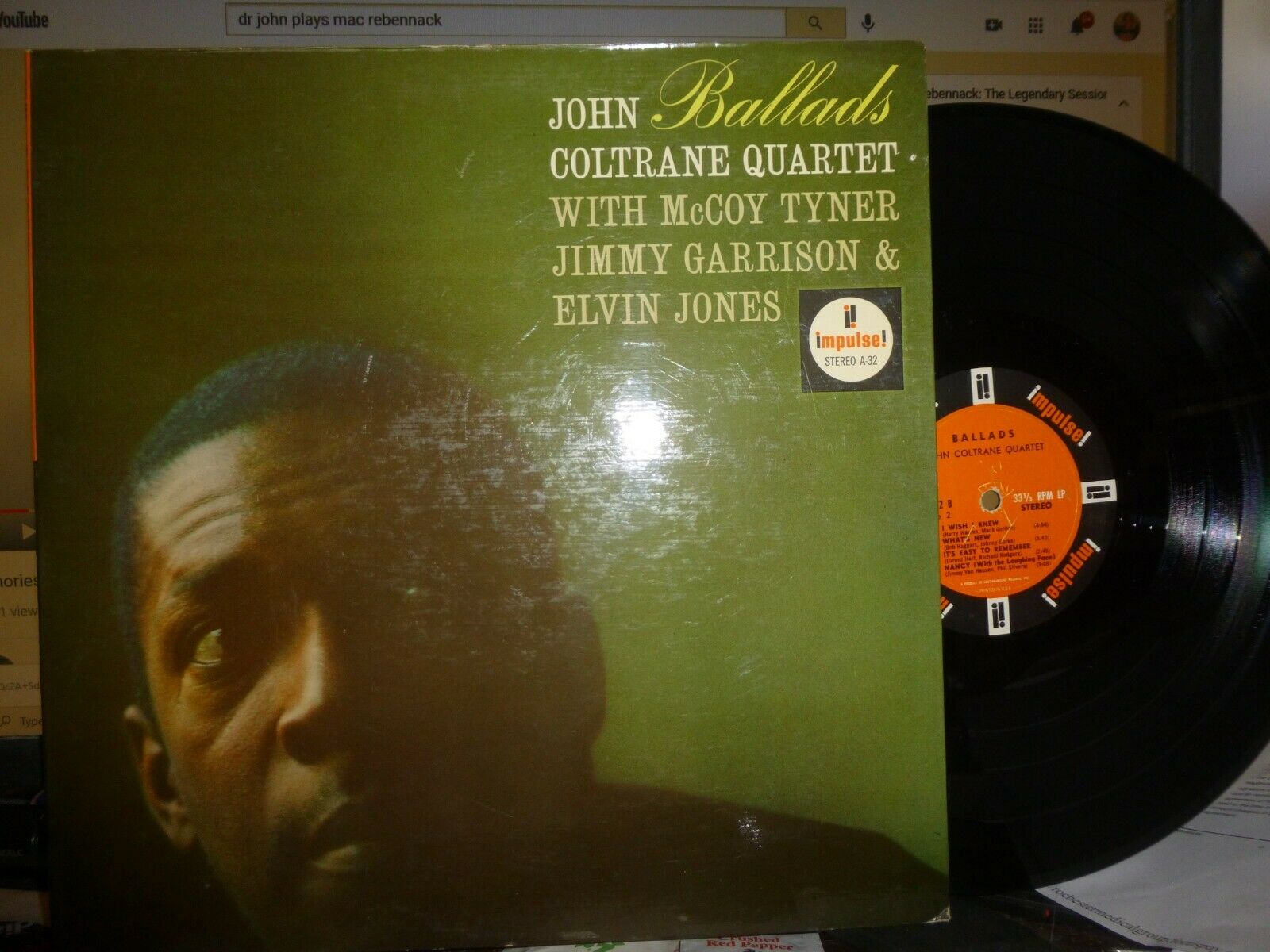
JOHN COLTRANE Quartet "BALLADS" LP Gatefold Orange Label VG+/VG+ Bell Sound
$
40


Favourite Auctions
To save auctions to your favourites, please login
If you don't have an account, please register
Description
AllMusic Review by Sam Samuelson [-]
Throughout John Coltrane's discography there are a handful of decisive and controversial albums that split his listening camp into factions. Generally, these occur in his later-period works such as Om and Ascension, which push into some pretty heady blowing. As a contrast, Ballads is often criticized as too easy and as too much of a compromise between Coltrane and Impulse! (the two had just entered into the first year of label representation). Seen as an answer to critics who found his work complicated with too many notes and too thin a concept, Ballads has even been accused of being a record that Coltrane didn't want to make. These conspiracy theories (and there are more) really just get in the way of enjoying a perfectly fine album of Coltrane doing what he always did -- exploring new avenues and modes in an inexhaustible search for personal and artistic enlightenment. With Ballads he looks into the warmer side of things, a path he would take with both Johnny Hartman (on John Coltrane & Johnny Hartman) and with Duke Ellington (on Duke Ellington and John Coltrane). Here he lays out for McCoy Tyner mostly, and the results positively shimmer at times. He's not aggressive, and he's not outwardly. Instead he's introspective and at times even predictable, but that is precisely Ballads' draw.
John Coltrane Quartet* ?– Ballads
Label:
Impulse! ?– AS-32
Format:
Vinyl, LP, Album, Repress, Stereo, Gatefold
Country:
US
Released:
1963
Genre:
Jazz
Style:
Modal, Cool Jazz
TracklistHide Credits
A1 Say It (Over And Over Again)
Written-By – Frank Loesser, Jimmy McHugh
4:17
A2 You Don't Know What Love Is
Written-By – Don Raye, Gene DePaul
5:12
A3 Too Young To Go Steady
Written-By – Harold Adamson, Jimmy McHugh
4:21
A4 All Or Nothing At All
Written-By – A. Altman*, J. Lawrence*
3:34
B1 I Wish I Knew
Written-By – Harry Warren (2), Mack Gordon
4:55
B2 What's New
Written-By – Bob Haggart, Johnny Burke
3:44
B3 It's Easy To Remember
Written-By – Lorenz Hart, Richard Rodgers*
2:47
B4 Nancy (With The Laughing Face)
Written-By – Jimmy Van Heusen, Phil Silvers
3:11
Companies, etc.
Manufactured By – ABC-Paramount Records, Inc.
Designed At – Viceroy (2)
Mastered At – Bell Sound Studios
Credits
Bass – Jimmy Garrison
Design [Cover] – Robert Flynn (2)
Drums – Elvin Jones
Engineer – Rudy Van Gelder
Photography By – Jim Marshall (3)
Piano – McCoy Tyner
Producer – Bob Thiele
Tenor Saxophone – John Coltrane
Notes
Early repress per ABC-PARAMOUNT on labels. Original pressings have AM-PAR on the labels.
Please do not mix up this release with John Coltrane Quartet* - Ballads; the latter has a different typeface and 'AS-32 A' & 'AS-32 B' on center labels, this one one has 'AS-32' without side indicating suffix.
Barcode and Other Identifiers
Matrix / Runout (Runout stamp side A): AS 32A-1A Bell Sound
Matrix / Runout (Runout stamp side B): AS 32B-1B Bell Sound
GOLDMINE GRADING
MINT ---- It should appear to be perfect. No scuffs or scratches, blotches or stains, labels or writing, tears or splits. Mint means perfect.
NEAR MINT ---- Otherwise mint but has one or two tiny inconsequential flaws that do not affect play. Covers should be close to perfect with minor signs of wear or age just becoming evident: slight ring-wear, minor denting to a corner, or writing on the cover should all be noted properly.
VERY GOOD PLUS ---- The record has been handled and played infrequently or very carefully. Not too far from perfect. On a disc, there may be light paper scuffs from sliding in and out of a sleeve or the vinyl or some of the original luster may be lost. A slight scratch that did not affect play would be acceptably VG+ for most collectors.
VERY GOOD ---- Record displays visible signs of handling and playing, such as loss of vinyl luster, light surface scratches, groove wear and spindle trails. Some audible surface noise, but should not overwhelm the musical experience. Usually a cover is VG when one or two of these problems are evident: ring wear, seam splits, bent corners, loss of gloss, stains, etc.
GOOD ---- Well played with little luster and significant surface noise. Despite defects, record should still play all the way through without skipping. Several cover flaws will be apparent, but should not obliterate the artwork.
POOR ---- Any record or cover that does not qualify for the above "Good" grading should be seen as Poor. Several cover flaws.
price rating








![AC/DC Live at River Plate (Limited Edition, Red Vinyl) [Import] (3 Lp's) Records](https://www.popsike.net/php/thumbnail.php?url=https://www.popsike.pics/pix/20231207/176086016698.jpg)