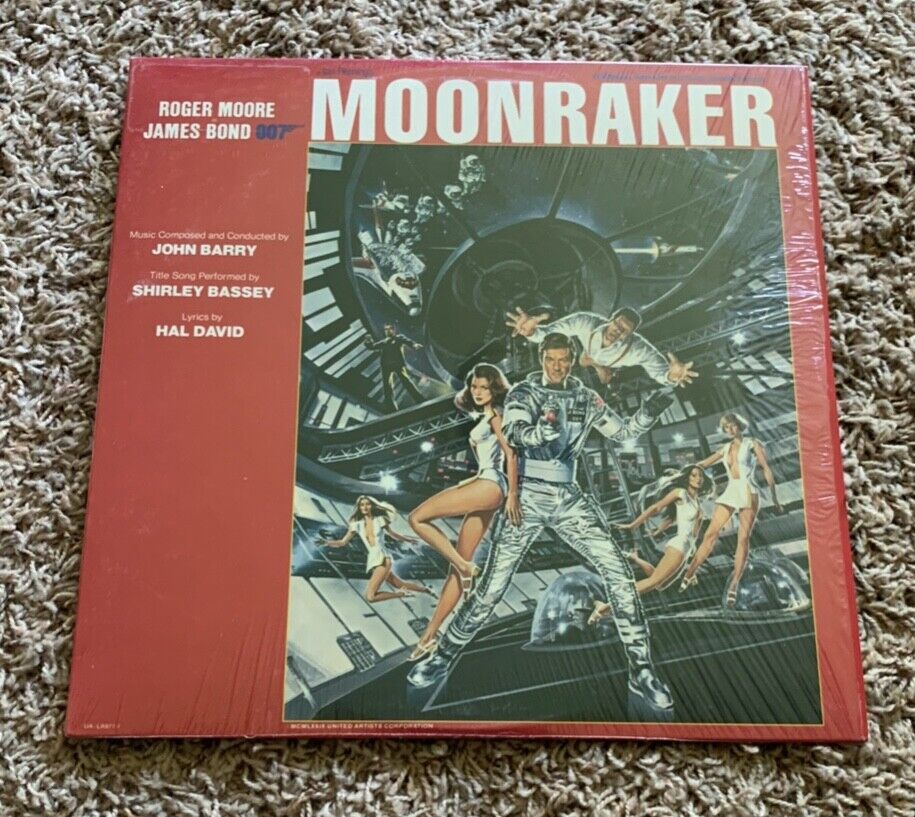
John Barry Moonraker (Soundtrack) Vinyl Record LP Album James Bond 007 VG+ 1979
$
30


Favourite Auctions
To save auctions to your favourites, please login
If you don't have an account, please register
Description
Outer sleeve in very good + condition. Has original plastic covering all but opening. Minor imperfections.
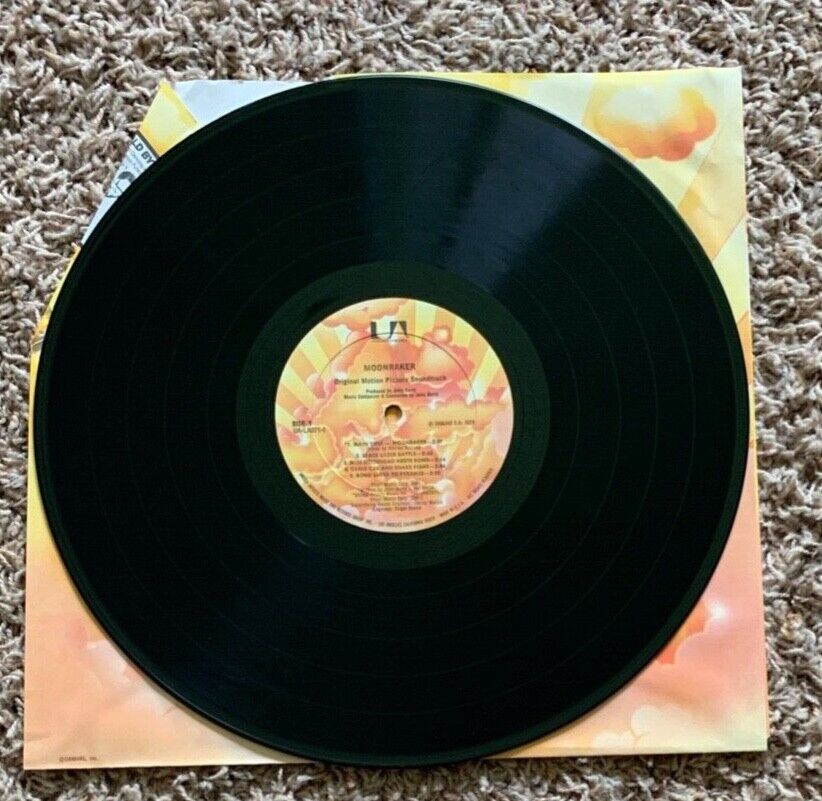
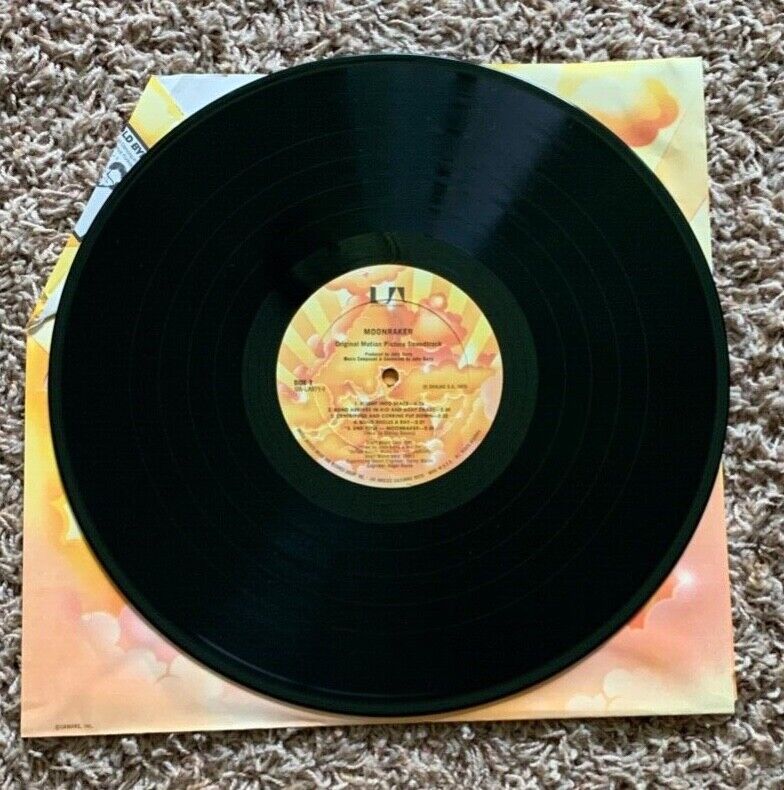
Original inner paper sleeve in ok condition. One corner fold.
Record has been cleaned via Spin-Clean and test played. Plays great. Vinyl in very good plus condition.
From smoke-free home.
All records will ship carefully via media mail unless you let me know that you prefer USPS priority mail.
John Barry – Moonraker (Original Motion Picture Soundtrack)
Label: United Artists Records – UA-LA971-I Format: Vinyl, LP, Album Country: US Released: 1979 Genre: Classical, Stage & Screen Style: Soundtrack, Score, Contemporary, ThemeTracklist
Hide Credits A1 Main Title - Moonraker Composed By, Lyrics By – Hal David Vocals, Performer – Shirley Bassey Composed By, Lyrics By – Hal David Vocals, Performer – Shirley Bassey 3:07 A2 Space Laser Battle 2:43 A3 Miss Goodhead Meets Bond 2:44 A4 Cable Car And Snake Fight 3:04 A5 Bond Lured To Pyramid 2:02 B1 Flight Into Space 6:26 B2 Bond Arrives In Rio And Boat Chase 2:34 B3 Centrifuge And Corrine Put Down 2:32 B4 Bond Smells A Rat 2:21 B5 End Title - Moonraker Lyrics By – Hal David Vocals, Performer – Shirley Bassey Lyrics By – Hal David Vocals, Performer – Shirley Bassey 2:28Companies, etc.
- Manufactured By – Liberty/United Records, Inc.
- Record Company – United Artists Music And Records Group, Inc.
- Phonographic Copyright ℗ – Danjaq S.A.
- Copyright © – United Artists Corporation
- Published By – Unart Music Corp.
- Published By – United Artists Music Co., Inc.
- Lacquer Cut At – United Artists Recording Studio
Credits
- Engineer – Roger Roche
- Engineer [Supervising Sound Engineer] – Danny Wallin*
- Mastered By, Lacquer Cut By – Jim Dorrell
- Producer, Composed By, Conductor – John Barry
Moonraker is the soundtrack for the eleventh James Bond film of the same name.[2]
Moonraker was the third of the three Bond films for which the theme song was performed by Shirley Bassey. Frank Sinatra was considered for the vocals, before Johnny Mathis was approached and offered the opportunity. Mathis was unhappy about the song and withdrew from the project, leaving the producers scrambling for a replacement. Kate Bush declined as she was due to embark on her British tour, so John Barry offered the song to Bassey just weeks before the release date. As a result, Bassey made the recordings at very short notice and never regarded the song 'as her own' as she had never had the chance to perform it or promote it first. Indeed, Bassey has seldom performed the song live in comparison to her other two Bond themes, "Goldfinger" and "Diamonds Are Forever". The film uses two versions of the title theme song, a ballad version heard over the main titles, and a disco version for the end titles. Confusingly, the United Artists single release labelled the tracks on the 7" single as "Moonraker (Main Title)" for the version used to close the film and "Moonraker (End Title)" for the track that opened the film. The song failed to make any real impact on the charts, which may partly be attributed to Bassey's failure to promote the single, given the last minute decision and the way in which it was quickly recorded to meet the schedule.
Contents
- 1Composition
- 2Track listing
- 3In popular culture
- 4See also
- 5References
Composition[edit]
As with "We Have All the Time in the World" in 1969, Hal David wrote the lyrics. Paul Williams's original lyrics were discarded.
Finally in 2005, Bassey sang the song for the first time outside James Bond on stage as part of a medley of her three Bond title songs. An instrumental strings version of the title theme was used in 2007 tourism commercials for the Dominican Republic.
The score for Moonraker marked a turning point in Barry's output, abandoning the Kentonesque brass of his earlier Bond scores and instead scoring the film with slow, rich string passages—a trend which Barry would continue in the 1980s with scores such as Raise the Titanic, Out of Africa and Somewhere in Time.
Moonraker uses for the first time since Diamonds Are Forever a piece of music called "007" (briefly, and late in track 7, "Bond Arrives in Rio and Boat Chase"), the secondary Bond theme composed by Barry which was introduced in From Russia with Love. This is the only time when the "007 Theme" is used in a Roger Moore Bond film; it is as of 2021 the last time it has been heard in a Bond film. Another link between the soundtracks of Moonraker and Diamonds Are Forever is the inclusion of a track titled "Bond Smells a Rat". The two tracks are not related to each other.
Unusually, the score was recorded in Paris—all of Barry's previous Bond scores had been recorded at London's CTS Studios. The film's production base was in France and it was decided the film would be scored there as well. Like some Bond films, the score for Moonraker has never received an extended release, due to the loss of the original session masters which appear to have been misplaced in France.[citation needed] As such, the album does not contain the "James Bond Theme" despite it appearing in the film.
Track listing[edit]
- "Moonraker (Main Title)" – Shirley Bassey (3:10)
- "Space Lazer Battle" (2:47)
- "Miss Goodhead Meets Bond" (2:48)
- "Cable Car and Snake Fight" (3:07)
- "Bond Lured to Pyramid" (2:02)
- "Flight into Space" (6:27)
- "Bond Arrives in Rio and Boat Chase" (2:38)
- "Centrifuge and Corrine Put Down" (2:35)
- "Bond Smells a Rat" (2:24)
- "Moonraker (End Title)" – Shirley Bassey (2:27)
Some familiar pieces of music also appear in the film:
- Frédéric Chopin's Prelude no. 15 in D-flat major (op. 28), "Raindrop"): Drax playing a piano when Bond arrives.
- Richard Strauss' "Also sprach Zarathustra" (op. 30) (associated with 2001: A Space Odyssey): a hunting horn plays its distinctive first three notes.
- Tritsch-Tratsch-Polka by Johann Strauss II: during the hovercraft scene on Saint Mark's square.
- The alien-contacting theme Wild Notes from Close Encounters of the Third Kind: as the key-code for a security door.
- Tchaikovsky's Romeo and Juliet Overture: when Jaws meets Dolly.
- Elmer Bernstein's theme from The Magnificent Seven: when Bond appears on horseback in gaucho clothing.
In popular culture[edit]
- The main title's opening notes were used in a 2007 tourism commercial for the Dominican Republic.
Moonraker is a 1979 spy-fi film, the eleventh in the James Bond series produced by Eon Productions, and the fourth to star Roger Moore as the fictional MI6 agent James Bond. The third and final film in the series to be directed by Lewis Gilbert, it co-stars Lois Chiles, Michael Lonsdale, Corinne Cléry, and Richard Kiel. Bond investigates the theft of a Space Shuttle, leading him to Hugo Drax, the owner of the Shuttle's manufacturing firm. Along with space scientist Dr. Holly Goodhead, Bond follows the trail from California to Venice, Rio de Janeiro, the Amazon rainforest, and finally into outer space to prevent a plot to wipe out the world population and to recreate humanity with a master race.[3][4]
The story was intended by author Ian Fleming to become a film even before he completed the novel in 1954; he based it on a screenplay manuscript he had devised earlier. The film's producers had originally intended to make For Your Eyes Only, but chose Moonraker owing to the rise of the science fiction genre in the wake of the Star Wars phenomenon. Budgetary issues led to the film being shot primarily in France; other locations included Italy, Brazil, Guatemala and the United States. The soundstages of Pinewood Studios in England, traditionally used for the series, were only used by the special effects team.
Moonraker had a high production cost of $34 million,[5] more than twice as much as The Spy Who Loved Me (1977), and it received mixed reviews. However, the film's visuals were praised, with Derek Meddings being nominated for the Academy Award for Best Visual Effects, and it eventually became the highest-grossing film of the series at the time with $210,300,000 worldwide,[5] a record that stood until 1995's GoldenEye.
Contents
- 1Plot
- 2Cast
- 3Production
- 3.1Script
- 3.1.1Novelization
- 3.2Casting
- 3.3Filming
- 3.4Music
- 3.1Script
- 4Release and reception
- 4.1Accolades
- 5See also
- 6References
- 7Sources
- 8External links
Plot[edit]
A Drax Industries Space Shuttle, Moonraker — on loan to the United Kingdom — is hijacked in midair while on a Shuttle Carrier Aircraft. The carrier is destroyed but no wreckage of the Shuttle is found. M, head of MI6, assigns James Bond, Agent 007, to investigate. En route to England, Bond is attacked and pushed out of an aeroplane by the mercenary assassin Jaws (whom he previously met in The Spy Who Loved Me). He survives by stealing a parachute from the pilot, while Jaws lands on a trapeze net within a circus tent.
At the Drax Industries spaceplane-manufacturing complex in California, Bond meets the owner of the company, Hugo Drax, and his henchman Chang. Bond also meets Dr. Holly Goodhead, an astronaut, and survives an assassination attempt while inside a centrifuge chamber. Drax's personal pilot, Corinne Dufour, sleeps with Bond and then helps Bond find blueprints for a glass vial made in Venice; Drax discovers her involvement and has her killed by his vicious pet dogs in the woods during the pheasant-hunting party the next day.
Bond again encounters Goodhead in Venice and observes her snooping around a door near the glass factory. Then he is chased through the canals by Drax's henchmen. He returns to the factory at night to investigate and discovers a secret biological laboratory, and learns that the glass vials are to hold a nerve gas deadly to humans, but harmless to plants and animals. Chang attacks Bond, but Bond hurls him through the stained glass clockface of the Saint Mark's clocktower, killing him; during the fight, Bond finds evidence that Drax is moving his operation to Rio de Janeiro. Rejoining Goodhead, he deduces that she is a CIA agent spying on Drax and sleeps with her. Bond has saved one of the vials he found earlier, as the only evidence of the now-empty laboratory; he gives it to M for analysis, who permits him to go to Rio de Janeiro under the pretense of being on leave.
Bond survives attacks by Jaws, whom Drax has hired as Chang's replacement, during Rio Carnival and on the Sugarloaf Cable Car. After Jaws' cable car crashes, he is rescued from the rubble by Dolly, a young woman, and the two fall in love. Drax's forces capture Goodhead, but Bond escapes; he learns that the toxin comes from a rare orchid indigenous to the Amazon jungle. Bond travels the Amazon River and comes under attack from Drax's forces, before eventually locating his base. Captured by Jaws, Bond is taken to Drax and witnesses four Moonrakers lifting off. Drax explains that he stole back the loaned Shuttle because another in his fleet had developed a fault during assembly. Bond and Goodhead are locked in a meeting room directly under the launch platform, and narrowly escape being burned alive by the exhausts of Moonraker 5, which is carrying Drax, and pose as pilots on Moonraker 6. The shuttles dock with a huge, city-like space station, hidden from radar by a cloaking device.
Bond and Goodhead disable the radar jamming cloaking device; the United States sends a platoon of Marines aboard another shuttle to intercept the now-visible space station. Jaws captures Bond and Goodhead, to whom Drax reveals his plan to destroy human life by launching 50 globes that would disperse the nerve gas into Earth's atmosphere. Drax had transported several dozen genetically perfect young men and women of varying races to the space station in the shuttles. They would live there until Earth was safe again for human life; their descendants would be the seed for a "new master race". Bond persuades Jaws to switch his allegiance by getting Drax to admit that anyone not measuring up to his physical standards, including him and Dolly, would be exterminated. Jaws attacks Drax's guards, and a laser battle ensues between Drax's forces and Bond, Jaws, and the Marines (attacking on MMUs). Drax's forces are defeated as the station is destroyed, while Bond shoots and ejects Drax into space. Bond and Goodhead use Drax's laser-armed Moonraker 5 to destroy the three launched globes and return to Earth. It is revealed that Jaws and Dolly, who ejected themselves in one of Drax's escape pods, after toasting with a bottle of champagne, are being recovered by the Marines. Bond's superiors get a video feed of Moonraker 5 and are bemused to see Bond and Goodhead making love in zero gravity.
Cast[edit]
- Roger Moore as James Bond 007, an MI6 agent assigned to look into the theft of a shuttle from the "Moonraker" space programme.
- Lois Chiles as Holly Goodhead, an astronaut scientist on loan from NASA working at Drax Industries. She is later revealed to be a CIA agent.
- Michael Lonsdale as Hugo Drax, an industrialist who plans to poison all humans on Earth, then repopulate the planet from his space station.
- Richard Kiel as Jaws, Drax's new henchman who replaces Chang at Drax Industries. He is known for his giant stature and possessing a set of strong steel teeth.
- Corinne Cléry as Corinne Dufour, Drax's personal pilot.
- Bernard Lee as M, the head of MI6. This was Bernard Lee's final appearance as M.
- Geoffrey Keen as Frederick Gray, the British Minister of Defence.
- Desmond Llewelyn as Q, MI6's "quartermaster" who supplies Bond with multipurpose vehicles and gadgets useful for the latter's mission.
- Lois Maxwell as Miss Moneypenny, M's secretary.
- Toshiro Suga as Chang (pronounced "cha"), Drax's main henchman.
- Emily Bolton as Manuela, 007's contact in Rio.
- Blanche Ravalec as Dolly, Jaws' girlfriend; never referred to by name.
- Irka Bochenko as Blonde Beauty, Drax's lead henchwoman.
- Michael Marshall as Colonel Scott, an American Space Marines commander.
- Leila Shenna as Hostess Private Jet, from the opening sequence.
- Anne Lonnberg as Museum Guide, and Drax's henchwoman.
- Jean-Pierre Castaldi as Pilot Private Jet, from the opening sequence.
- Walter Gotell as General Anatoly Gogol, the head of the KGB.
- Alfie Bass as Consumptive Italian.
- Claude Carliez as Gondolier.
Production[edit]
The end credits for the previous Bond film, The Spy Who Loved Me, said, "James Bond will return in For Your Eyes Only". However, following the box office success of the 1977 space-themed film Star Wars, the producers chose the novel Moonraker as the basis for the next film.[6] For Your Eyes Only was postponed and ended up following Moonraker in 1981.[7]
Script[edit]
Ian Fleming had originally intended the novel, published in 1955, to be made into a film even before he began writing it. A part of the novel was thus based on an original idea for a screenplay which had been on his mind for years.[8] Fleming first pitched the novel to Hungarian-British film producer Alexander Korda, who had expressed interest in purchasing the rights to Live and Let Die. In 1954, Stanley Meyer attempted to purchase an option for both Live and Let Die and Moonraker, but withdrew his offer after Fleming asked for too much money.[9] In 1955, American actor John Payne offered $1,000 for a nine-month option to Moonraker, plus $10,000 if production eventually took off. The negotiations broke up the following year because of disagreements regarding Payne's ownership of the other Bond novels caused when Fleming tried to manipulate Payne and the Rank Organisation into getting in a bidding war with each other.[9] Fleming eventually settled with Rank Organisation, a British company who owned Pinewood Studios. Rank wound up not developing the film, even after Fleming contributed his own script trying to push production forward,[10] and Fleming purchased the rights back in 1959.[11] Moonraker ended up being the last James Bond novel to receive a screen adaptation until Casino Royale in 2006.[12]
However, as with several previous Bond films, the story from Fleming's novel is almost entirely dispensed with, and little more than the idea of Hugo Drax as an industrialist who makes rockets was used in the film. Drax has a plan for a master race in the film, but in the novel actually had been a Nazi (unbeknownst to the English). The dramatic scene of Bond and his female companion being trapped in an exhaust duct under a rocket where they are nearly burned to death also appears in the film. Otherwise the film is more in keeping with contemporary trends in science fiction. The 2002 Bond film Die Another Day makes further use of some ideas and character names from the novel. Tom Mankiewicz wrote a short outline for Moonraker that was mostly discarded. According to Mankiewicz, footage shot at Drax's lairs was considerably more detailed than the edited result in the final version.[13] Some scenes from Mankiewicz's script were used in subsequent films, including the Acrostar Jet sequence, used in the pre-credit sequence for Octopussy, and the Eiffel Tower scene in A View to a Kill.[6]
In 1978 Steven Spielberg offered to direct the film after the release of Close Encounters of the Third Kind, but Albert R. Broccoli turned him down.[14]
In March 2004 rumours surfaced about a lost 1956 version of Moonraker by Orson Welles, and a James Bond web site repeated it on April Fool's Day in 2004 as a hoax. Supposedly, this recently discovered lost film consisted of 40 minutes of raw footage with Dirk Bogarde as Bond, Welles as Drax, and Peter Lorre as Drax's henchman.[15]
Novelization[edit] Main article: James Bond and MoonrakerThe screenplay of Moonraker differed so much from Ian Fleming's novel that Eon Productions authorised the film's screenwriter Christopher Wood to write a novelisation, his second (after James Bond, The Spy Who Loved Me). It was named James Bond and Moonraker to avoid confusion with Fleming's original novel Moonraker. It was published in 1979, with the film's release.[16]
Casting[edit]
The height difference between the giant Jaws and his diminutive girlfriend DollyInitially, the chief villain, Hugo Drax, was to be played by British actor James Mason, but once the decision was made that the film would be an Anglo-French co-production under the 1965–1979 film treaty, French actor Michael Lonsdale was cast as Drax and Corinne Cléry was chosen for the part of Corinne Dufour, to comply with qualifying criteria of the agreement.[17] Stewart Granger and Louis Jourdan were considered also for the role of Drax.[18][19] Jourdan later portrayed prince Kamal Khan, chief villain of Octopussy. American actress Lois Chiles had originally been offered the role of Anya Amasova in The Spy Who Loved Me (1977), but had turned down the part when she decided to take temporary retirement. Chiles was cast as Holly Goodhead by chance, when she was given the seat next to Lewis Gilbert on a flight and he believed she would be ideal for the role as the CIA scientist.[6] Jaclyn Smith was originally offered the role of Holly Goodhead but had to turn it down owing to scheduling conflicts with Charlie's Angels. Drax's henchman Chang was played by Japanese aikido instructor Toshiro Suga; he was recommended for the role by executive producer Michael G. Wilson, who was one of his pupils.[6] Wilson, continuing a tradition he started in the film Goldfinger, has a small cameo role in Moonraker: he appears twice, first as a tourist outside the Venini Glass shop and museum in Venice, then at the end of the film as a technician in the US Navy control room.
The Jaws character, played by Richard Kiel, makes a return, although in Moonraker the role is played more for comedic effect than in The Spy Who Loved Me. Jaws was intended to be a villain against Bond to the bitter end, but director Lewis Gilbert stated on the DVD documentary that he received so much fan mail from small children saying "Why can't Jaws be a goodie not a baddie", that as a result he was persuaded to gradually transform Jaws into Bond's ally by the end of the film.[6]
Originally Jaws's girlfriend was going to be portrayed as even more massive than him, but Kiel insisted on a rewrite.[9] Diminutive French actress Blanche Ravalec, who had recently begun her career with minor roles in French films such as Michel Lang's Holiday Hotel (1978) and Claude Sautet's A Simple Story (1978), was cast as the bespectacled Dolly, the girlfriend of Jaws. Originally, the producers were dubious about whether the audience would accept the height difference between them, and only made their decision once they were informed by Richard Kiel that his real-life wife was of the same height.[20] Lois Maxwell's 22-year-old daughter, Melinda Maxwell, was also cast as one of the "perfect" human specimens from Drax's master race.[8]
Filming[edit]
Production began on 14 August 1978. The main shooting was switched from the usual 007 Stage at the Pinewood Studios to France, because of the high taxation in Britain at the time. Only the cable car interiors and space battle exteriors were filmed at Pinewood. The massive sets designed by Ken Adam were the largest ever constructed in France and required more than 222,000 man-hours to construct (roughly 1,000 hours by each of the crew, on average).[6]
The Château de Vaux-le-Vicomtewas used for Drax's chateau in the film. An extensive aerial view of the site was witnessed by helicopter in the early stages of the film by Bond and Dufour arriving.Drax's mansion, set in California, was actually filmed at the Château de Vaux-le-Vicomte, about 55 kilometres (34 mi) southeast of Paris, for the exteriors and Grand Salon. The remaining interiors, including some of the scenes with Corinne Defour and the drawing room, were filmed at the Château de Guermantes.[6]
Much of the film was shot in the cities of London, Paris, Venice, Palmdale, California, Port St. Lucie, Florida, and Rio de Janeiro. The production team had considered India and Nepal as locations, but after scouting trips these were rejected as impractical to work into the script, particularly considering the time constraints.[6] They decided on Rio de Janeiro relatively early on, a city that producer Albert R. Broccoli had visited on holiday, and a team was sent there in early 1978 to capture initial footage from the Carnival, which featured in the film.[6]
Stuntman Richard Graydon slipped and narrowly avoided falling to his death during the filming of the cable carsequence at Sugarloaf Mountain.At the Rio de Janeiro location, many months later, Roger Moore arrived several days later than scheduled for shooting, owing to recurrent health problems and an attack of kidney stones that he had suffered while in France.[6] Upon arrival, Moore was immediately whisked off the plane for hair and make-up work before reboarding the plane to film the sequence with him arriving as James Bond in the film. Sugarloaf Mountain was a prominent location in the film, and during filming of the midair cable car sequence in which Bond and Goodhead are attacked by Jaws, stuntman Richard Graydon slipped and narrowly avoided falling to his death.[6] For the scene in which Jaws bites into the steel tramway cable with his teeth, the cable was actually made of liquorice, although Kiel was still required to use his steel dentures.[8]
Iguazu Falls, in the south of Brazil, was used in the film, although as Q notes, the falls were supposedly somewhere in the upper basin of the Amazon River. The second unit had originally planned on sending an actual boat over the falls.[6] However, on attempting to release it, the boat became firmly embedded on rocks near the edge. Despite a dangerous attempt by helicopter and rope ladder to retrieve it, the plan had to be abandoned, forcing the second unit to use a miniature at Pinewood instead.[6] The exterior of Drax's pyramid headquarters in the Amazon rain forest near the falls was actually filmed at the Tikal Mayan ruins in Guatemala.[8] The interior of the pyramid, however, was designed by Ken Adam at a French studio, in which he purposefully used a shiny coating to make the walls look plastic and false.[6] All of the space centre scenes were shot at the Vehicle Assembly Building of the Kennedy Space Center, Florida, although some of the earlier scenes of the Moonraker assembly plant had been filmed on location at the Rockwell International manufacturing plant in Palmdale, California.[21]
The climax of the film with the laser battle on Drax's space station. Moonraker holds the world record for the largest number of zero gravity wires in one scene.The early scene in which Jaws pushes Bond out of the aircraft without a parachute took weeks of planning and preparation. The skydiving sequence was coordinated by Don Calvedt under the supervision of second unit director John Glen and was shot above Lake Berryessa in northern California. As Calvedt and skydiving champion B.J. Worth developed the equipment for the scene, which included a 1-inch-thick (25 mm) parachute pack that could be concealed beneath the suit to give the impression of the missing parachute, and equipment to prevent the freefalling cameraman from suffering whiplash while opening his parachute, they brought in stuntman Jake Lombard to test it all. Lombard eventually played Bond in the scene, with Worth as the pilot from whom Bond takes a parachute, and Ron Luginbill as Jaws. Both Lombard and Worth became regular members of the stunt team for aerial sequences in later Bond films.[6][22][23] When the stuntmen opened their parachutes at the end of every shoot, custom-sewn velcro costume seams separated to allow the hidden parachutes to open.[8] The skydiver cinematographer used a lightweight Panavisionexperimental plastic anamorphic lens, bought from an old pawn shop in Paris, which he had adapted, and attached to his helmet to shoot the entire sequence. The scene took a total of 88 skydives by the stuntmen to be completed.[6] The only scenes shot in studio were close-ups of Roger Moore and Richard Kiel.[22]
Since NASA's Space Shuttle program had not been launched, Derek Meddings[24] and his miniatures team had to create the rocket launch footage without any reference. Shuttle models attached to bottle rockets and signal flares were used for take-off, and the smoke trail was created with salt that fell from the models. The space scenes were done by rewinding the camera after an element was shot, enabling other elements to be superimposed in the film stock, with the space battle needing up to forty rewinds to incorporate everything. The climactic scenes of the space station disintegrating were created by Meddings and other members of the special effects team shooting the miniature model with shotguns.[6][25]
As James Bond is arriving at the scene of the pheasant shoot, a trumpet is sounded playing the first three brass notes from Also sprach Zarathustra, referencing the film 2001: A Space Odyssey (1968).
Music[edit]
Main article: Moonraker (soundtrack)Moonraker was the third of three Bond films for which the theme song was performed by Shirley Bassey (following Goldfinger and Diamonds Are Forever). Frank Sinatra was originally considered for the vocals, and Kate Bush was asked, but she declined.[26] Johnny Mathis was approached and offered the opportunity. However, Mathis—despite having started recording with Barry—was unable to complete the project, leaving producers to offer the song to Bassey just weeks before the premiere date in England.[27] Bassey made the recordings with very short notice and as a result, she never regarded the song 'as her own' as she had never had the chance to perform it in full or promote it first.[27] The film uses two versions of the title theme song, a ballad version heard over the main titles, and a disco version over the closing titles. The song made little impact on the charts, reaching #159, partly attributed to Bassey's failure to promote the single, given the last-minute decision to quickly record it to meet the schedule[28] and also confusion regarding the two versions of the track, when the United Artists single release labelled the tracks on the 7" single as "Moonraker (Main Title)" for the version used to close the film and "Moonraker (End Title)" for the track that opened the film.[29][30]
In 2005, Bassey sang the song for the first time outside James Bond on stage as part of a medley of her three Bond title songs.[27] An instrumental strings version of the title theme was used in 2007 tourism commercials for the Dominican Republic.
The soundtrack of Moonraker was composed by John Barry and recorded in Paris, again, as with production, marking a turning point away from the prior studio, CTS Studios in London. The score also marked a turning point in John Barry's output, abandoning the Kentonesque brass of his earlier Bond scores in favor of slow, rich string passages – a trend which Barry would continue in the 1980s with scores such as Out of Africa and Somewhere in Time.[31] For Moonraker, for the first time since Diamonds Are Forever (1971), Barry used a piece of music called "007" (on track 7), and "Bond smells a rat", the secondary Bond theme composed by Barry and introduced in From Russia with Love during Bond's escape with the Lektor; some classical music pieces were also included in the film. For the scene where Bond visits Drax in his chateau, Drax plays Frédéric Chopin's Prelude no. 15 in D-flat major (op. 28), "Raindrop", on his grand piano (although he plays in the key of D major).[32] Tritsch-Tratsch-Polka by Johann Strauss II was used during the hovercraft scene on the Piazza San Marco in Venice,[32] and Tchaikovsky's "Romeo and Juliet Overture" plays when Jaws meets Dolly following his accident.[32] Other passages pay homage to earlier films, including Richard Strauss's Also sprach Zarathustra (op. 30),[32] associated with 2001: A Space Odyssey, with the hunting horn playing its distinctive first three notes, Elmer Bernstein's theme from The Magnificent Seven when Bond appears on horseback in gaucho clothing at MI6 headquarters in Brazil, and the alien-contacting theme from Close Encounters of the Third Kind as the key-code for a security door as mentioned previously.[32] The Italian aria "Vesti la giubba" from Ruggero Leoncavallo's opera I Pagliacci, was sung in Venice before one of the henchmen falls to his death from a building, landing inside a piano.
Release and reception[edit]
Moonraker premiered on 26 June 1979, in the Odeon Leicester Square, United Kingdom. Three days after the UK release, it went on general release in the US, opening in 788 theatres with 900 prints struck; it was United Artists' widest opening at the time.[33] It grossed $14,744,718 in its first week from 900 bookings.[34] On the mainland of Europe, the most common month of release was in August 1979, opening in the Nordic countries of Denmark, Finland, Norway, Iceland and Sweden between 13 and 18 August. Given that the film was produced largely in France, and it involved some notable French actors, the French premiere for the film was relatively late, released in that country on 10 October 1979. It saw a record attendance of 413,314 in its first week in France.[35] Moonraker grossed a worldwide total of $210,300,000, making it United Artists' highest-grossing film at the time, surpassing The Spy Who Loved Me.[35][5]
With Moonraker, we went too far in the outlandish. The audience did not believe any more and Roger spoofed too much.
Richard Maibaum[36]
Moonraker received a mixed reception by critics. On review aggregator Rotten Tomatoes, the film holds a 59% approval rating based on 54 reviews, with an average rating of 5.50/10. The site's critical consensus reads, "Featuring one of the series' more ludicrous plots but outfitted with primo gadgets and spectacular sets, Moonraker is both silly and entertaining."[37] On Metacritic the film has a score of 66% based on reviews from 13 critics.[38]
The New York Times film critic Vincent Canby called Moonraker "one of the most buoyant Bond films of all. Almost everyone connected with the movie is in top form, even Mr. Moore. Here he's as ageless, resourceful, and graceful as the character he inhabits."[39] Canby subsequently said the film was, alongside Goldfinger, the best of the series.[40]
The Globe and Mail critic Jay Scott said Moonraker was second only to Goldfinger. "In the first few minutes – before the credits – it offers more thrills than most escapist movies provide in two hours." During the title sequence, "the excitement has gone all the way up to giddy and never comes down." Scott admired the film's theme song and cited with approval the film's location work. He also singled out Ken Adam's sets, dubbing them "high-tech Piranesi."[41]
Frank Rich of Time felt "The result is a film that is irresistibly entertaining as only truly mindless spectacle can be. Those who have held out on Bond movies over 17 years may not be convinced by Moonraker, but everyone else will be."[42]
Reviewers such as James Berardinelli praised the visual effects and stunts,[43] and film scholar James Monaco designated the film a "minor masterpiece" and declared it the best Bond film of them all.[44]
Most critics consider Moonraker one of the lesser films in the series, largely because of the extent and absurdity of the plot which takes James Bond into space, some of the ploys used in the film for comedic effect, and its extended dialogue. In November 2006, Entertainment Weekly ranked Moonraker fourteenth among the Bond films, describing it as "by far the campiest of all 007 movies" with "one of the worst theme songs".[45] IGN listed it eleventh, calling it outlandish and saying that despite the actors "trying what they can to ground the film in reality, the laser gun/space station finale pretty much undercuts their efforts".[46] Norman Wilner of MSN chose it as the fourth worst film of the series, considering that the film "just flat-out sucks".[47]
Critic Nicholas Sylvain said "Moonraker seems to have more than its share of little flaws and annoyances which begin right from the opening pre-credit sequence. The sheer idiocy (and impossibility) of having a fully fueled shuttle on the back of the Boeing during the trans-Atlantic crossing should be evident, and later in the film, the whole Jaws-falls-in-love and becomes a 'good guy' routine leaves me rather cold, and provides far too much cheesy comedy moments, as does the gondola driving through the square scene."[48]
The scene in which Moore drives a hovercraft gondola around St Mark's Square in Venice was widely criticised by film critics.In a review of the film from 1979, Gene Siskel of the Chicago Tribune took a critical view of its amount of product placement, and observed:
In the beginning of the Bond series, before they were thought of as a series, each film was a good action picture with a colourful, entertaining hero.
Today, they come off as conglomerate business enterprises rather than movies. How else does one explain the intrusive commercial plugs in "Moonraker" for Christian Dior perfume, British Airways, Bollinger champagne, Glaston boats, and Seiko watches? Truly, money derived from these plugs can't be worth the loss of story continuity when the products are flashed in front of the camera. Someone is being awfully cheap about the plugs, which borders on incredibility because the James Bond series is one of the surest moneymakers in the film business. Maybe the producers of "Moonraker" are blind to story construction?
That certainly would explain the film's failure.[49]
In a review of the film from the same year, the Chicago Sun-Times film critic Roger Ebert, while clearly expressing his approval of the advanced special effects and Ken Adam's extravagant production sets, criticised the pace in which the locations of the film evolved, remarking, "it's so jammed with faraway places and science fiction special effects that Bond has to move at a trot just to make it into all the scenes".[50] Christopher Null of Filmcritic.com said of the film: "Most rational observers agree that Moonraker is without a doubt the most absurd James Bond movie, definitely of the Roger Moore era and possibly of all time".[51] However, while he criticised the extravagance of the plot and action sequences, he believed that this added to the enjoyment of the film, and particularly approved of the remark "I think he's attempting re-entry!" by "Q" during Bond and Goodhead's orbiting of the Earth which he described as "featuring what might be the best double entendre ever".[51]
Reviewing Moonraker, film critic Danny Peary wrote, "The worst James Bond film to date has Roger Moore walking through the paces for his hefty paycheck and giving way to his double for a series of unimaginative action scenes and 'humorous' chases. There's little suspense and the humor falls flat. Not only is Jaws so pacified by love that he becomes a good guy, but the filmmakers also have the gall to set the finale in outer space and stage a battle right out of Star Wars."[52]
The exaggerated nature of the plot and space station sequence has seen the film parodied on numerous occasions. Of note is the Austin Powers spoof film The Spy Who Shagged Me (1999) which while a parody of other James Bond films, makes reference to Moonraker by Dr. Evil's lair in space. The scene in which Drax is shot by the cyanide dart and ousted into space is parodied by Powers' ejection of Dr. Evil's clone Mini-Me into outer space in the same way.[53]
Sean Connery, who had played James Bond in six of the first seven films in the series, stated in an interview that: "I went in London to see Moonraker with Roger and I think it's departed so much from any sort of credence from the reality that we had [in my six films]." He also criticized the film for: "such a dependence on the effects and there's no substance."[54]
However, the opening skydiving sequence, in which Bond is pushed out of an aeroplane by Jaws, and must obtain a parachute from the pilot skydiving below him, has come to be considered one of the series best pre-title sequences.[55] It is frequently lauded by critics and fans as one of the most spectacular action sequences in the Bond series.[56]
Accolades[edit]
Derek Meddings, Paul Wilson and John Evans were nominated for the Academy Award for Best Visual Effects,[57] and the film was nominated for three Saturn Awards, Best Science Fiction Film, Best Special Effects, and Best Supporting Actor (Richard Kiel).[58]
price rating