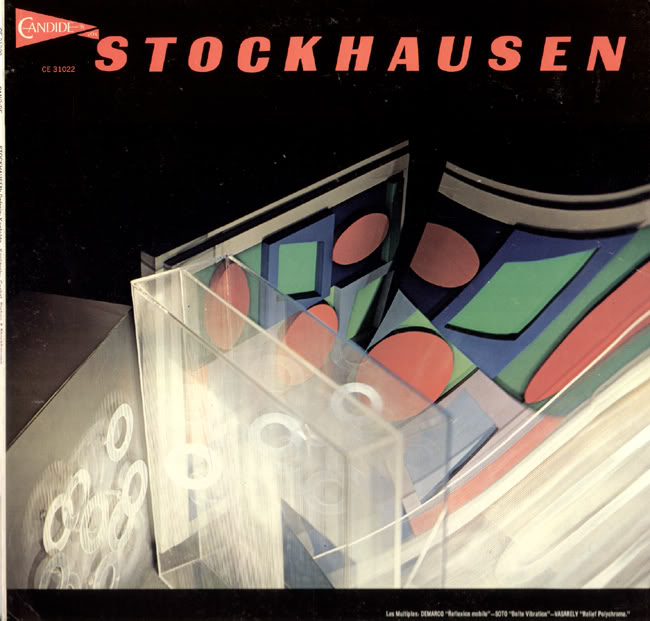
KARLHEINZ STOCKHAUSEN KONTAKTE REFRAIN CANDIDE CE 31022
$
25


$ 25
Sold For
Apr 2, 2010
Sold Date
Mar 26, 2010
Start Date
1
Number Of Bids
USA
Country Of Seller
eBay
Sold at
Favourite Auctions
To save auctions to your favourites, please login
If you don't have an account, please register
Description
Karlheinz Stockhausen
Kontakte (1959-1960)
for piano, percussion & electronic sounds
CANDIDE CE 31022
Very Rare US Pressing - features an insert of liner notes by Stockhausen
Near Mint- cover (tiny bit of surface wear),
Near Mint- LP with a few paper sleeve marks, no play or handling wear, just a few marks from liner.
Kontakte (1959 - 1960) This work marks the end of Stockhausen's first compositional period, which was most notable for the composer's experiments with numerical serialism. Despite the given date of Kontakte's composition, Stockhausen actually began work on it in 1958, but was delayed in part by having to share the electronic music studio in Cologne with fellow composers György Ligeti and Mauricio Kagel, both of whom were similarly working on large-scale pieces. Like so many of Stockhausen's works, Kontakte exists in more than one version. There are, in fact, two: the first, No. 12 in the composer's catalogue, is a purely electronic composition on tape; the second, No. 12 1/2, is for electronic sounds, piano, and percussion. This second version is particularly important, as it is Stockhausen's first work to combine electronics and live performers. In the late 1950s, Stockhausen became increasingly influenced by the aleatoric music of American composers like Morton Feldman and John Cage, as well as by American jazz. These influences are evident in Kontakte, though it is a work that clearly belongs to the European avant-garde tradition. It also presages developments in Stockhausen's own style, including elements — such the addition of instrumentalists to an existing tape composition — central to his later works. The title refers to the moments of "contact" between the electronic sounds on the tape and the live performers. The tape consists of percussion sounds altered by different electronic means, including a ring modulator, a reverberator, and an impulse generator. The instrumental parts intertwine with the taped sounds, creating a wildly diverse array of textures and timbres over the course of six sections, or "moments." The moments are determined by events on tape, but the instrumentalists also participate in the transition from one moment to the next by changing character. Each moment contains six subdivisions of intensity, from "just noticable" to "violent," that refer to variations in acoustical phenomena including volume, speed, and register. The pianist and percussionists must respond and interact carefully with the tape, ensuring a proper balance of dynamics and intensity. While Kontakte has a quasi-improvisational feel, the instrumental parts are written out in full. In his original conception of Kontakte, Stockhausen had envisaged a piece in which performers would respond freely to the events on tape; however, initial rehearsals were, in the composer's own words, "a real disaster. The musicians did not know what to do." Ultimately, Stockhausen expressed displeasure with Kontakte, and, as in the cases of so many of his other compositions, regards it as unfinished. Refrain (1959) for piano, vibes, celesta (or synthesizer) & sound projector
In his Refrain (1959) for three players, Karlheinz Stockhausen poses one solution to the concept of an "open" form—that is, one in which some structural aspects are left to the choice of the player during performance. Stockhausen had experimented with indeterminacy before; in the earlier Klavierstück XI (1956), for example, the pianist decides the performing order of fragments of music distributed across a page. Certain details (pitches, etc.) are fixed locally, relative to the fragment in which they occur. In Refrain, the overall structure is fixed, as are local parameters of pitch, register, and rhythm (except for note durations). A ringing sonority predominates throughout the work, though at intervals the quiet, resonant atomosphere is disturbed by figuration (glissandi, trills, etc.), the temporal placement of which is determined by the player. The score is in the shape of an arc intersected by a transparent strip that pivots at the arc's fulcrum; the strip, imprinted with various musical parameters, is placed atop the printed music. Refrain also calls for phonemes spoken by the players as part of the articulation of each chord; these function largely to obscure the characteristic attacks of the instruments. Refrain was first performed at the Berlin Festival on October 2, 1959 by David Tudor (piano and wood blocks), Cornelius Cardew (celesta and antique cymbals), and Siegfried Rockstroh (vibraphone, cowbells, and glockenspiel). The work's instrumentation may vary somewhat, provided instruments with a similar timbral range and adequate sustaining capability are substituted. Likewise, other modifications to Stockhausen's original configuration may be made; for instance, the celesta may be amplified. Such changes may, accordingly, affect the work's performance duration.
Important Works from this ground breaking artist of the Avant-Garde genre.
I combine shipping to save you costs on additional LPs bought within one week (7 days) and send at same time.
Karlheinz Stockhausen emerged early on as one of the most influential and unique voices in the post-WWII European musical avant-garde and his prominence continued throughout the rest of the twentieth century and into the twenty first. Combining a keen sensitivity to the acoustical realities and possibilities of sound, rigorous and sophisticated compositional methods expanded from integral serialism, innovative theatricality, and a penchant for the mystical, Stockhausen remains one of the most innovative musical personalities to span the turn of this century. Stockhausen was born in 1928 near Cologne. Orphaned as a teen, he immersed himself in artistic pursuits and showed promise both as a writer and a musician. He took classes at the new music school in Darmstadt with Adorno before moving to Paris, where he studied with Messiaen and met Boulez and Pierre Schaeffer. These encounters, as well as studies in phonetics and communication, proved a crucial influence on his subsequent work at the electronic music studio in Cologne; by the mid-'50s he had secured a spot in the vanguard of both electronic music and integral serialism. During the next decade he forged relationships with some of the most prominent contemporaries, including Kagel, Ligeti, and Cage, and, taking over the reins at the Darmstadt school, mentored such innovative up-and-comers as Cornelius Cardew and La Monte Young. His influence extended into popular culture, as well: he appears on the cover of the Beatles' Sgt. Pepper album. Stockhausen held various appointments during the rest of the twentieth century, and continued teaching summer seminars attended by important emerging composers. Stockhausen's most influential compositions vary widely in their style and media, and attest to the composer's far-ranging interests in science, technology, religion, cosmology, and mysticism. His various instrumental and vocal works from the 1950s, 1960s, and 1970s explore various ways of extrapolating serial methods and mathematical structures, such as the Fibonacci series, to dictate pitches, rhythms, articulations, and larger formal structures. The influential tape piece Gesang der Jünglinge (1955) combines the jumbled phonemes from a Biblical source text with an elaborately methodic splicing scheme. Hymnen (1966) mixes various national anthems with complex electronic sound structures. In Stimmung (1968), a group of singers intones various mystical names to the harmony of the overtone series. From the late '70s onward, Stockhausen's efforts focused on LICHT, a sprawling opera cycle drawn from various religious mythologies, particularly the Urantia Book, a collection of writings supposedly delivered to Earth by extraterrestrials.
price rating


![Floating Points - Crush | [Black Vinyl LP] | Ninja Tune](https://www.popsike.net/php/thumbnail.php?url=https://www.popsike.pics/pix/20230703/394718230174.jpg)