"Kenny's Window" LP 1977 Maurice Sendak MINT RARE SEALED
A$
38
$
25




Favourite Auctions
To save auctions to your favourites, please login
If you don't have an account, please register
Description
"Kenny's Window" LP 1977 Maurice Sendak
This is a rare item. There are two copies on Amazon at $944US each! This one is still in its sealed, original shrink wrap!
Vinyl: Mint
Cover: Excellent.
Item details
Vintage from 1977.
Materials: paper, cardboard, vinyl
Kennys Window is the first children’s book written and illustrated by Maurice Sendak. It tells the story of a young boy’s quest for a garden that he sees in his dream, which involves answering seven questions given to him by a four-legged rooster in that dream. From the back cover: Can you draw a picture on the blackboard when somebody doesn't want you to? What is an only goat? Can you hear a horse on the roof? Can you fix a broken promise? What is a very narrow escape? What looks inside and what looks outside? Do you always want what you think you want?
------
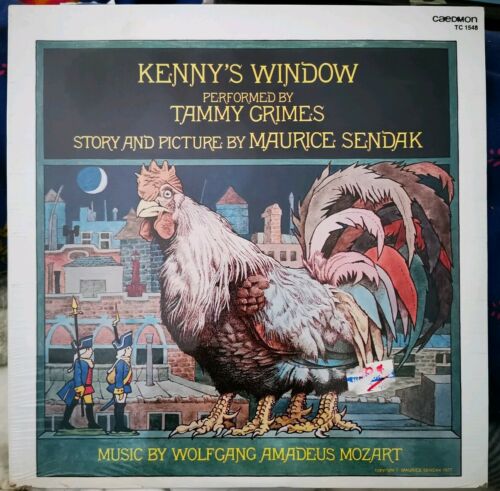
Kennys Window Performed by Tammy Grimes Story and Picture by Maurice Sendak
Music by Wolfgang Amadeus Mozart
Side A:
Band 1: Introduction, The Dream
Band 2: First Question
Band 3: Second Question
Band 4: Third Question
Side B:
Band 1: Fourth Question
Band 2: Fifth Question
Band 3: Sixth Question
Band 4: Seventh Question
------
The wise and unexpected answers to these seven provocative questions can all be found in Kenny's Window, the first children's book that Maurice Sendak wrote as well as illustrated. Published in 1956 when the artist was 27, this long and magical tale constitutes a treasure trove of the themes, characters and psychological excursions that were to become hallmarks of Sendak's mature work.
Up to this point in an already successful career, Sendak felt that he could not undertake a book of his own for lack of a worthwhile topic. It was in the reading of One Little Boy, a clinical study of a disturbed child by the psychologist Dorothy Baruch, that the artist discovered the prototype for his first here, Kenny, and a subject that was fully to engage his talents and sensibility from that moment on: children who, in Sendak's own words, "are held back by life and, one way or other manage miraculously to find release from their troubles."
The subject matter was particularly congenial to Sendak at the time, for he was undergoing psychoanalysis and becoming increasingly aware of the wellsprings in childhood of our deepest desires and fears. The new author, in fact, dedicated this maiden work to his parents, his editor Ursula Nordstrom, and his analyst.
A dominant theme in Kenny's Window is the possibility for escape from the humdrum confines of everyday reality. "LET'S DO SOMETHING!" shouts the perfectly normal - If hyper-imaginative hero to his toys one snowy day, and the cry is familiar to every child who ever yearned to discover more about that big. mysterious world beyond the front door -a place that is "miles long", where a person can get lost." If only Kenny can find answers to a string of cryptic queries posed by a four-legged rooster he meets in a dream, he will win entrance into a wonderful garden where the sun and moon shine side by side and he will never have to go to sleep."
The intrepid Kenny embarks on seven separate adventures in quest of the right replies. In one, he must devise a way to placate his teddy bear, Bucky, whose feelings have been hurt. In another, he travels, via "a little train that climbed straight up the side of a mountain," all the way to Switzerland in search of an only goat. In a third Kenny finds himself deep in philosophy discourse with a familiar Sendakian supporting player, a female Sealyham dog, here dubbed "Baby." And in the tale's dreamlike finale, our urban hero watches as the mysterious rooster fades slowly "into the singing lights of the city" - the same beloved New York that, years later the Brooklyn-born Sendak would pay rich tribute to in his in the Night Kitchen.
Sendak fans will recognize in the plucky and assertive protagonist Kenny more than a fleeting resemblance to future Sendak heroes - to the brave and willful Max of Where the Wild Things Are, to the unflappable daredevil Mickey of In the Night Kitchen.
The young listener who joins Kenny in his search for answers will learn a lot he hadn't bargained for that to write a poem you must think of a nice word and rhyme it with a lot of other nice words until you come to the end;" that never and always are very long times; that even if a promise isn't broken, it can be bent almost beyond recognition; and that to make a wish is to be "halfway to wherever you want to go."
A beguilingly loose-jointed story, full of intuitive wisdom and insight, Kenny's Window - like Antoine de Saint Exupery's fairy tale for older children, The Little Prince - deftly uses whimsy and fantasy to reveal significant, and occasionally painful truths about life: sometimes it can smell like winter and spring simultaneously; cruelty and generosity often exist side by side in the same person; there are times when we cannot get what we want, just as, occasionally, we won't want what we've worked hard to get. Ultimately, there emerges the wry Sendakian message that a dream's best fulfillment may arise in dreaming yet another dream; that dreams are, in fact, the stuff we all are made of, and the lives of children, in particular, can be greatly enriched by their airy and liberating promise. -SELMA G. LANES
Selma G. Lanes, author of DOWN THE RABBIT HOLE: Adventures and Misadventures in the Realm of Children's Literature, is a critic and editor of children's books.
Tammy Grimes was described by Walter Kerr, theater critic for the New York Times, as "a genius" and "a miracle" of the stage. Miss Grimes made her Broadway musical debut in the unforgettable Unsinkable Molly Brown for which she won a Tony Award for Best Actress in a musical comedy, the Drama Critics' Award and Drama Desk Award for Best Actress. Approaching each role with a sensitivity that is truly remarkable, Miss Grimes has appeared as "Mopsa" in A Winter's Tale at the Stratford in Ontario, as the ghostly "Elvira"in High Spirits (a musical based on Noel Coward's Blithe Spirit): in supper club acts across the nation, and in films and television. Her Broadway appearance in Noel Coward's Private Lives won her a second Tony for Best Actress in a dramatic performance. She has most recently appeared on Broadway in A Musical Jubilee which the New York Times described as "joyous," and starred in Neil Simon's riotous comedy California Suite. She has been a guest on many television dramatic and variety shows including the highly acclaimed Borrowers with Eddie Albert Other Caedmon recordings of Tammy Grimes reading Maurice Sendak stories are HIGGLETY PIGGLETY POP! (TC 1519) and WHERE THE WILD THINGS ARE (TC 1531).
CREDITS: Cover copyright © Maurice Sendak 1977 Library of Congress #77-740437
Caedmon, 1977
Directed by Ward Botsford Studio Recording and Mastering: Howard W. Harris
Tape Editor: Daniel A. Wolfert Music: Courtesy of Vox Productions, Inc.
Mozart: Piano Sonata No. 11 in A Major, K. 331 Movement 1: Theme (Andante grazioso and Variations) Walter Klien, pianist
SOURCE: KENNY'S WINDOW copyright 1955 by Maurice Sendak
Sent with Australia Post Standard Service.
price rating