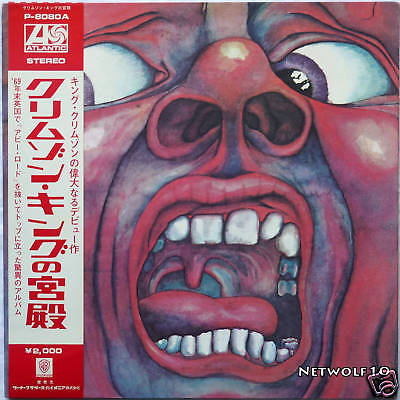
King Crimson - In the Court of the..- LP - Japan - OBI
€
80
$
93


Favourite Auctions
To save auctions to your favourites, please login
If you don't have an account, please register
Description
dragonfly_100 Store
TO USA CUSTOMER
KING CRIMSON – IN THE COURT OF THE CRIMSON KING – JAPAN PRESS WITH OBI
Descrizione Dettagliata – Detailed Description
Artista - Artist
King Crimson
Titolo - Title
In the Court of the Crimson King
Stampa - Issue
Japan Press
Etichetta - Label
Warner – Pioneer Japan / Atlantic Record
Anno - Year
1971
N° Catalogo – N° Catalog
P – 8080A
N° Dischi – N° LP
1
Commento - Comment
LP a copertina apribile a spessa cartonatura con trama in rilievo. Rarissima seconda stampa del pubblicata nel 1971, in perfette condizioni di conservazione, pressata su etichetta rossa e verde Atlantic, con inserto aggiuntivo di 2 pagine, con testi in giapponese e note biografiche. OBI a colori a sfondo bianco e rosso, riportante il prezzo di 2.000 Yen.
I King Crimson sono un gruppo progressive rock inglese, nato nel 1969 e ancora attivo, anche se con una formazione completamente diversa, eccettuata la presenza di uno dei fondatori della band, Robert Fripp, considerato da sempre anima del gruppo. In tutta la storia della band, Fripp è stato sempre presente, anche se ha dichiarato che non si considera affatto il leader del gruppo. Per lui i King Crimson sono "un modo di fare le cose", e la coerenza musicale che si è mantenuta in tutta la storia del gruppo, nonostante i frequenti cambiamenti dei membri, riflette questo punto di vista. Il nome King Crimson ("Re Cremisi") venne coniato da Peter Sinfield (membro della prima formazione) come sinonimo di Beelzebub, principe dei demoni; secondo Fripp, Beelzebub sarebbe una forma anglicizzata dell'espressione araba B'il Sabab, che significa "l'uomo con uno scopo", nonostante l'etimologia generalmente accettata sia che il termine provenga dall'ebraico Ba'al-z'bub, che significa "il signore delle mosche". Nonostante i King Crimson abbiano avuto poco successo dal punto di vista della presenza sulle radio o in televisione, hanno una vastissima discografia, suonano spesso dal vivo e vantano un seguito di appassionati molto vasto. Inoltre, fin dagli esordi l'influenza della loro musica è stata incalcolabile. Una prima "prova" di band la si può intravedere sotto il nome di Giles, Giles & Fripp: Robert Fripp, chitarra e mellotron, i fratelli Mike e Peter Giles, rispettivamente batteria e basso elettrico. Il successo del primo e unico disco pubblicato non è esaltante. Fripp non demorde, e dà origine a un quintetto denominato King Crimson: si allontana Peter Giles, arriva Ian McDonald che suona fiati (non solo sassofono e flauto traverso, ma anche clarinetto e fagotto) e tastiere, al quale presto si aggiungono Greg Lake (in sostituzione di Peter Giles), basso elettrico, chitarra folk e voce e Peter Sinfield ai testi e tecnico da palco. La formazione, dopo un buon periodo di estenuanti prove nel magazzino di un pub, esordisce partecipando al famoso concerto dei Rolling Stones in onore di Brian Jones, il 5 luglio del 1969 a Hyde Park, Londra. Le sonorità proposte e i testi di Sinfield creano subito molto clamore. La critica classificherà subito il gruppo come l'ennesimo della corrente "progressive", ma, vedremo, i King Crimson avranno pochissimi punti in comune con nomi quali ELP, Genesis o Yes, a parte il mellotron o i rimandi nei testi a certe simbologie esoteriche e fiabesche. Greg Lake in esibizione a Llandano, Galles (2005). Già dal primo LP, In the Court of the Crimson King, realizzato nell'ottobre 1969, si percepisce che il Re Cremisi è un'entità ben diversa dalle allora mode "romantiche". Pete Townshend degli Who avrà modo di dichiararlo "un disco incredibile". Sicuramente è un esordio di quelli che lasciano il segno, e tutt'oggi, dopo quasi 40 anni, mantiene intatte tutte le sue peculiarità e innovazioni. Lo squarcio di 21st Century Schizoid Man, con la voce distorta di Lake, e i vari solos di Fripp e McDonald, la geniale poesia di I talk to the wind, il lirismo di Epitaph: siamo già dinanzi ad un gruppo estremamente maturo, non assimilato ad alcun stilema del momento, capace di creare qualsiasi sorta di emozione musicale con una capacità tecnica ed una personalità, per quei tempi, assolutamente di spicco. Il gruppo è subito, comunque, un'emanazione della complessa e originale personalità musicale di Fripp, geniale chitarrista (mancino, che però suona da destro), a suo modo re-interprete di Jimi Hendrix e di Bela Bartok contemporaneamente, capace di coniugare le lancinazioni metal con i "modi" jazz. Lo stesso Fripp si circonderà di volta in volta di musicisti in grado di condividere il suo progetto musicale, ma anche di contribuire con idee proprie, e della geniale creatività poetica di Peter Sinfield; nel corso dei primi quattro LP ci saranno continui mutamenti di formazione, ma sempre con Fripp e Sinfield a fungere da punti di riferimento. La partenza di Greg Lake nel 1970, allettato dalle proposte e dalle maggiore prospettive di successo con Emerson e Palmer, scombussola immediatamente la band. Ne risente il secondo LP, In the Wake of Poseidon (1970) che propone agli ascoltatori materiali già registrati con la voce di Greg Lake sul lato A (proseguendo lo stile del primo LP), ma che nella seconda facciata vede Fripp lanciarsi in sperimentazioni con tastiere elettroniche che potrebbero essere anche legate ai contatti che andava allacciando con Brian Eno (col quale di lì a poco avrebbe inciso due album fondamentali, No Pussyfooting ed Evening Star). Si aggiunga la presenza del pianista jazz Keith Tippett, e si capirà che il gruppo era entrato in una fase di rapida metamorfosi.
In the Court of the Crimson King è il titolo del loro primo album in studio, pubblicato nel 1969. Nell'album si sente l'influsso dei Moody Blues di Nights in White Satin (specie nella suggestiva ballata Epitaph), ma il gruppo batte anche vie del tutto proprie e originali, come nel brano di apertura, 21st Century Schizoid Man; racconta Robert Fripp che essa veniva eseguita come pezzo d'apertura nei concerti, scioccando spesso il pubblico composto di miti hippie che s'aspettavano le romantiche ballate del gruppo. 21st Century Schizoid Man potrebbe sembrare quasi fuori posto, perché aggredisce con sincopi sinfoniche e uno slogan distorto per lanciarsi poi in una jam furibonda (con un suggestivo delirio di chitarra e fiondate feroci di sax). Musicalmente parlando è un brano complicatissimo - tra i più "ostici" del gruppo -, pieno di stacchi e variazioni di tempo, ma nonostante la sua complessità ritmica e armonica risulta fruibile e ancora oggi, dopo tanti anni, ed estremamente godibile. Spesso gli appassionati dei King Crimson cominciavano ad ascoltare l'LP posando la puntina del giradischi nello spazio tra 21st Century... e I Talk to the Wind. Eppure la furia iconoclasta di quel primo brano riemergerà pressoché intatta nella seconda fase dei KC, quella che s'apre con Larks' Tongues in Aspic; e proprio 21st Century... venne spesso eseguito dal vivo anche dalle recenti incarnazioni dei King Crimson. Rappresenta pienamente lo spirito del gruppo in questa fase la visione/allucinazione di In the Court of the Crimson King, una suite-balletto che fonde folk medievale, song rinascimentale, jazz-rock, musica psichedelica e sinfonismo classico. Ma in tutta la musica dei King Crimson di questo primo periodo c'è un miracoloso equilibrio di melodie pop, arrangiamenti jazzistici, armonie classiche, visionarietà psichedeliche. La sintesi quasi alchemica di musica classica, jazz e rock, viene raggiunta attraverso le esperienze dei componenti del gruppo; si può dire che le tre componenti siano rappresentate dai tre strumenti guida: mellotron, sassofono e chitarra. Il fatto saliente stava nell'essere riusciti a fondere tradizioni così diverse. Semmai la tecnica del gruppo risaltava nel cromatismo quasi delirante delle composizioni, in cui gli strumenti sembrano fare a gara a decorare con tinte sempre più forti. Il chitarrismo calligrafico di Robert Fripp si accoppiava magnificamente alle ventate elettroniche di Ian McDonald, al basso innovativo di Greg Lake (in 21st Century Schizoid Man addirittura vi sono due tracce di basso) che è anche straordinario vocalist e effettivo produttore del disco, al passo marziale di Giles. Vera introduzione all'universo fiabesco del gruppo è però I Talk to the Wind, tenue ballata accompagnata da riverberi di oboe e vibrafono. I talk to the wind verrà riproposta in un nuovo arrangiamento da un insoddisfatto Robert Fripp nelle successive antologie del gruppo. Il primo grande capolavoro sinfonico è Epitaph, che si apre con una maestosa marea di mellotron per ridursi subito a un bisbiglio marziale e malinconico; nell'incedere solenne, classicheggiante, di questo spiritual, nel suo crescendo apocalittico e nell'arrangiamento certosino di ogni sequenza è riconoscibile il marchio di fabbrica dei King Crimson. Una minuziosa architettura timbrico-ritmica, eretta cellula sonora su cellula sonora, sosteneva le loro delicate melodie folk. Il capolavoro nel capolavoro era in realtà Moonchild, una lunga suite che era anche il brano meno lineare. Qui le atmosfere gotiche degli altri brani vengono ambientate in uno scenario futuristico: il ritornello dimesso e androide affonda in una palude di suoni dissonanti e di rumori percussivi.
LP gatefold cardboard with embossed pattern. Very rare second printing published in 1971, in perfect condition of preservation, pressed on red and green Atlantic label, with insert additional 2 pages, with texts in Japanese and biographical notes. OBI color white background and red, showing the price of 2.000 yen.
King Crimson is an English progressive rock group, founded in 1969 and still active, albeit with a completely different formation, except for the presence of one of the founders of the band, Robert Fripp has always been considered the core group. Throughout the history of the band, Fripp has always been present, although he held that it is not considered the leader of the group. For him, the Crimson King is "a way of doing things," and the musical coherence that was maintained throughout the history of the group, despite the frequent changes of members, reflects this point of view. The name King Crimson (Crimson King ") was coined by Peter Sinfield (Member of first training) as a synonym for Beelzebub, prince of demons, according Fripp, Beelzebub would be an anglicised form B'il Sababa Arabic expression meaning" man with a purpose ", although the etymology is generally accepted that the term derives from the Hebrew Baal-z'bub, which means" the lord of the flies. In spite of King Crimson has had little success in terms of presence on radio or television, have a vast discography, they're live and boast a very large fanbase. Moreover, from the beginning the influence of their music has been incalculable. A first "proof" of the band you can see under the name of Giles, Giles & Fripp Robert Fripp, guitar and mellotron, brothers Mike and Peter Giles, drums and bass respectively. The success of the first and only published record is not exciting. Fripp did not give up, and gives rise to a quintet called King Crimson: leaves Peter Giles, Ian McDonald arrives sounding brass (not just saxophone and flute, but also clarinet and bassoon) and keyboards, which will soon be joined Greg Lake ( for Peter Giles), bass guitar, folk guitar and vocals and Peter Sinfield texts and technical support from the stage. Training, after a good period of grueling tests in the warehouse of a pub, begins taking part in the famous Rolling Stones concert in honor of Brian Jones, on 5 July 1969 in Hyde Park, London. The sound proposals and texts from Sinfield created a great stir immediately. The critics immediately classify the group as yet another of the current "progressive," but we shall see, King Crimson will have very little in common with names such as ELP, Genesis or Yes, apart from the mellotron or references in the texts to certain esoteric symbolism and fabulous. Greg Lake in performance in Llandano, Wales (2005). From the first LP, In The Court Of The Crimson King, made in October 1969, he perceives that the King Crimson is an entity very different from the then mode "romantic." Pete Townshend of The Who will have the opportunity to declare "an incredible drive. Surely it is an onset of those who leave their mark, and still, after almost 40 years, maintains all its peculiarities and innovations. The glimpse of 21st Century Schizoid Man, his voice distorted, Lake, and several solos by Fripp and McDonald, the brilliant poetry I talk to the wind, the lyricism of Epitaph: We are already very mature before a group, not treated as number of elements of the moment, able to create any sort of musical emotion with a technical skill and personality, for those times, absolutely outstanding. The group is now, however, an offshoot of the complex and original musical personality of Fripp, a brilliant guitar (left-handed, but it sounds right), in its way re-interpretation of Jimi Hendrix and Bela Bartok at the same time, able to combine the Lanciniano metal with the "ways" jazz. Fripp is the same in turn surrounds the musicians are able to share his musical project, but also to contribute their ideas, creativity and poetic genius of Peter Sinfield and during the first four LPs, there will be continual changes in training, but always with Fripp and Sinfield to serve as reference points. The departure of Greg Lake in 1970, lured by the proposals and the prospects for greater success with Emerson and Palmer, immediately upsets the band. It suffers from the second LP, In the Wake of Poseidon (1970) suggests that listeners in pre-recorded material with the voice of Greg Lake on side A (continued the style of the first LP), but that in the second side sees Fripp embark on experiments with electronic keyboards that could also be linked to contacts that was established with Brian Eno (with whom he soon made two key albums, No Pussyfooting and Evening Star). Add the presence of the jazz pianist Keith Tippett, and you will understand that the group had entered a phase of rapid metamorphosis.
In the Court of the Crimson King is the title of their first studio album, released in 1969. The album feels the influence of the Moody Blues Nights in White Satin (especially in the evocative ballad "Epitaph), but the group also beats all its streets and original, as is the opening track, 21st Century Schizoid Man, says Robert Fripp it was performed as opening track in concert, often shocking the audience of the romantic myths that they thought, hippie ballads of the group. 21st Century Schizoid Man "may seem almost out of place, because it attacks with symphonic syncopation and slogan distorted to launch later in a furious jam (with an impressive frenzy of guitar and slingshots ferocious sax). Musically it is a complicated piece - among the more "stubborn" in the group - full of cuts and changes in time, but despite its rhythmic and harmonic complexity is usable and still today, after so many years, and extremely enjoyable. Often, fans of King Crimson began to hear the LP turntable, placing the needle into the space between 21st Century ... and I Talk to the Wind. Yet the iconoclastic fury of that first full re-emerge almost intact in the second phase of KC, the one that opens with Larks' Tongues in Aspic, and its 21st Century ... was often performed live again by the recent incarnations of King Crimson. Fully represents the spirit of the group at this stage the vision / hallucination of In the Court of the Crimson King, a suite-ballet that fuses folk medieval, Renaissance song, jazz-rock, psychedelia and classical symphony. But in all the music of King Crimson of this first period there is a miraculous balance of pop melodies, arrangements, jazz, classical harmonies, psychedelic visionary. Almost alchemical synthesis of classical, jazz and rock is obtained through the experiences of the group, we can say that the three components are represented by the three steering instruments: mellotron, saxophone and guitar. The main feature was being able to combine traditions so different. If anything, the technique of the group stood out in almost delirious chromatic compositions, in which the instruments seem to do a competition to decorate with paint ever stronger. Calligraphic guitarist Robert Fripp is mated beautifully with gusts electronic Ian McDonald, Greg Lake on bass innovative (in 21st Century Schizoid Man, there are even two tracks below) which is also amazing vocalist and producer of the actual disc, pace-martial Giles. Real introduction to the universe of the group is fabulous but I Talk to the Wind, soft ballad accompanied by reverberations of oboe and vibraphone. I talk to the wind will be revived in a new arrangement by a dissatisfied Robert Fripp in subsequent anthologies of the group. The first great symphonic masterpiece is Epitaph, which opens with a majestic flood of mellotron and is reduced to a whisper at once martial and melancholy nell'incedere solemn, classical, this spirituality in its apocalyptic crescendo, and each sequence in the arrangement of the Carthusian You can recognize the trademark of King Crimson. A detailed tonal-rhythmic architecture, built on sound unit sound unit, supporting their delicate folk melodies. The masterpiece in the masterpiece was actually Moonchild, a long suite that was also the song less linear. Here the gothic atmosphere of the other tracks are set in a futuristic scenario: the chorus resigned and android sinks into a morass of dissonant sounds and percussive sounds.
Condizioni - Conditions
Copertina
Cover
NM
Vinile
Vinyl
NM
Testi
Lyric Sheet
NM
Obi
NM
Foto Dettagliate
Modalità di pagamento e condizioni generali – Shipping and Payment
Accetto pagamenti solo con Paypal e bonifico bancario.
Per i pagamenti effettuati tramite Paypal, si accettano solo spedizioni tracciabili.
Il pagamento dovrà avvenire entro 7 giorni dalla chiusura dell’ acquisto ( a meno che il compratore non comunichi le sue motivazioni). Trascorso tale termine l’ oggetto sarà rimesso in vendita con conseguente rilascio di feedback negativo.
Tutte le foto utilizzate nelle mie aste sono sempre riferite ai reali oggetti in vendita.
Tutti gli imballi, sia per i dvd che per i vinili, saranno effettuati nel miglior modo possibile, per evitare danneggiamenti del prodotto durante il trasporto.
I accept payments only through Paypal and bank transfer.
For payments made via Paypal, we only accept shipments traceable.
Payment must be within 7 days from the closure of purchase (unless the buyer does not give reasons). After that time, the object will be relisted for sale, with consequent release of negative feedback.
All photos used in my auctions are always referring to real objects in the sale.
All packaging, both for the dvd for the vinyl, will be made in the best possible way, to avoid damage of the product during transport. Any duty or customs for incoming items are the responsibility of buyer.
Tipologie di Spedizione e costi per l’ Italia
Posta Raccomandata
Per Acquisti fino a 350 grammi
6,50 euro
Per Acquisti da 350 grammi a 1 Kg
8,50 euro
Pacco celere 3
Per Acquisti oltre 1 Kg
11 euro
Tipologie di Spedizione e costi per l’ Estero – Shipping’s metod and cost
Posta Raccomandata
ZONA 1
ZONA 2
ZONA 3
Europa,
Bacino del Mediterraneo
Africa,
Asia,
Americhe
Oceania
For Purchases of up to 350 grams
Per Acquisti fino a 350 grammi
11 euro
14 euro
18 euro
For Purchases from 350 grams to 1 kg
Per Acquisti da 350 grammi a 1 Kg
15 euro
19 euro
26 euro
For Purchases of 1 Kg to 2 Kg
Per Acquisti da 1 Kg a 2 Kg
21 euro
31 euro
36 euro
price rating