King Crimson - In the Wake of Poseidon - LP - Japan withOBI
€
55
$
64


Favourite Auctions
To save auctions to your favourites, please login
If you don't have an account, please register
Description
<div style="text-align:center"><img src="http://ti2.auctiva.com/sw/java.gif" border="0"><br><table align="center"><tr><td><a style="text-decoration:none" href="http://store.auctiva.com/dragonfly_100"><img src="http://ti2.auctiva.com/sw/images.gif" border="0"></a></td><td height="27px" valign="middle" align="center"><font face="arial" size="2"><b><a href="http://store.auctiva.com/dragonfly_100">dragonfly_100</a> Store</b></font></td></tr></table></div>
<img src="http://ti2.auctiva.com/web/aswCredit.gif" border="0"><br><a href="http://www.auctiva.com/?how=scLnk1" target="_blank"><img src="http://ti2.auctiva.com/images/sc1line1.gif" border="0"></a> TO USA CUSTOMER
KING CRIMSON – IN THE WAKE OF POSEIDON – JAPAN PRESS WITH OBI
Descrizione Dettagliata – Detailed Description
Artista - Artist
King Crimson
Titolo - Title
In the wake of Poseidon
Stampa - Issue
Japan Press
Etichetta - Label
Atlantic Record – Warner/Pioneer Japan
Anno - Year
1980
N° Catalogo – N° Catalog
P – 10124A
N° Dischi – N° LP
1
Commento - Comment
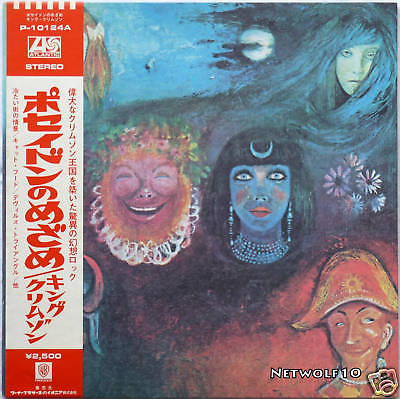
LP con copertina apribile a spessa cartonatura con trama in rilievo, pressato su etichetta Atlantic rossa e verde, con inserto aggiuntivo di 2 pagine, con i testi in inglese. OBI a colori a sfondo rosso e bianco, riportante il prezzo di 2.500 Yen.
I King Crimson sono un gruppo progressive rock inglese, nato nel 1969 e ancora attivo, anche se con una formazione completamente diversa, eccettuata la presenza di uno dei fondatori della band, Robert Fripp, considerato da sempre anima del gruppo. In tutta la storia della band, Fripp è stato sempre presente, anche se ha dichiarato che non si considera affatto il leader del gruppo. Per lui i King Crimson sono "un modo di fare le cose", e la coerenza musicale che si è mantenuta in tutta la storia del gruppo, nonostante i frequenti cambiamenti dei membri, riflette questo punto di vista. Il nome King Crimson ("Re Cremisi") venne coniato da Peter Sinfield (membro della prima formazione) come sinonimo di Beelzebub, principe dei demoni; secondo Fripp, Beelzebub sarebbe una forma anglicizzata dell'espressione araba B'il Sabab, che significa "l'uomo con uno scopo", nonostante l'etimologia generalmente accettata sia che il termine provenga dall'ebraico Ba'al-z'bub, che significa "il signore delle mosche". Nonostante i King Crimson abbiano avuto poco successo dal punto di vista della presenza sulle radio o in televisione, hanno una vastissima discografia, suonano spesso dal vivo e vantano un seguito di appassionati molto vasto. Inoltre, fin dagli esordi l'influenza della loro musica è stata incalcolabile. Una prima "prova" di band la si può intravedere sotto il nome di Giles, Giles & Fripp: Robert Fripp, chitarra e mellotron, i fratelli Mike e Peter Giles, rispettivamente batteria e basso elettrico. Il successo del primo e unico disco pubblicato non è esaltante. Fripp non demorde, e dà origine a un quintetto denominato King Crimson: si allontana Peter Giles, arriva Ian McDonald che suona fiati (non solo sassofono e flauto traverso, ma anche clarinetto e fagotto) e tastiere, al quale presto si aggiungono Greg Lake (in sostituzione di Peter Giles), basso elettrico, chitarra folk e voce e Peter Sinfield ai testi e tecnico da palco. La formazione, dopo un buon periodo di estenuanti prove nel magazzino di un pub, esordisce partecipando al famoso concerto dei Rolling Stones in onore di Brian Jones, il 5 luglio del 1969 a Hyde Park, Londra. Le sonorità proposte e i testi di Sinfield creano subito molto clamore. La critica classificherà subito il gruppo come l'ennesimo della corrente "progressive", ma, vedremo, i King Crimson avranno pochissimi punti in comune con nomi quali ELP, Genesis o Yes, a parte il mellotron o i rimandi nei testi a certe simbologie esoteriche e fiabesche. Greg Lake in esibizione a Llandano, Galles (2005). Già dal primo LP, In the Court of the Crimson King, realizzato nell'ottobre 1969, si percepisce che il Re Cremisi è un'entità ben diversa dalle allora mode "romantiche". Pete Townshend degli Who avrà modo di dichiararlo "un disco incredibile". Sicuramente è un esordio di quelli che lasciano il segno, e tutt'oggi, dopo quasi 40 anni, mantiene intatte tutte le sue peculiarità e innovazioni. Lo squarcio di 21st Century Schizoid Man, con la voce distorta di Lake, e i vari solos di Fripp e McDonald, la geniale poesia di I talk to the wind, il lirismo di Epitaph: siamo già dinanzi ad un gruppo estremamente maturo, non assimilato ad alcun stilema del momento, capace di creare qualsiasi sorta di emozione musicale con una capacità tecnica ed una personalità, per quei tempi, assolutamente di spicco. Il gruppo è subito, comunque, un'emanazione della complessa e originale personalità musicale di Fripp, geniale chitarrista (mancino, che però suona da destro), a suo modo re-interprete di Jimi Hendrix e di Bela Bartok contemporaneamente, capace di coniugare le lancinazioni metal con i "modi" jazz. Lo stesso Fripp si circonderà di volta in volta di musicisti in grado di condividere il suo progetto musicale, ma anche di contribuire con idee proprie, e della geniale creatività poetica di Peter Sinfield; nel corso dei primi quattro LP ci saranno continui mutamenti di formazione, ma sempre con Fripp e Sinfield a fungere da punti di riferimento. La partenza di Greg Lake nel 1970, allettato dalle proposte e dalle maggiore prospettive di successo con Emerson e Palmer, scombussola immediatamente la band. Ne risente il secondo LP, In the Wake of Poseidon (1970) che propone agli ascoltatori materiali già registrati con la voce di Greg Lake sul lato A (proseguendo lo stile del primo LP), ma che nella seconda facciata vede Fripp lanciarsi in sperimentazioni con tastiere elettroniche che potrebbero essere anche legate ai contatti che andava allacciando con Brian Eno (col quale di lì a poco avrebbe inciso due album fondamentali, No Pussyfooting ed Evening Star). Si aggiunga la presenza del pianista jazz Keith Tippett, e si capirà che il gruppo era entrato in una fase di rapida metamorfosi.
In the Wake of Poseidon è il loro secondo album in studio, pubblicato nel 1970. La formazione dei King Crimson è già cambiata rispetto al disco d'esordio, a seguito dell'annunciato abbandono di Greg Lake, Mike Giles e Ian McDonald; il rimpasto dei musicisti rimarrà una costante della prima fase del gruppo, sino alla fine del 1972. Sia Lake che Giles, tuttavia, accettarono la richiesta di Robert Fripp di contribuire alle incisioni di quest'album come turnisti, sebbene le note di copertina non distinguano tra musicisti ospiti e membri effettivi. Il contributo di Lake è limitato alla voce su tre dei quattro brani cantati del disco; in cambio, il cantante pretese di entrare in possesso dell'impianto voci dei King Crimson. Mike Giles, dal canto suo, richiese ed ottenne dalla casa discografica - all'insaputa del resto della band - un raddoppio del compenso allora previsto per le registrazioni. Ian McDonald, invece, esce definitivamente di scena e le tastiere passano nelle mani di Fripp che le alterna alla chitarra. Il basso è suonato da Peter Giles, fratello di Mike, più idoneo di Lake a ricoprire il ruolo in tempi rapidi, a giudizio di Fripp che aveva già collaborato con lui. Un solo brano è cantato da Gordon Haskell, futuro bassista del gruppo. Completano la lista degli "ospiti" il jazzista Keith Tippett al pianoforte e Mel Collins ai fiati. Apre il disco Peace - a Beginning, un breve tema che ricorrerà altre due volte nel corso dell'opera, e che qui è affidato alla sola voce di Lake. Il resto del lato A pare voler ricalcare pedissequamente la prima facciata di In The Court Of The Crimson King: Pictures of a City (cantata da Lake) ricorda molto 21st Century Schizoid Man, anche se veniva già suonata live dalla formazione del 1969 col titolo A Man, A City. Gli elementi in comune con Schizoid sono: la lunga digressione strumentale molto veloce con struttura armonica blues (anche qui alterata) culminante in un break all'unisono, incastonata fra strofe cantate su base distorta; il finale cacofonico e tronco; infine il testo sul tema dell'alienazione, qui ambientato in una metropoli dei giorni nostri. Cadence and Cascade (Haskell alla voce), ballata dall'andamento delicato ed intimista e con ricco uso del flauto, richiama musicalmente l'atmosfera di I Talk To the Wind e come quest'ultima funge da drastico contraltare all'aggressività della traccia precedente. Il brano è accreditato ai soli Fripp e Sinfield sebbene sull'album McDonald and Giles dello stesso anno compaia il brano Flight of the Ibis, piuttosto simile nella struttura e scritto da Ian McDonald quando era ancora nei King Crimson. In the Wake of Poseidon (Lake alla voce), infine, ricorda nettamente Epitaph sia per struttura che per armonia, nonché per gli arrangiamenti della sezione ritmica e l'uso "sinfonico" del Mellotron. Il lato B inizia con Peace - a Theme, in cui il tema già esposto in apertura di album è eseguito dalla sola chitarra acustica, per poi lasciar posto a Cat Food (Lake alla voce), brano aspro ancora su base armonica blues ma con alterazioni inusuali e tempi composti, colorato di free-jazz nel suo sviluppo grazie al contributo di Keith Tippett. Il brano è co-firmato da Ian McDonald e risale infatti anch'esso al 1969. Fu pubblicato come singolo, prima dell'uscita di quest'album, con l'allora inedita Groon come lato B. A seguire: The Devil's Triangle, lungo pezzo strumentale il cui titolo allude al Triangolo delle Bermuda ma anche all'uso massiccio del tritono nelle armonie. La prima parte, intitolata Merday Morn, cita in chiave elettrica il brano Mars - The Bringer Of War dalla pièce sinfonica I pianeti di Holst. Questa sezione faceva parte del repertorio del gruppo nel '69 e reca infatti anche la firma di McDonald. Il titolo, che in origine era appunto Mars, fu cambiato proprio su richiesta degli eredi di Holst. Dopo un breve interludio (intitolato Hand Of Sceiron) costituito da un rumore di vento seguito da un metronomo, la seconda metà del pezzo annega volutamente in un caos di Mellotron e improvvisazione free in cui nuovamente Tippett la fa da padrone. In un passaggio, persino il coro del brano The Court Of The Crimson King emerge per qualche secondo dal mare di suoni. Chiude il disco Peace - an End in cui le due precedenti esposizioni del tema (voce di Lake e chitarra) compaiono finalmente in simultanea, svelando fra l'altro la differenza di tonalità fra loro. A differenza del primo album, le cui composizioni erano ripartite piuttosto equamente fra i musicisti, su Poseidon Fripp risulta per lo più unico autore accreditato delle musiche (uniche eccezioni: le già citate Cat Food e Merday Morn); sino al 1972 e per altri due album dopo questo, Fripp e Sinfield risulteranno unici autori dei King Crimson. Si può dunque rilevare che dalla lavorazione di quest'album in poi incominci la vera e propria leadership di Fripp nei King Crimson, seppur derivata in principio dalla mera necessità di prendersi carico della situazione precaria seguita alla defezione di tre su cinque dei membri fondatori del gruppo. la copertina dell'album è un dipinto del 1967 dell'artista londinese Tammo De Jongh, dal titolo: 'The 12 Archetypes' or 'The 12 Faces Of Humankind' («I dodici archetipi» o «i dodici volti del genere umano»). Raffigura per l'appunto dodici volti umani, ciascuno dei quali simboleggia a sua volta un archetipo secondo la peculiare fisiognomica teorizzata dall'omeopata e radioestesista John De Monte, che a suo tempo aveva commissionato l'opera a De Jongh. Il testo del brano In The Wake Of Poseidon si ispira appunto a queste 12 figure: per l'esattezza, due versi per ciascun archetipo.La copertina interna è invece costituita da un dipinto astratto dello stesso Sinfield sul quale sono sovrimpressi i testi delle canzoni e i crediti dell'album.
LP Gatefold with a thick cardboard textured embossed, pressed on red and green Atlantic label, with insert additional 2 pages, with texts in English. OBI color red background and white, showing the price of 2.500 yen.
King Crimson is an English progressive rock group, founded in 1969 and still active, albeit with a completely different formation, except for the presence of one of the founders of the band, Robert Fripp has always been considered the core group. Throughout the history of the band, Fripp has always been present, although he held that it is not considered the leader of the group. For him, the Crimson King is "a way of doing things," and the musical coherence that was maintained throughout the history of the group, despite the frequent changes of members, reflects this point of view. The name King Crimson (Crimson King ") was coined by Peter Sinfield (Member of first training) as a synonym for Beelzebub, prince of demons, according Fripp, Beelzebub would be an anglicised form B'il Sababa Arabic expression meaning" man with a purpose ", although the etymology is generally accepted that the term derives from the Hebrew Baal-z'bub, which means" the lord of the flies. In spite of King Crimson has had little success in terms of presence on radio or television, have a vast discography, they're live and boast a very large fanbase. Moreover, from the beginning the influence of their music has been incalculable. A first "proof" of the band you can see under the name of Giles, Giles & Fripp Robert Fripp, guitar and mellotron, brothers Mike and Peter Giles, drums and bass respectively. The success of the first and only published record is not exciting. Fripp did not give up, and gives rise to a quintet called King Crimson: leaves Peter Giles, Ian McDonald arrives sounding brass (not just saxophone and flute, but also clarinet and bassoon) and keyboards, which will soon be joined Greg Lake ( for Peter Giles), bass guitar, folk guitar and vocals and Peter Sinfield texts and technical support from the stage. Training, after a good period of grueling tests in the warehouse of a pub, begins taking part in the famous Rolling Stones concert in honor of Brian Jones, on 5 July 1969 in Hyde Park, London. The sound proposals and texts from Sinfield created a great stir immediately. The critics immediately classify the group as yet another of the current "progressive," but we shall see, King Crimson will have very little in common with names such as ELP, Genesis or Yes, apart from the mellotron or references in the texts to certain esoteric symbolism and fabulous. Greg Lake in performance in Llandano, Wales (2005). From the first LP, In The Court Of The Crimson King, made in October 1969, he perceives that the King Crimson is an entity very different from the then mode "romantic." Pete Townshend of The Who will have the opportunity to declare "an incredible drive. Surely it is an onset of those who leave their mark, and still, after almost 40 years, maintains all its peculiarities and innovations. The glimpse of 21st Century Schizoid Man, his voice distorted, Lake, and several solos by Fripp and McDonald, the brilliant poetry I talk to the wind, the lyricism of Epitaph: We are already very mature before a group, not treated as number of elements of the moment, able to create any sort of musical emotion with a technical skill and personality, for those times, absolutely outstanding. The group is now, however, an offshoot of the complex and original musical personality of Fripp, a brilliant guitar (left-handed, but it sounds right), in its way re-interpretation of Jimi Hendrix and Bela Bartok at the same time, able to combine the Lanciniano metal with the "ways" jazz. Fripp is the same in turn surrounds the musicians are able to share his musical project, but also to contribute their ideas, creativity and poetic genius of Peter Sinfield and during the first four LPs, there will be continual changes in training, but always with Fripp and Sinfield to serve as reference points. The departure of Greg Lake in 1970, lured by the proposals and the prospects for greater success with Emerson and Palmer, immediately upsets the band. It suffers from the second LP, In the Wake of Poseidon (1970) suggests that listeners in pre-recorded material with the voice of Greg Lake on side A (continued the style of the first LP), but that in the second side sees Fripp embark on experiments with electronic keyboards that could also be linked to contacts that was established with Brian Eno (with whom he soon made two key albums, No Pussyfooting and Evening Star). Add the presence of the jazz pianist Keith Tippett, and you will understand that the group had entered a phase of rapid metamorphosis.
In the Wake of Poseidon is their second studio album, released in 1970. The formation of King Crimson has already changed from the debut album, following the abandonment of Greg Lake, Mike Giles and Ian McDonald, the musicians will remain a constant reshuffling of the first phase of the group until the end of 1972. Lake Giles is that, however, accepted the request from Robert Fripp to contribute to recordings of this album as shift workers, although the liner notes do not distinguish between musicians and guest members. The contribution of Lake is limited to item three of the four songs sung disc in return, singer claims to possess the plant rumors of King Crimson. Mike Giles, meanwhile, demanded and obtained by the record - unbeknownst to the rest of the band - then a doubling of the fee provided for the recordings. Ian McDonald, however, leaves the scene and finally pass into the hands of the keyboards that alternatives Fripp on guitar. The bass is played by Peter Giles, the brother of Mike, the most suitable for Lake to fill the role quickly, in the opinion of Fripp, who had already worked with him. One song is sung by Gordon Haskell, future bassist of the group. Completing the list of "guests" the jazz musician Keith Tippett on piano and Mel Collins to the wind. Opens the disc Peace - A Beginning, a short subject that will use two other times during the work, and here lies with the voice of Lake. The rest of side A seems to want to blindly follow in the first side of In The Court Of The Crimson King: Pictures of a City (sung by Lake) recalls very 21st Century Schizoid Man, even if it was already played live by the formation in 1969 under the title A Man, A City. The elements in common with Schizoid are the long digression instrumental blues harmonic structure with very fast (again altered) culminating in a break in unison, set between verses sung on a distorted, the final cacophonous and trunk and finally the text on the subject alienation, here set in a metropolis of today. Cadence and Cascade (the Haskell vocals), delicate and intimate ballad on the performance and full use of the flute, musically recalls the atmosphere of I Talk To the Wind, and how it serves as a dramatic counterpoint to aggression of the previous track. The song is credited solely Sinfield and Fripp McDonald and Giles although the album of the same year appears the song "Flight of the Ibis, rather similar in structure and written by Ian McDonald when he was in King Crimson. In the Wake of Poseidon (Lake item), finally, remember clearly Epitaph for both structure and for harmony and for the arrangements of the rhythm section and use "symphonic" of the Mellotron. Side B starts with Peace - a Theme, in which the issue has already been stated at the opening of albums and performed only by acoustic guitar, before giving way to Cat Food (Lake in the voice), yet rugged full-on blues harmonica, but with changes unusual times and compounds, colored free-jazz in its development thanks to the contributions of Keith Tippett. The song was co-written by Ian McDonald and also dates back to 1969. It was released as a single before the release of this album, with the then unpublished Groon as the B-side Up Next: The Devil's Triangle, long instrumental piece whose title alludes to the Bermuda Triangle, but also the widespread use of the tritone harmonies. The first part, entitled Merday Morn, electric key quotes in the piece Mars - The Bringer of War from Holst's The Planets symphony play. This section was part of the repertoire of the group in '69 and it also bears the signature of McDonald. The title, which originally was just Mars, was changed at the request of the heirs of Holst. After a brief interlude (entitled Hand Of Sceiron) comprising a wind noise, followed by a metronome, the second half of the piece deliberately drowned in a chaos of Mellotron and free improvisation in which the re Tippett is the host. In one passage, even the chorus of the song The Court Of The Crimson King emerges from the sea for a few seconds of sound. Closes the disc Peace - An End in the two previous exhibitions of the topic (voice of Lake and guitar) finally appear simultaneously, revealing among other things, the difference in tone between them. Unlike the first album, whose compositions were divided fairly evenly between the musicians on Fripp Poseidon is largely credited with sole author of the music (the only exceptions: the aforementioned Cat Food and Merday Morn) until 1972 and for two After this album, Fripp and Sinfield will be the sole author of King Crimson. It can therefore be noted that the working of this album then begins in the real leadership of Fripp of King Crimson, although derived in principle by the mere necessity to take charge of the precarious situation that followed the defection of three of the five founding members of the group . The album cover is a painting of 1967 London-based artist Tammo De Jongh, entitled 'The 12 Archetypes' or' The 12 Faces of Humankind '(' The twelve archetypes "or" the twelve faces of mankind ") . It represents precisely twelve times humans, each of which symbolizes an archetype in turn according to the peculiar physiognomy and theorized dall'omeopata dowsing John De Monte, which once had commissioned the work to De Jong. The full text of In The Wake Of Poseidon is based precisely on these 12 characters: to be exact, two lines for each archetipo.La inner sleeve is formed of an abstract painting of the same Sinfield on which are superimposed the lyrics and credits of the album.
Condizioni - Conditions
Copertina
Cover
NM
Vinile
Vinyl
EX+++
Testi
Lyric Sheet
EX+
Obi
EX++
Foto Dettagliate
Modalità di pagamento e condizioni generali – Shipping and Payment
Accetto pagamenti solo con Paypal e bonifico bancario.
Per i pagamenti effettuati tramite Paypal, si accettano solo spedizioni tracciabili.
Il pagamento dovrà avvenire entro 7 giorni dalla chiusura dell’ acquisto ( a meno che il compratore non comunichi le sue motivazioni). Trascorso tale termine l’ oggetto sarà rimesso in vendita con conseguente rilascio di feedback negativo.
Tutte le foto utilizzate nelle mie aste sono sempre riferite ai reali oggetti in vendita.
Tutti gli imballi, sia per i dvd che per i vinili, saranno effettuati nel miglior modo possibile, per evitare danneggiamenti del prodotto durante il trasporto.
I accept payments only through Paypal and bank transfer.
For payments made via Paypal, we only accept shipments traceable.
Payment must be within 7 days from the closure of purchase (unless the buyer does not give reasons). After that time, the object will be relisted for sale, with consequent release of negative feedback.
All photos used in my auctions are always referring to real objects in the sale.
All packaging, both for the dvd for the vinyl, will be made in the best possible way, to avoid damage of the product during transport. Any duty or customs for incoming items are the responsibility of buyer.
Tipologie di Spedizione e costi per l’ Italia
Posta Raccomandata
Per Acquisti fino a 350 grammi
6,50 euro
Per Acquisti da 350 grammi a 1 Kg
8,50 euro
Pacco celere 3
Per Acquisti oltre 1 Kg
11 euro
Tipologie di Spedizione e costi per l’ Estero – Shipping’s metod and cost
Posta Raccomandata
ZONA 1
ZONA 2
ZONA 3
Europa,
Bacino del Mediterraneo
Africa,
Asia,
Americhe
Oceania
For Purchases of up to 350 grams
Per Acquisti fino a 350 grammi
11 euro
14 euro
18 euro
For Purchases from 350 grams to 1 kg
Per Acquisti da 350 grammi a 1 Kg
15 euro
19 euro
26 euro
For Purchases of 1 Kg to 2 Kg
Per Acquisti da 1 Kg a 2 Kg
21 euro
31 euro
36 euro
<div style="text-align:center"><a style="text-decoration:none" href="http://mostpopular.sellathon.com/?id=AC783867"><img src="http://www.sellathon.com/Resources/Images/countercredit.gif" border="0"></a></div>
price rating