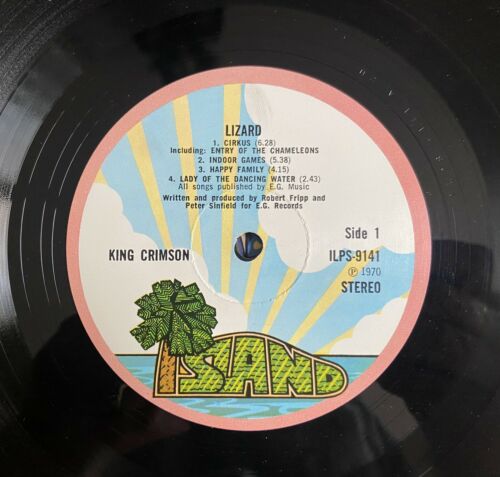
King Crimson "Lizard" Island ILPS 9141 Pink Rim A2/B2 UK 1st press g/fold 1970
£
29
$
38
Favourite Auctions
To save auctions to your favourites, please login
If you don't have an account, please register
Description
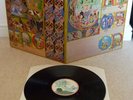
King Crimson "Lizard" Island Records ILPS-9141 UK 1st press Vinyl, LP, housed in a gate-fold sleeve and released in 1970.
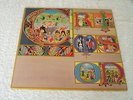
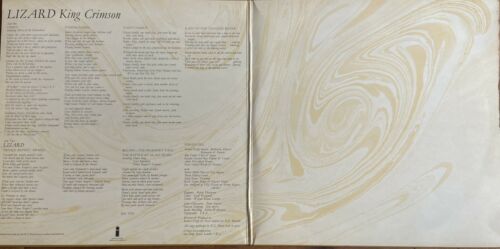
The vinyl appears to have been lightly played and is in great shape. It played through beautifully on my elderly stereo - no hop, stick or jump. It is housed in its original, gate-fold sleeve, which shows minimal signs of wear and which is also in great condition - no rips or writing. The spine is intact and legible, although the lettering is inverted. Matrix / Runout Side 1 : ILPS 9141 A 2-U Matrix / Runout Side 2 : ILPS 9141 B 2-U
Lizard is the third studio album by British progressive rock band King Crimson, released in December 1970 by Island Records in the UK, and in January 1971 by Atlantic Records in the United States and Canada. It was the second consecutive King Crimson album recorded by transitional line-ups of the group that did not perform live, following In the Wake of Poseidon. This is the only album by the band to feature singer and bass guitarist Gordon Haskell (apart from his appearance singing "Cadence and Cascade" on the previous album) and drummer Andy McCulloch as official members of the band.
Haskell was previously a classmate of Robert Fripp at Queen Elizabeth's grammar school in Wimborne near Bournemouth, the pair having subsequently played together in the local band The League of Gentlemen. Haskell later contributed vocals to the King Crimson track "Cadence and Cascade" on "In the Wake of Poseidon", after Greg Lake left the band to join Emerson, Lake & Palmer. Fripp asked Haskell to become an official member of King Crimson for the recording of "Lizard". Another supporting musician on "In the Wake of Poseidon", saxophonist/flautist Mel Collins was also asked to become a full-time member, as was drummer Andy McCulloch, who replaced Michael Giles. The group was then augmented with session musicians, including another "In the Wake of Poseidon" alumnus, the noted jazz pianist Keith Tippett, together with Yes vocalist Jon Anderson, and brass/woodwind players Robin Miller, Mark Charig, and Nick Evans.
Haskell and McCulloch had an unhappy experience recording "Lizard", finding it difficult to connect with the material, especially Haskell as a devotee of soul and Motown music. During rehearsals for a prospective tour following the album's completion, Haskell left King Crimson. He sought legal redress for the next 19 years because he believed he had been cheated out of royalties owed him for the album. Shortly after Haskell left the group, McCulloch did likewise. The press release drafted by Sinfield to promote "Lizard" wryly quoted Max Ehrmann's poem "Desiderata", which contains advice on how to chart a true course through confusion.
Collins, on the other hand, remained in King Crimson with Fripp and Sinfield for the recording of the group's next album, "Islands". Haskell was replaced with Boz Burrell on bass guitar and vocals, while McCulloch was replaced with his sometime housemate Ian Wallace. The "Islands" line-up of the group would finally give some of the "Lizard" material a live airing, with "Cirkus" and "Lady of the Dancing Water" becoming part of King Crimson's touring repertoire. "Cirkus" would also later become part of the touring repertoire of the "21st Century Schizoid Band", whose members included Mel Collins and Jakko Jakszyk.
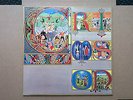
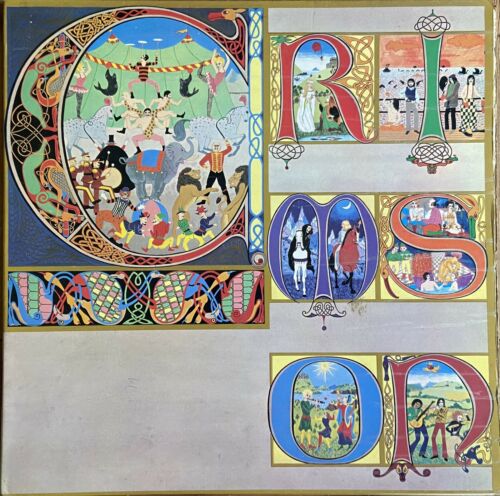
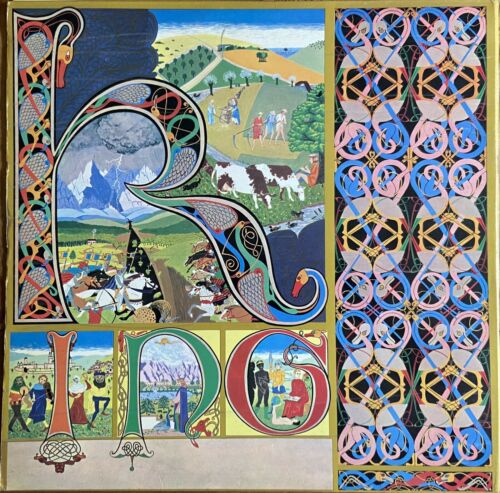
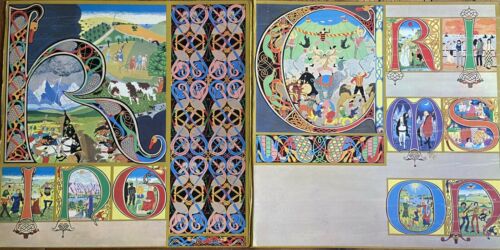
"Lizard"'s outside cover art is by Gini Barris, who was commissioned to produce it by Peter Sinfield. The inside cover consists of the song lyrics and credits printed over a marbled pattern, credited to Koraz Wallpapers, a company run by Barris' boyfriend at the time.
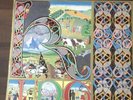
The album's outside cover consists of the words 'King Crimson' spelled out in ornate medieval lettering, the word 'King' on the back cover and the word 'Crimson' on the front cover, with each letter incorporating one or two discrete images. These images in turn represent Sinfield's lyrics from the album – the images in the word 'King' representing the lyrics of the various sections and subsections of track 5, "Lizard"; while the images in the word 'Crimson' represent the lyrics of tracks 1–4. Whereas the images representing "Lizard" are medieval in content – depicting Prince Rupert, his environs (including a peacock), and the Battle of Glass Tears – the images representing the other four tracks juxtapose medieval and contemporary scenes. The image around the letter 'i' in 'Crimson', for example, depicts the Beatles, corresponding with their pseudonymous appearance in the lyrics to "Happy Family". Around the "n" on the front cover, there is a depiction of Rupert the Bear piloting a yellow aeroplane.
In his book Prog Rock FAQ, Will Romano called Barris' work "one of the era's most beautifully strange pieces of album cover artwork". In an interview with Romano, Barris said that "Lizard" was "one of my first jobs" since studying graphics at the Central School of Art and Design in London. She contacted Sinfield after hearing he needed an artist to produce a cover for "Lizard". When she suggested creating medieval miniatures, a passion of hers, Sinfield "went for it" and commissioned her to do the job. Barris recalled that she did not hear the music until after the album's release, but worked from the lyrics Sinfield had given her. She cited the Lindisfarne Gospel and Très Riches Heures du Duc de Berry illuminated manuscripts as inspiration for her work.
In his retrospective review, AllMusic's Dave Lynch described it as, "Seamlessly blending rock, jazz, and classical in a way that few albums have successfully achieved, Lizard is epic, intimate, cacophonic, and subtle by turn – and infused with the dark moods first heard when "21st Century Schizoid Man" and "Epitaph" reached listeners' ears the previous year." Classic Rock reviewer described "Lizard" as "a decidedly Miles Davis-influenced hodgepodge of classical and jazz influences brought to their logical, near-chaotic end" and defined its music "mind-bending, unclassifiable creative stuff." In 2011, PopMatters named the title track at #13 in the list "The 25 Best Progressive Rock Songs of All Time."
price rating