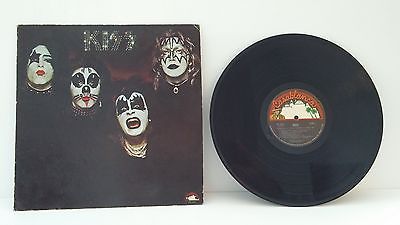
Kiss - Kiss LP - 1st Release - Casablanca Records NB 9001 Excludes Kissin' Time
$
51


Favourite Auctions
To save auctions to your favourites, please login
If you don't have an account, please register
Description
Kiss - Kiss LP - 1st Release - Casablanca Records NB 9001 Excludes Kissin' Time
This is a first release: matrix/runout is NB 90001-60001-1A for side 1 and NB 90001-60002-1A for side 2.
The record is in a strong VG+ condition. The cover is in VG to VG+ condition, leaning heavily to VG+. There is significant edge wear, especially along the bottom. There is fraying along the spine which negatively impacts the wording. There are a couple of creases in the top right and bottom left of the front cover. There is some creasing in the corners of the back cover. There is a 5/8" long by 1/4" high piece of tape on the back of the album. There is no ring wear or seam splits and the majority of the cover is quite clean. Any other imperfections are minor and can be seen in the photos. This does not come with the original inner sleeve.
The record has been graded both through play and visually (under a bright, 100 watt bulb, and at multiple angles).
I use the Goldmine Grading System which I include below.
I have a significant collection of LPs from many genres which I will be auctioning off over the next few months. Please check back often if you like what’s being listed.
I will ship the record in a shipping box specifically designed for records between two sheets of corrugate.
Shipping discounts offered if ship out more than one LP at the same time.
Discounts apply to shipments within the U.S. only.
LP 2 and 3 $1.50 extra for each
LP 4 and up $1 extra for each
Satisfaction guaranteed or full refund.
Goldmine Grading System
MINT (M)
Absolutely perfect in every way.
NEAR MINT (NM)
A NM record looks like it just came from a retail store and was opened for the first time. In other words, it’s nearly perfect.
NM records are shiny, with no visible defects. Writing, stickers or other markings do not appear on the label, nor do any “spindle marks” from someone trying to blindly put the record on the turntable. Major factory defects are absent; a record and label obviously pressed off center is not Near Mint. If played, it will do so with no surface noise.
NM covers are free of creases, ring wear and seam splits of any kind.
VERY GOOD PLUS (VG+) or EXCELLENT (E)
A VG+ record is, except for a couple minor things, Near Mint. If a record leans towards the higher end of the VG+ grade, it will be called Excellent (E).
VG+ records may show some slight signs of wear, including light scuffs or very light scratches that do not affect the listening experience. Slight warps that do not affect the sound might be present. Minor signs of handling might appear, too, such as telltale marks around the center hole, but repeated playing has not misshapen the hole.
VG+ covers have only minor wear. A VG+ cover might have some very minor seam wear or a split (less than one inch long) at the bottom, the most vulnerable location. There may be some very light ring wear or discoloration, but it should be barely noticeable. Also, a VG+ cover may have some defacing, such as a cut-out marking.
Very Good (VG)
Many of the imperfections found on a VG+ record are more obvious on a VG record.
VG records lack most of the original gloss found on factory-fresh records. Groove wear is evident on sight, as are light scratches deep enough to feel with a fingernail. When played, a VG record has surface noise, and some scratches may be audible, especially in soft passages and during a song’s intro and ending. But the noise will not overpower the music otherwise.
Minor writing, tape or a sticker can be found on the label.
VG covers have many signs of human handling. Ring wear in the middle or along the edges of the cover is obvious, though not overwhelming. Some more creases might be visible. Seam splitting will be more obvious; it may appear on all three sides, though it won’t be obvious upon looking. Someone might have written on it or stamped a price tag on it, too.
Good (G), Good Plus (G+) or Very Good Minus (VG–)
The record still plays through without skipping, but it has significant surface noise and groove wear, and the label is worn, with significant ring wear, heavy writing, or obvious damage caused by someone trying to remove tape or stickers.
A Good to VG– cover has ring wear to the point of distraction, has seam splits obvious on sight and may have even heavier writing than on a VG cover.
Kiss (Kiss album)
From Wikipedia, the free encyclopedia Kiss Studio album by Kiss Released February 18, 1974 Recorded October–November 1973; April 1974 ("Kissin' Time") at Bell Sound Studios, New York City Genre- Hard rock
- glam rock
- Kenny Kerner
- Richie Wise
(1974) Hotter Than Hell
(1974) Singles from Kiss
- "Nothin' to Lose"
Released: February 18, 1974 - "Kissin' Time"
Released: May 10, 1974 - "Strutter"
Released: August 10, 1974
Kiss is the debut album by American rock band Kiss, released on February 18, 1974. Much of the material on the album was written by Gene Simmons and Paul Stanley, as members of their pre-Kiss band Wicked Lester. Simmons estimated that the entire process of recording and mixing took three weeks, while co-producer Richie Wise has stated it took just 13 days.[7]
Contents
[hide]- 1Album information
- 2Repressing
- 3Reception
- 4Songs
- 4.1"Strutter"
- 4.2"Nothin' to Lose"
- 4.3"Firehouse"
- 4.4"Cold Gin"
- 4.5"Let Me Know"
- 4.6"Kissin' Time"
- 4.7"Deuce"
- 4.8"Love Theme from Kiss"
- 4.9"100,000 Years"
- 4.10"Black Diamond"
- 5Track listing
- 6Personnel
- 7Charts
- 8Certifications
- 9References
Album information[edit]
The album was recorded at Bell Sound Studios in New York City, which was owned by the company that owned Buddah Records. Neil Bogart, founder of Casablanca Records, was an executive at Buddah prior to forming Casablanca.[7] Casablanca Records held a party at the Century Plaza Hotel in Los Angeles to celebrate the West Coast release of Kiss (February 18) and to introduce the record company to the press and other record industry executives.
Kiss began their first album tour with a performance at the Northern Alberta Jubilee Auditorium in Edmonton, Alberta on February 5, 1974. A few weeks later, they made their first national TV appearance on ABC's In Concert, followed by a performance of Firehouse on The Mike Douglas Show. During the interview portion of the show, Gene Simmons declared himself to be "evil incarnate", eliciting nervous, confused reactions from the studio audience, to which comedian Totie Fields humorously commented, "Wouldn't it be funny if he's just a nice Jewish boy underneath the makeup?" Although neither confirming or denying his Jewish heritage, Simmons replied, "You should only know", to which, Fields countered, "I do. You can't hide the hook", referring to Simmons' nose.
In keeping with the Casablanca theme, the party included palm trees and a Humphrey Bogart lookalike. Kiss performed their usual loud and bombastic stage show, which turned Warner Bros. Records (Casablanca's record distributor) against the group.[7] Soon after the show, Warner Bros. contacted Neil Bogart and threatened to end their deal with Casablanca if Kiss did not remove their makeup. With manager Bill Aucoin's backing, Kiss refused. Shortly after the release of Kiss, Warner Bros. released Casablanca from their contract.[7]
The album's cover showed the group positioned against a black background in a pose visually reminiscent of the Beatles' With the Beatles album (Peter Criss stated that this was the visual effect the band was looking for). Gene Simmons has since stated that Meet The Beatles was a big inspiration to him. Three of the four band members applied their own makeup for the album cover photo, as they usually did, but Criss' "Catman" makeup was applied by a professional, whose work came out looking quite a bit different from the look Criss had established, and to which he would return immediately afterward. Ace Frehley, wanting to impress the other members of Kiss, dyed his hair with silver spray paint.[7] According to Criss, photographer Joel Brodsky thought Kiss were literally clowns, and wanted to place balloons behind the group for the shoot.[8] Brodsky denied this, chalking it up to imagination.[7] As this was also the first album for the group, they still had yet to perfect the look they would come to be known for later on. For example, Simmons' "Demon" makeup, while noticeable as his, appears rough and not in the definitive form he later became known for.
Repressing[edit]
In the late 1980s, the album was repressed by Mercury Records with a live version of "Nothin' to Lose" in place of the studio version. To date, the repressed version is still available in stores in vinyl format.
Reception[edit]
Despite the band's promoting and touring, Kiss sold approximately 75,000 copies after its initial release, without the presence of a hit single.[7] It was certified gold on June 8, 1977, having shipped 500,000 copies.[9] The album was re-released in 1997 (along with most of Kiss' earlier albums) in a remastered version.
In 2003, Kiss was included in the Spin list of essential glam rock albums.[10]
Songs[edit]
With the exception of "Kissin' Time", all of the material for Kiss was written before the band entered the studio. Some of the songs were written during Wicked Lester's brief existence, while "Firehouse" was written by Paul Stanley while he was attending the High School of Music & Art in New York City.[7]
"Strutter"[edit]
"Strutter", which opens the album with a drum fill, is an uptempo rock song that was written before Frehley joined Kiss. Stanley wrote the lyrics, and the music was based on a song Simmons had written years before, "Stanley the Parrot",[7] which he had recorded with former Wicked Lester member Brooke Ostrander in a New Jersey apartment. "Strutter" remains one of the few Kiss songs where Stanley and Simmons share songwriting credits, and was a standard number at Kiss concerts throughout the 1970s. It was released in August 1974 as the third and final single from the album.
"Nothin' to Lose"[edit]
"Nothin' to Lose", the band's first single, is a song written by Simmons and sung by him, Criss and Stanley. The song chronicles the singer coercing his girlfriend into trying anal sex, and her subsequent enjoyment of it. The B-side was "Love Theme from KISS", the album's instrumental.
"Firehouse"[edit]
The North Carolina glam metal band FireHouse takes its name from the song "Firehouse".[citation needed] The song is well known for Simmons fire breathing during live concerts.
"Cold Gin"[edit]
This song was the first composed for Kiss by Frehley. Insecure in his own singing ability, Frehley turned over the vocals for the album to Simmons. "Cold Gin" was a concert staple throughout the 1970s. During the Alive/Worldwide Tour, Frehley assisted on lead vocals.
The song refers to the stimulating effect that cold gin supposedly has on the male sex drive. The song credits cold gin as the only thing that keeps the couple together in a troubled relationship.
There was a Kiss tribute band from Los Angeles named after this classic song, featuring Tommy Thayer as Frehley, Jaime St. James as Criss, Chris McLernon as Simmons and Anthony White as Stanley. St. James and Thayer would later go on to form Black 'N Blue, a band produced by Simmons, and Thayer would eventually join Kiss, taking Frehley's place after the Farewell tour.
"Cold Gin" was covered by the alternative metal group Disturbed at a one-off tribute show to Pantera guitarist "Dimebag" Darrell Abbott, as it was known to be the guitarist's favorite song. That live performance featured members of Drowning Pool and Anthrax, David Draiman on vocals and Vinnie Paul on drums.
Pantera and Skid Row performed the song together live while the bands were on tour together in 1992, with Ace Frehley on guitar as a special guest. The performance was taped and included on Pantera's 2000 home video, 3 Vulgar Videos from Hell. Death Angel covered the song on their 1988 album Frolic Through the Park.
Frehley noted: "I wrote 'Cold Gin' in a New York subway, in my head, both lyrics and music. I had a spiral notebook with me. I never took a guitar lesson, nobody believes that. I didn't realize it was gonna become a Kiss classic".
A live version of the song was included on Kiss' popular and successful live album Alive!. When Alive! was re-released as part of the Kiss Alive! 1975–2000 box set, the song was mistakenly credited to Stanley instead of Ace Frehley in the 72-page booklet that accompanied the album.
Weezer vocalist and guitarist Rivers Cuomo has said that this was the first song he ever learned to play on guitar.[11]
"Cold Gin" was named the seventh-best drinking song of all time.[12]
"Let Me Know"[edit]
"Let Me Know", previously titled "Sunday Driver", was the song Stanley played when he was first introduced to Simmons, and it was later recorded by Wicked Lester. Simmons and Stanley shared lead vocal duties on the song, which was given a bridge and instrumental coda when recorded for Kiss.[7] During later Kiss concerts, this coda was moved to the end of "She" and before that, "Watchin' You".
"Kissin' Time"[edit]
"Kissin' Time" was not included on the original album; in fact it was not recorded until two months after the album's February release. By April, the album was clearly not the commercial success the band and Casablanca Records founder Neil Bogart were hoping for. Bogart, who knew that a catchy single could save the album, ordered Kiss back into the studio to record "Kissin' Time", which was a Top 20 hit for Bobby Rydell in 1959. It was released as a single on May 10, but never reached any higher than number 83. It did, however, boost sales of the album even though it was not added to the album until it was reissued in July 1974 (against the wishes of the band).[7]
"Deuce"[edit]
Simmons has stated that he does not know the meaning of the song's lyrics.[7] "Deuce" has been a staple of the band's concerts, opening their shows from 1973–1976 and again for their 1996 reunion.
"Love Theme from Kiss"[edit]
This instrumental evolved from a song titled "Acrobat", played during the band's 1973 club shows. It can be found on their 2001 box set. The song is shortened for the album. It is the only Kiss song to feature songwriting credits for all four original members. "Love Theme from Kiss" appeared in the 2010 movie Somewhere, directed by Sofia Coppola.
"100,000 Years"[edit]
"100,000 Years" begins with a bass riff by Simmons. The live version includes a long drum solo continuing on from the short one found on the album, as heard on Alive! The demo version can be heard on the 2001 release of the Kiss box set. There was a lost verse towards the end of the song which never made the final cut.
"I spent a lot of time listening to and relearning a lot of the solos I used to do," remarked Frehley during the band's 1996 reunion. "Like the one in '100,000 Years' – I was listening to it before the tour started, thinking it was just about the nuttiest solo I'd ever heard. I'd never write something like that today."[13]
"Black Diamond"[edit]
"Black Diamond" begins with Stanley singing the first verse accompanied by a twelve-string, acoustic guitar. After he yells out "hit it!", the full band kicks in and Criss assumes lead vocal duties, repeating the first verse. After the chorus, the song slows down for Frehley's guitar solo, after which it gradually slows down further and fades out. After Criss' departure from the band, the vocal duties have fallen to subsequent drummers Eric Carr and Eric Singer.
Track listing[edit]
No. Title Writer(s) Lead vocals Length 1. "Strutter" Paul Stanley, Gene Simmons Stanley 3:10 2. "Nothin' to Lose" Simmons Simmons, Peter Criss 3:27 3. "Firehouse" Stanley Stanley 3:17 4. "Cold Gin" Ace Frehley Simmons 4:22 5. "Let Me Know" Stanley Simmons, Stanley 2:58 6. "Kissin' Time" Kal Mann, Bernie Lowe Simmons, Stanley, Criss 3:52 7. "Deuce" Simmons Simmons 3:06 8. "Love Theme from Kiss" Frehley, Stanley, Simmons, Criss Instrumental 2:24 9. "100,000 Years" Stanley, Simmons Stanley 3:22 10. "Black Diamond" Stanley Criss (intro: Stanley) 5:13 Total length: 35:11Personnel[edit]
Kiss- Paul Stanley – vocals, rhythm guitar
- Ace Frehley – lead guitar
- Gene Simmons – vocals, bass guitar
- Peter Criss – drums, percussion, vocals
- Bruce Foster – piano on "Nothin' to Lose"
- Warren Dewey – fire engine on "Firehouse"
- Kenny Kerner – producer [14]
- Richie Wise – producer [14]
- George Marino - mastering engineer
Charts[edit]
Album Chart (1974) Peakposition Weeks on
chart Canadian Albums Chart[15] 82 - New Zealand Albums Chart[16] 38 - US Billboard Pop Albums[17] 87 22
price rating