LED ZEPPELIN III (3) IST UK PRESS Peter Grant Credit
£
36
$
48


Favourite Auctions
To save auctions to your favourites, please login
If you don't have an account, please register
Description
LED ZEPPELIN III
RED / PLUM
Original UK 1ST PRESS Vinyl LP
'Peter Grant Executive Producer'
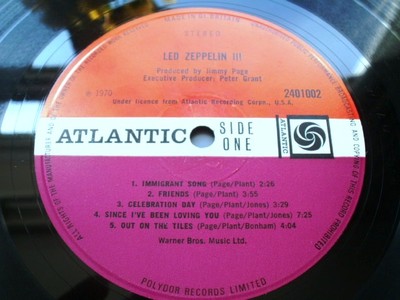
Non-hyphenated catalogue number 2401002 on labels
Original E. J. Day & Co Sleeve
With Working Wheel
THIS LP IS MEGA RARE AND HIGHLY COLLECTABLE
CLICK HERE
AND LISTEN TO THE WHOLE ALBUM
I have downloaded the whole album to a podcast in approx. 5 min sections which slightly overlap so that nothing is left out.
Description:
Vinyl:
It is the 1ST PRESS original heavy red/plum vinyl which has retained most of its original lustre and sheen; it does have quite a few superficial hairline marks but does not affect the audio too much. It does have some background noise which you can hear during the quiet moments but it doesn’t spoil the sound. The record could probably do with a professional clean as this will get rid of the static noise. It lays perfectly level on the turntable and looks brilliant giving a great sound, please listen and judge yourself.
I have graded strictly to the Record Collectors Guide at VERY GOOD
Inscribed in the dead wax:
Matrix Number
Side 1: 2401002 A7
Side 2: 2401002 B5
Mother Stamp
Side 1: 1 1 Do what thou wilt
Side 2: 1 2 1 1 So mote it be
Sleeve:
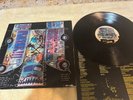
First issue fully laminated E J. Day Gatefold sleeve with the wheel working perfectly.
It lays flat no curving as with most you find, and only a minimal amount of colour fade / yellowing around the edges, but has suffered with laminate creases (see photos)
There is NO graffiti/stickers/unwanted writing whatsoever.
The spine is excellent square and true, NO curving.
Graded VERY GOOD
Inner sleeve;
It comes with the original Poly lined (Plastic Bags, Made in England) patent 800513/973939, MADE IN ENGLAND. It has ageing discolour around the edges, it is completely intact although creased. VERY GOOD
The vinyl is housed in a brand new poly lined inner
Labels:
Labels are the sensational red / plum ATLANTIC with the ATLANTIC logos to the left of the central holes on both sides of the labels to confirm that this is the very first issue of this magnificent rarity. Has the original first pressing "produced by Jimmy Page executive producer Peter Grant" label texts, and the cat no in one 2401002 later pressings do not have this.
Label one has NO sign of any graffiti, NO rips NO tears or stickers, and only a few spindle lines, Label two does have a mark where a sticker has been removed, it hasn’t torn the label just left a residue behind.
Side One Graded EXCELLENT
Side Two Graded VERY GOOD
Track Listing
Side A:
Immigrant Song
Friends
Celebration Day
Since I've Been Loving You
Out on The Tiles
Side B:
Gallows Pole
Tangerine
That's The Way
Bron-y-aur Stomp
Hats Off To (Roy) Harper
Biography
Led Zeppelin III is the third studio album by the English rock band Led Zeppelin. It was recorded between January and July 1970 and released on 5 October 1970 by Atlantic Records. Composed largely at a remote cottage in Wales known as Bron-Yr-Aur, this work represented a maturing of the band's music towards a greater emphasis on folk and acoustic sounds. This surprised many fans and critics, and upon its release the album received rather indifferent reviews.
Although it is not one of the highest sellers in Zeppelin's catalogue, Led Zeppelin III is now generally praised, and acknowledged as representing an important milestone in the band's history. Although acoustic songs are featured on Led Zeppelin III's predecessors, it is this album which is widely acknowledged for showing that Led Zeppelin was more than just a conventional rock band and that they could branch out into wider musical territory.
Many of the songs featured on the album were conceived in mid-1970 at Bron-Yr-Aur, an 18th century cottage in Gwynedd, Wales, on a hilltop overlooking the Dyfi Valley, three miles north of the market town Machynlleth. There, Jimmy Page and Robert Plant spent some time after an exhausting concert tour of North America to play and compose new music. This remote setting had no running water or electric power, which encouraged a slight change of musical direction for the band towards an emphasis on acoustic arrangements. As Page later explained:
After the intense touring that had been taking place through the first two albums, working almost 24 hours a day, basically, we managed to stop and have a proper break, a couple of months as opposed to a couple of weeks. We decided to go off and rent a cottage to provide a contrast to motel rooms. Obviously, it had quite an effect on the material that was written... It was the tranquillity of the place that set the tone of the album. Obviously, we weren't crashing away at 100 watt Marshall Stacks. Having played acoustic and being interested in classical guitar, anyway, being in a cottage without electricity, it was acoustic guitar time... After all the heavy, intense vibe of touring which is reflected in the raw energy of the second album, it was just a totally different feeling. Plant has expressed similar recollections:
[Bron-Yr-Aur] was a fantastic place in the middle of nowhere with no facilities at all-and it was a fantastic test of what we could do in that environment. Because by that time we'd become obsessed with change, and the great thing was that we were also able to create a pastoral side of Led Zep. Jimmy was listening to Davey Graham and Bert Jansch and was experimenting with different tunings, and I loved John Fahey. So it was a very natural place for us to go to.
After preparing the material that would emerge on the album, Page and Plant were joined by the other members of the band (John Bonham and John Paul Jones) at Headley Grange, a run-down mansion in East Hampshire, to rehearse the songs. With its relaxed atmosphere and rural surroundings, Headley Grange appealed to the band as the favoured alternative to the discipline of a conventional studio.
The album was then recorded in a series of sessions in May and June 1970 at both Headley Grange and at Olympic Studios, London. Some additional work was put in at Island Records' new Basing Street Studios in Notting Hill, London, in July, then mixed at Ardent Studios, Memphis in August 1970 during Led Zeppelin's sixth American concert tour.The album was produced by Page and engineered by Andy Johns and Terry Manning.
Composition
As noted above, Led Zeppelin III marked a change in focus for the band from late 1960s hard rock to a more folk rock or electric folk and acoustic inspired sound. These styles had been present to a lesser degree in the band's first two releases, but here it was the main emphasis, and one that would remain prominent in some of the group's later albums. This development endeared the band to many progressive rock fans who would never have listened to Led Zeppelin's established blues and rock repertoire. With Led Zeppelin III the group's songwriting dynamic also changed, from Page's domination of the first two albums towards a more democratic affair in which all four group members contributed their own compositions and ideas—patterns that would continue in future sessions.
The album contains two songs which became key components of the band's live concert performances for many years: "Immigrant Song" and "Since I've Been Loving You". The first of these, written by Page and Plant, is about the Viking invasions of England and was inspired by the band's recent live performance in Iceland. "Since I've Been Loving You" is a classic, original blues in the key of C minor featuring heartfelt interplay by all four group members. It would become a live performance staple for the band, replacing "I Can't Quit You Baby" from the first album as the band's slow blues showcase.
The album also featured the rock songs "Celebration Day" and "Out on the Tiles", the eastern-influenced "Friends" and the acoustic tracks "Bron-Y-Aur Stomp", "Tangerine" and "That's the Way", the last considered by Page to be a breakthrough for still-developing lyric writer Plant. The song "Gallows Pole" is an updated arrangement of a traditional folk song called "The Maid Freed from the Gallows". The album concludes with "Hats Off to (Roy) Harper", a track dedicated to their influential contemporary and friend, Roy Harper, honouring Harper’s work and acknowledging the band's roots in acoustic music.
Release and critical reaction
Led Zeppelin III was one of the most eagerly awaited albums of 1970, and advance orders in the US alone were close to the million mark. Its release was trailered by a full page advertisement taken out in Melody Maker magazine at the end of September, which simply said "Thank you for making us the world's number one band.
Although the band's expanding musical boundaries were greeted warmly by some, detractors attacked the heavier tracks as being mindless noise. In a representative review published in Rolling Stone, critic Lester Bangs praised "That's the Way" as "beautiful and genuinely moving", while characterising the band's heavier songs as crude and little differentiated from each other. Others criticised the acoustic material for merely imitating the music of Crosby, Stills, Nash & Young. Page suggested that this comparison was inaccurate, stating in an interview he gave to Cameron Crowe that: When the third LP came out and got its reviews, Crosby, Stills and Nash had just formed. That LP had just come out and because acoustic guitars had come to the forefront all of a sudden: LED ZEPPELIN GO ACOUSTIC! I thought, Christ, where are their heads and ears? There were three acoustic songs on the first album and two on the second.
Page has also said that the negative press given to the third album affected him so much that he did not give press interviews for 18 months after its release, and was also one of the reasons why the band's subsequent untitled album contained no written information on it at all. However, in more recent years, he has commented on the negative press reaction in somewhat more diplomatic terms: with hindsight, I can see how if somebody got Led Zeppelin III, which was so different from what we'd done before, and they only had a short time to review it on the record player in the office, then they missed the content. They were in a rush and they were looking for the new "Whole Lotta Love" and not actually listening to what was there. It was too fresh for them and they didn't get the plot. So, in retrospect, it doesn't surprise me that the diversity and breadth of what we were doing was overlooked or under-appreciated at the time.
Led Zeppelin III was a trans-Atlantic No. 1 hit. It spent four weeks at the top of the Billboard chart, while it entered that British chart at No. 1 and remained there for three weeks (returning to the top for a further week on 12 December). However, following the lukewarm, if not confused and sometimes dismissive reception from critics, sales lagged after this initial peak. As Plant said: Led Zeppelin III was not one of the best sellers in the catalogue because the audience turned round and said 'What are we supposed to do with this?' – 'Where is our 'Whole Lotta Love Part 2'? They wanted something like Paranoid by Black Sabbath! But we wanted to go acoustic and a piece like "Gallows Pole" still had all the power of "Whole Lotta Love" because it allowed us to be dynamic.
In spite of its initially indifferent reviews and lower sales than Led Zeppelin's other early albums, Led Zeppelin III's reputation has recovered considerably with the passage of time. The RIAA certified the album 2x platinum in 1990, and 6x platinum in 1999.
Album sleeve design
Led Zeppelin III's original vinyl edition was packaged in a gatefold sleeve with an innovative cover, designed by Zacron, a multi-media artist whom Page had met in 1963 whilst Zacron was a student at Kingston College of Art. He had recently resigned a lectureship at Leeds Polytechnic to found Zacron Studios, and in 1970 Page contacted him and asked him to design the third album's cover.
The cover and interior gatefold art consisted of a surreal collection of seemingly random images on a white background, many of them connected thematically with flight or aviation (as in "Zeppelin"). Behind the front cover was a rotatable laminated card disc, or volvelles, covered with more images, including photos of the band members, which showed through holes in the cover. Moving an image into place behind one hole would usually bring one or two others into place behind other holes. This could not be replicated on a conventional cassette or CD cover, but there have been Japanese and British CDs packaged in miniature versions of the original sleeve. In France this album was released with a different album cover, simply showing a photo of the four band members.
The idea of including a volvelle, based on crop rotation charts, was initially Page's concept. However, the result was a meeting of minds as Zacron had been working on rotating graphics from 1965. Zacron felt that by not including text on the front of the cover, the art would endure.
In an article featured in the December 2007 issue of Classic Rock magazine, Zacron claimed that upon his completion of the artwork, Page telephoned him while he was in New York to express his satisfaction with the results, saying "I think it is fantastic". However, in a 1998 interview Page himself gave to Guitar World magazine, he described the results as a disappointment: I thought it looked very teeny-bopperish. But we were on top of a deadline, so of course there was no way to make any radical changes to it. There were some silly bits—little chunks of corn and nonsense like that.
The album cover featured on the front page of The Daily Mail's Live Magazine in December 2007, which hailed Led Zeppelin III as "the greatest rock album of all time".
The first pressings of the album included the phrases ( "So mote it be" & "Do what thou wilt"), inscribed on the lacquer itself by engineer Terry Manning during the final mastering process. This phrase is from the core tenet of Aleister Crowley's philosophy of Thelema: "Do what thou wilt shall be the whole of the law. Love is the law, love under will. There is no law beyond do what thou wilt." Page was a scholar of Crowley's work, once owning a private collection of Crowley manuscripts, artwork and other ephemera, and in the 1970s even bought one of his residences, Boleskine House on the shores of Loch Ness in Scotland.
POSTAGE DETAILS
The cost of postage is set out below, however if you require any further information please email me. Some countries are cheaper than others so it could be less than below, so if you are outside the UK please wait for an invoice from me as this could save you money.
The cost below is for a single album weighing 600grams.
The price for ‘value over £46’ includes insurance of anything between £47 and £500.
WITHIN THE UK
Value up to £46
Value over £46
Royal Mail 1st Class Recorded
£4.00
Special Delivery
£7.00
Europe
Value up to £46
Value over £46
International Signed For
£10.00
International Signed For
£13.50
Rest Of World
Value up to £46
Value over £46
International Signed For
£13.00
International Signed For
£16.00
HOW IT WILL BE SENT
I always send out records very secure. The vinyl is taken out of the sleeve and then the cover and vinyl are placed in a plastic sleeve. It is then wrapped in bubble wrap and placed in a strong album mailer (DEFENDA MUSIC MAX) plus an extra cardboard stiffener. It will be secured with parcel and fragile tape.
RETURNS AND FEEDBACK
If I have missed something or the description is wrong in anyway and you’re not happy with your purchase please contact me first (before you leave feedback) I WILL sort it out and I WILL of course make a REFUND. I do try my best to be as accurate as possible and would never miss-lead you in anyway. In the unlikely event the record is far removed from the description I put, then I will give a refund, but I will expect it back within 10 days from you receiving it and in the same condition as I sent it.
(Please read all of my description) I will not make any refunds if you simply just changed your mind, I will always be fair and honest.
EXCELLENT 100% POSITIVE FEEDBACK
BID WITH CONFIDENCE!!!
ALWAYS FEEL FREE TO ASK QUESTIONS
FEEDBACK
I will always leave 5 star feedback; for items I sell I will leave your feedback when you have paid, and for items I buy I will wait until I have received the item. I will never leave negative feedback, if there is a problem I will contact you first and I hope that you will do the same for me.
ALL WINNING BIDDERS TO PAY WITHIN 4 DAYS OF THE AUCTION ENDING. (if you require more time please contact me before bidding. THANKS)
About me & policies;
I am an enthusiast in vinyl and have been collecting since the early 70’s, it is one of my hobbies and not my living. I always try my hardest to get my description correct and always put on as many photos as I can, the good and bad bits so you can see everything in detail. I also try and put on any Biography’s I can as sometimes they can be very useful information. I always play through the entire album before I list it. Nearly all of the records I put onto eBay are at least excellent, but sometimes I will put ones that are a lower grade if they are rare or collectable. I use the Record Collectors Grading Guide to grade my vinyl. I always offer a refund if I have missed something you’re not happy with. I normally post on Monday’s and Wednesday’s so it could be posted next day or at the most 3 days from when I receive payment. As for payment I think that 4 to 5 days after you have won should be long enough, but if you need longer please contact me before you bid. I always post ‘To be signed for’ as this stops any confusion. I will always leave you 5 star feedback and hope that you will do the same, if for any reason you’re not happy then please contact me first.
GRADING
All my records are graded using the
Record Collector Magazine's Grading Guide
MINT:
The record itself is in brand new condition with no surface marks
or deterioration in sound quality.
The cover and any extra items are in perfect condition.
Records advertised as sealed or un-played should be mint.
EXCELLENT:
The record shows some signs of having been played,
but there is very little lessening in sound quality.
The cover and packaging might have slight wear and/or creasing.
VERY GOOD:
The record has obviously been played many times,
but displays no major deterioration in sound quality,
despite noticeable surface marks and the occasional light scratch.
Normal wear and tear on the cover or extra items,
without any major defects, is acceptable.
GOOD:
The record has been played so much
that the sound quality has noticeably deteriorated,
perhaps with some distortion and mild scratches.
The cover and contents suffer from folding,
scuffing of edges, spine splits, discoloration, etc.
FAIR:
The record is still just playable but it has not been cared for properly
and displays considerable surface noise; it may even jump.
The cover and contents will be torn, stained and/or defaced.
price rating