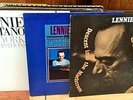
LP NEIL YOUNG Time Fades Away - Reprise 62857 CLUB-SONDERAUFLAGE - Mint-/ EX
€
60
$
68



Favourite Auctions
To save auctions to your favourites, please login
If you don't have an account, please register
Description
LP NEIL YOUNG
Time Fades Away
Club-Sonderauflage
Country of release: Germany, 197?
Original released: 1973
Label: Reprise
Catalogue number 62 857
Barcode: -
Klappcover/Gatefold Sleeve: Nein/No
Includes Lyricsheet (Poster)
Condition Record: Mint -
Condition Cover: Excellent
Lyricsheet (Poster): Mint -
Tracks Side 1:
1. Time Fades Away (5:36)
2. Journey Through The Past (3:19)
3. Yonder Stands The Sinner (3:17)
4. L.A. (3:11)
5. Love In Mind (2:02)
Tracks Side 2:
1. Don't Be Denied (5:18)
2. The Bridge (3:05)
3. Last Dance (8:45)
Listen At YouTube:
http://www.youtube.com/watch?v=NR0Q4JnYOJg
This album may do for Neil Young's declining image what Pat Garrett & Billy the Kid did for Dylan's. But like Dylan's much-maligned movie soundtrack LP, Time Fades Away has its virtues when taken on its own terms and not as the latest major work of a major artist. Here, Young seems to have consciously avoided the sober sense of importance that accompanied After the Gold Rush and Harvest by recording his new material live and rough. Mistakes and fluffs dot these performances, and Young has made no attempt to correct them. For whatever reason, he's made a startlingly unorthodox album.
If Time Fades Away isn't the standard big statement we've come to expect from such performers, neither is it the standard live album of the successful artist. There are no hits, no familiar tunes; for that matter, there's hardly any audience response — it's quickly faded out at each song's end. More than any of his earlier works, this record shows Young's reticence about being a public figure.
Young's privateness has always been at the heart of his writing and performing, right alongside his staunch moral sense. These two elements have been both his prime virtues and his main flaws. Both elements are evident in this new material, with uneven but sometimes positive results.
There is an overbearing sense of self-righteousness in the title song, with its images of nervous junkies strung out on the street. But it's saved by a sharply ironic chorus, in which the junkie's weak parent whines: "Son, don't be home too late/Try to get back by eight/Son, don't wait 'til the break of day/'Cause you know how time fades away...." The lyric is energized by hard, jerking instrumental work from the Stray Gators and by Young's jagged, piercing vocal: He's still the best whiner in rock & roll. And he expresses anguish like no one else.
Young's is a pain-dominated, rather Old Testament sensibility, and nowhere is all this more obvious than in "L.A." Young's self-righteousness becomes absolute, and he depicts himself as some neo-Israelite prophet warning the unhearing masses of the inevitable apocalypse. Young's blanket condemnations, "Southern Man" and "Alabama" included, are as simplistic as they are venomous, but their fire makes them compelling nonetheless. That "L.A." is reflectively sung while the two earlier songs sounded impetuous makes this one's content and tone that much more ugly.
It's hard to believe that the same person who conceived "L.A." could write and sing the delicate "Journey Through the Past," "The Bridge," and "Love In Mind." These are small-scope, understated songs, and they're performed convincingly by Young, with only his own simple piano.
The best song on the album is "Don't Be Denied," which continues the tone but expands the scope of his quiet, personal songs. It is a complete autobiography in four verses, and the most effective part deals with his childhood. In this section, Young cuts rapidly through scenes that depict the private trials of a rather delicate kid in a rugged land. This song seems an explicit re-expression of the emotional content of Young's moving but impenetrably private "Broken Arrow." The latter part of "Denied," in which Young deals with the problems of being a celebrity, forgoes universality for the writer's personal complaints but is no less credible for it. A lack of honesty in his work has never been one of Young's problems; if anything, he's gone too far in the other direction, saying what would have better been left unsaid and looking bigoted or just plain foolish in the process.
He comes off rather silly in "Last Dance," a long, ponderous song that sounds like Young's parody of his own After the Gold Rush hard-rock style. And he's out of control on "Yonder Stands the Sinner," which is self-deprecating in what seems to be a more intentional way. His voice breaks when he squeal-shouts the word, "sinner!," as if he were disclaiming the moralistic fury of "L.A."
If Young appears foolish and arrogant at various points on the album, he seems to be allowing us a glimpse of these flaws, rather than letting them slip through and spoil his big moments without his consent, as happened on Harvest. Time Fades Away is an idiosyncrasy from one of rock's most idiosyncratic artists. If it isn't a resounding success, the album is still a revealing self-portrait by an always fascinating man. (Bud Scoppa, January 3, 1974/rollingstone.com)
Neil Young - Guitar, Vocals, Harmonica, Piano
Ben Keith - Slide Guitar, Vocals
Tim Drummond - Bass
Johnny Barbata - Drums
Jack Nitzsche - Piano, Vocals
&
David Crosby - Guitar (Track 3), Vocals (Track 3, 8)
Graham Nash - Guitar, Vocals (Track 8)
Joe Yankee - Bass (Track 4)
Versand innerhalb Deutschland (versichert mit GLS - generell innerhalb von 24 Stunden) 5,00 Euro
Egal wieviele LPs gekauft werden, Versand immer 5,00 Euro. Keine weiteren Versandkosten ab der zweiten LP!!
Shipping within EEC & Oversea (REGISTERED AIRMAIL) 10,00 Euro
Weitere Infos oder Fotos? Bitte fragen
Need more infos or photos? Please ask
price rating