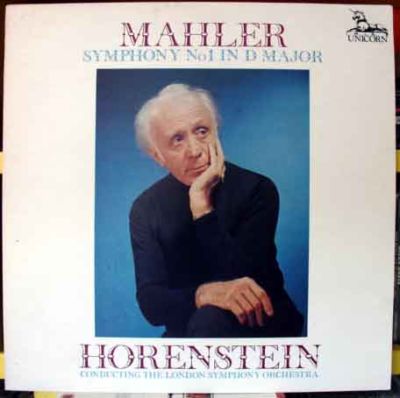
LP UNICORN RHS 301 MAHLER SYM 1 HORENSTEIN/LSO
£
29
$
38


Favourite Auctions
To save auctions to your favourites, please login
If you don't have an account, please register
Description
MY FEEDBACK WILL REASSURE YOU THAT I AM
AN HONEST AND TRUSTWORTHY SELLER
~~~~~~~~~~~~~~~~~
UNICORN RHS 301 (1969):
Symphony No.1
Royal Symphony Orchestra
conducted by
Jascha Horenstein
Phonogram/Philips cut and pressed
~~~~~~~~~~~~~
GRAMOPHONE COMPARATIVE REVIEW FROM 1969:
Almost any record collector must at times have cherished thoughts of casting particular singers in an opera, a particular instrumentalist in a concerto or a particular conductor in a symphony John Goldsmith of Unicorn must be one of the first enthusiasts outside the regular companies to get up and do something about such an idea. Earlier this year he promoted an excellent record of Jascha Horenstein in Nielsen's Fifth Symphony. He was determined that Horenstein—a formative influence during the early days of LP—should have a chance to display his art to the new stereo generation.
Not content with one ambitious project, he embarked on another, sponsoring this version of Mahler's First Symphony with the LSO. Having hired a conductor and orchestra of international status, he matched this with a comparable recording team—Harold Lawrence, now the LSO's general manager returning to his old skill as a recording manager, Deryck Cooke acting as musical adviser, and Bob Auger (whose fine work on the RCA Salome was rightly praised last November) as recording engineer.
In some ways this is a more daring project than the Nielsen, because very obviously there is the strongest competition on such a symphony as Mahler's First. But what Goldsmith rightly realised is that Horenstein's interpretation is unique, utterly distinct from those I have chosen to list above as the most pointful rivals. Obviously Solti and Kubelik provide a sharper, more direct experience, more exciting if you will, where Horenstein's qualities are more subtly persuasive. After his early Vox version I had rather expected him to be rather too straight and literal is his reading for my own Mahlerian taste, but except possibly in the last movement, that is not so. He generally avoids extremes of emotional expressiveness, but his pointing of detail prevents any feeling of squareness.
In the first movement for example his main tempo is very relaxed compared with
Kubelik's, but just as Barbirolli in the finale of the Fifth brings out the link with a Mahler song in his choice of tempo, so does Horenstein, for he evokes the relaxed world of the Wayfaring Lad song from which the main theme derives. Where Kubelik whips up the coda to a frenzy, Horenstein has one thinking of overtones not just of earlier Mahler but of Hansel and Gretel. Nor does the interpretation lack bite, for the LSO brass in particular are in splendid form, and I never remember before such excitement on the three horn trill just after fig. 29.
In the Ländler second movement Horenstein introduces a highly idiomatic little glissando when the violins take up the tune, where Mahler very deliberately avoids the usual staccato and puts a slur between the E and the A. Kubelik may be sharper, faster, brighter but Horenstein's merit lies in his warmth, his evocation of an easygoing lilting Austrian dance. In the trio Kubelik adopts a real Viennese style for what he treats as a waltz, where Horenstein is straighter, gentler with the lilt and the pointing of phrase. In the slow movement Horenstein is faster than I expected, but the minor key Frere Jacques remains relaxed, and at this tempo the music leads naturally into the Weill-like biting passage that Mahler marked "Mit parodie".
Here Horenstein captures a relaxed Viennese nostalgia, the music being parodied heard at one remove, not direct. As for the muted string passage at fig. 10, Horenstein makes it uniquely tender and delicate, where Kubelik keeps it fresh and folk-like.
A similar contrast comes in the finale with the big extended melody. Horenstein approaches it with a seductive and idiomatic glissando, and then adopts a consciously expressive style. He reminded me at this point very much of Barbirolli in his magnificent new version of the Fifth Symphony: tender expressiveness conveying inner intensity without any hint of the heart being worn on the sleeve. I was also reminded of Suitner's similarly delicate handling, but in fact Horenstein's performance is the more beautifully achieved.
Horenstein’s main tempo is much slower than Kubelik's or for that matter Suitner's and the manner a degree straighter than in the rest of the work. At first it seems a rather solid view of the finale but its firm emphatic quality has a cumulative effect. Horenstein sees this movement as a weighty, expansive conclusion, not just an exciting one.
I hope I have presented Horenstein's qualities fairly and clearly. The Kubelik performance in some ways makes a safer recommendation, but as with Barbirolli's Fifth one can readily argue that twentieth century forcefulness can easily be overplayed in Mahler.
Bob Auger's recording for Horenstein is very good indeed with plenty of separation and good inner clarity. The timpani is rather far forward, and the peaks entailed in its major outbursts have had something to do, I suspect, with the comparatively low level of the transfer. One needs to have plenty of gain on one's amplifier to get full immediacy in the many quieter passages. But on any count John Goldsmith has proved his point: it was imperative that Horenstein's authority as a Mahlerian should be presented with the help of modern stereo, and I am glad his enterprise has achieved it with such measure of success.
~~~~~~~~~~~~~~~~~~~~~~~~~
CONDITION:
Disc: This copy appears never to have been played.
No hairlines
No spindle marks.
No signs of handling.
No imperfections of any kind.
Just a deep velvety rainbow sheen only seen on an unplayed record.
Looks as if it was made yesterday!
Sleeve:
Slight hint of a cease to the upper right front corner
Dried adhesive residue in uper left front corner visible at certain angles.
Otherwise:
The sleeve looks and feels brand new.
Bright stiff new look to the sleeve which looks as if it was made last week!
The outer matt finish looks absolutely Brand New.
Spine perfect
Rear also looks brand new, fresh and clean.
No wear to any other edges.
Corners fine.
Overall superb condition.
~~~~~~~~~~
POSTAGE
(A NOTE ABOUT UK POSTAGE)
I use a strong purpose made mailing envelope to send LPs.
These cost about £0.40p each.
I remove the disc from its sleeve to avoid seam splits resulting from movement in the post.
I pack the disc in a poly liner and then insert two stiff cardboard squares to stiffen the package to avoid damage in the post.
The package now costs £2.51p to post within the UK.
Add in the 40p for the mailing envelope and you will see that 9 pence is left over for my time and a certain amount of parcel tape!
UK: £3
EU/SCANDINAVIA: £5
USA: £6
REST OF WORLD: £7
BEFORE YOU BUY PLEASE READ THIS:
PLEASE pay by PAYPAL
NON-UK buyers MUST pay by PAYPAL
I will accept cheques or postal orders from UK bidders.
I am unable to accept cash in any form (eBay rules).
THIS ITEM WILL BE SENT BY UK ROYAL MAIL
IT WILL BE WELL PACKED AND PROTECTED AGAINST THE POSSIBILITY OF DAMAGE IN TRANSIT.
I WILL SEND THIS ITEM ANYWHERE IN THE WORLD.
~~~~~~~~~~~~~~~~~~~~~~~~~~~~~~~
Payment should be made within 24 hours.
If this is not going to be possible for any reason, please let me know.......
I am very flexible as long as I know what's going on, so please contact me if there is any problem.
Please note that unlike some ebay users I do NOT expect my buyers to pay my PAYPAL or EBAY charges.
Not only is this against the spirit of the eBay "community" it is also forbidden by eBay's rules!
price rating