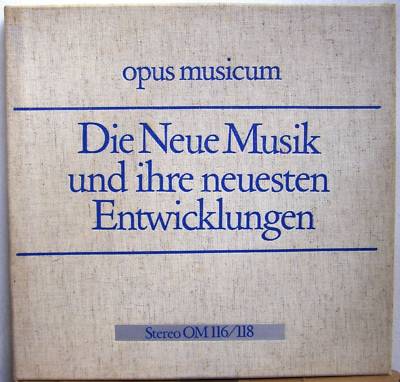
LUC FERRARI-JOHN CAGE-XENAKIS-STOCKHAUSEN 3-LP BOX RARE
$
105


Favourite Auctions
To save auctions to your favourites, please login
If you don't have an account, please register
Description
LUC FERRARI / KARLHEINZ STOCKHAUSEN / JOHN CAGE / MAURICIO KAGEL / EARLE BROWN / GYORGY LIGETI / IANNIS XENAKIS / LUCIANO BERIO / ETC.
DIE NEUE MUSIK UND IHRE NEUESTEN ENTWICKLUNGEN 3-LP BOXSET
Opus Musicum
Linen Box
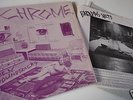
w/2 books
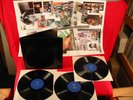
Mega rare deluxe linen triple LP boxset with 2 books featuring rare electronic & avant-garde compositions from the 60's from Luc Ferrari, Earle Brown, John Cage, Mauricio Kagel and the like.
Some info on the release: Extremely rare piece of "new music" history released sometime in the late 60's / early 70's by the german Opus Musicum label. Deluxe release coming inside beautiful linen boxset, accompanied by 2 books explaining everything about the records, the composers and compositions. Features rare pieces like Luc Ferrari's "Tete et Queue du dragon", John Cage's "Variations I", also compositions from Mauricio Kagel, Iannis Xenakis, Jens-Peter Ostendorf, Luciano Berio, Penderecki, Dieter Schnebel, Gyorgy Ligeti, Bernd Alois Zimmermann, Hans Werner Henze, Karlheinz Stockhausen, Pierre Boulez & Olivier Messiaen. Impossible to find, your only chance to get a pristine copy of this rarity.
Karlheinz Stockhausen (22 August 1928 – 5 December 2007) was a German composer, widely acknowledged by critics as one of the most important but also controversial composers of the twentieth and early twenty-first centuries. Another critic calls him "one of the great visionaries of 20th-century music" (Hewett 2007). He is known for his ground-breaking work in electronic music, aleatory (controlled chance) in serial composition, and musical spatialization. He was educated at the Hochschule für Musik Köln and the University of Cologne, and later studied with Olivier Messiaen in Paris, and with Werner Meyer-Eppler at the University of Bonn. One of the leading figures of the Darmstadt School, his compositions and theories were and remain widely influential, not only on composers of art music, but also on jazz and popular-music artists. His works, composed over a period of nearly sixty years, eschew traditional forms. In addition to electronic music—both with and without live performers—they range from miniatures for musical boxes through works for solo instruments, songs, chamber music, choral and orchestral music, to a cycle of seven full-length operas. Stockhausen met the Belgian composer Karel Goeyvaerts, who had just completed studies with Olivier Messiaen (analysis) and Darius Milhaud (composition) in Paris, and Stockhausen resolved to do likewise. He arrived in Paris on 8 January 1952 and began attending Messiaen's courses in aesthetics and analysis, as well as Milhaud's composition classes. He continued with Messiaen for a year, but was disappointed with Milhaud and abandoned his lessons after a few weeks. In March 1953, he left Paris to take up a position as assistant to Herbert Eimert at the newly established Electronic Music Studio of Nordwestdeutscher Rundfunk (NWDR) (from 1 January 1955, Westdeutscher Rundfunk, or WDR) in Cologne (Kurtz 1992, 56–57). In 1962, he would succeeded Eimert as director of the studio (Morawska-Büngeler 1988, 19). From 1954 to 1956, he studied phonetics, acoustics, and information theory with Werner Meyer-Eppler at the University of Bonn (Kurtz 1992, 68–72). Together with Eimert, Stockhausen edited the influential journal Die Reihe from 1955 to 1962. Stockhausen's two early Electronic Studies (especially the second) had a powerful influence on the subsequent development of electronic music in the 1950s and 1960s, particularly in the work of the Italian Franco Evangelisti and the Poles Andrzej Dobrowolski and W?odzimierz Koto?ski. French composer Jean-Claude Éloy regards Stockhausen as the most important composer of the second half of the twentieth century, and cites virtually "all his catalog of works" as "a powerful discoveration, and a true revelation". Dutch composer Louis Andriessen acknowledged the influence of Stockhausen's Momente in his pivotal work Contra tempus of 1968. German composer Wolfgang Rihm, who studied with Stockhausen, was influenced by Momente, Hymnen, and Inori. Jazz musicians such as Miles Davis, Cecil Taylor, Charles Mingus, Herbie Hancock, Yusef Lateef, and Anthony Braxton cite Stockhausen as an influence. Stockhausen was influential within pop and rock music as well. Frank Zappa acknowledges Stockhausen in the liner notes of Freak Out!, his 1966 debut with the Mothers of Invention. Rick Wright and Roger Waters of Pink Floyd also acknowledge Stockhausen as an influence. San Francisco psychedelic groups Jefferson Airplane and the Grateful Dead are vaguely said to have done the same, though Stockhausen himself merely says the former band included students of Luciano Berio and both were "well orientated toward new music". Founding members of Cologne-based experimental band Can, Irmin Schmidt and Holger Czukay, state they studied with Stockhausen, and this is confirmed to have been from 1963 to 1966 at the Cologne Courses for New Music. German electronic pioneers Kraftwerk also say they studied with Stockhausen, and Icelandic vocalist Björk has acknowledged Stockhausen's influence. He's also mentioned in the Nurse with wound list of influences.
Iannis Xenakis (May 29, 1922 – February 4, 2001) was a Greek composer, music theorist and architect. He is commonly recognized as one of the most important post-war avant-garde composers. Xenakis pioneered the use of mathematical models such as applications of set theory, varied use of stochastic processes, game theory, etc., in music, and was also an important influence on the development of electronic music.
Among his most important works are Metastaseis (1953–4) for orchestra, which introduced independent parts for every musician of the orchestra; percussion works such as Psappha (1975) and Pléïades (1979); compositions that introduced spatialization by dispersing musicians among the audience, such as Terretektorh (1966); electronic works created using Xenakis' UPIC system; and the massive multimedia performances Xenakis called polytopes. Among the numerous theoretical writings he authored, the book Formalized Music: Thought and Mathematics in Composition (1971) is regarded as one of his most important. As an architect, Xenakis is primarily known for his early work under Le Corbusier: the Sainte Marie de La Tourette, on which the two architects collaborated, and the Philips Pavilion at Expo 58, which Xenakis designed alone.
Xenakis pioneered electronic, computer music, the application of mathematics, statistics, and physics to music and music theory, and the integration of sound and architecture. He used techniques related to probability theory, stochastic processes, statistics, statistical mechanics, group theory, game theory, set theory, and other branches of mathematics and physics in his compositions. He integrated music with architecture, designing music for pre-existing spaces, and designing spaces to be integrated with specific music compositions and performances. He integrated both with political commentary. He viewed compositions as reification and formal structures of abstract ideas, not as ends, to be later incorporated into families of compositions, "a form of composition which is not the object in itself, but an idea in itself, that is to say, the beginnings of a family of compositions." Specific examples of mathematics, statistics, and physics applied to music composition are the use of the statistical mechanics of gases in Pithoprakta, statistical distribution of points on a plane in Diamorphoses, minimal constraints in Achorripsis, the normal distribution in ST/10 and Atrées, Markov chains in Analogiques, game theory in Duel and Stratégie, group theory in Nomos Alpha, set theory in Herma and Eonta, and Brownian motion in N'Shima. Xenakis was a contemporary with fellow greek composers Anestis Logothetis, Jani Christou and Kyriakos Sfetsas and was creating in a time that flourished the various sound experiments of Pierre Schaeffer & Pierre Henry, Henk Badings and of course Luciano Berio, Luigi Nono, Giacinto Scelsi, Alvin Curran and Toshi Ichiyanagi. At the Shirah Arts Festival in Persepolis, he designed Polytope as a composition specific to the historic site. The following year he was commissioned by the brutal dictator, the Shah of Iran, to compose Nuits, which Xenakis dedicated to political prisoners in protest at the Shah’s atrocities. Composers who have acknowledged being influenced by Xenakis include Krzysztof Penderecki and Toru Takemitsu. On the Nurse with wound list of influences.
Condition: Vinyls, box and books lie in mint- condition. A really pristine copy, very well preserved, vinyls super clean, a real keeper's copy.
Tracklist
A Karlheinz Stockhausen - Gruppen Für 3 Orchester Conductor - Bruno Maderna, Karlheinz Stockhausen, Michael GielenOrchestra - Kölner Rundfunk Sinfonieorchester B1 Olivier Messiaen - Mode De Valeurs Et D'Intensités Piano - Yvonne Loriod B2 Pierre Boulez - Improvisation Sur Mallarmé II Aus "Pli Selon Pli" Conductor - Pierre Boulez
Guitar - Paul Stingl
Mandolin - Hugo d'Alton
Orchestra - BBC Symphony Orchestra
Piano - Maria Bergman
Soprano Vocals - Halina Lukomska Présence - Ballet Blanc En 5 Scènes B3 Bernd Alois Zimmermann - Présence II Cello - Siegfried Palm
Piano - Aloys Kontarsky
Violin - Sascha Gawriloff B4 Bernd Alois Zimmermann - Présence III Cello - Siegfried Palm
Piano - Aloys Kontarsky
Violin - Sascha Gawriloff - - C Mauricio Kagel - Répertoire Aus Staatstheather Ensemble - Mitglieder Des Philharmonischen Staatsorchesters Hamburg Schlagzeugensemble D1 Hans Werner Henze - El Cimarrón, Nr. IV Die Flucht Und Nr. XV Das Messer Baritone Vocals - William Pearson
Flute - Karlheinz Zöller
Guitar - Leo Brouwer
Percussion - Stomu Yamash'ta D2 Dieter Schnebel - Für Stimmen (Missa Est) Nr. 3 (Madrasha II) Chorus - Schola Cantorum Stuttgart
Chorus Leader - Clytus Gottwald D3 György Ligeti - Lux Aeterna Chorus - Chor Des Norddeutschen Rundfunks Hamburg
Chorus Leader - Helmut Franz D4 Krzysztof Penderecki - Polymorphia Für 48 Streichinstrumente Conductor - Henryk Czyz
Orchestra - Orchester Der Krakauer Philharmonie E1 György Ligeti - Continuum Für Cembalo Solo Harpsichord - Elisabeth Chojnacka E2 John Cage - Variations I Organ - Zsigmond Szathmáry E3 Earle Brown - Streichquartett (1965) Ensemble - LaSalle-Quartett E4 Luciano Berio - Sequenza V Für Posaune Solo Trombone - Vinko Globokar F1 Jens-Peter Ostendorf - Multiphonia Für Flöte Solo Flute - Beate-Gabriela Schmitt F2 Iannis Xenakis - Orient-Occident Producer [Realisation] - Pierre Henry F3 Luc Ferrari - Tête Et Queue Du Dragon
SHIPPING & PAYMENT
Shipping: Shipping for this triple LP boxset with 2 books is 16.50$ airmail in Europe / 23$ for the rest of the world
Registered mail: +5$
Insurance: optional
Combined shipping: BIG discounts
Payment: Paypal
Packaging: I am a collector too and i know