Led Zeppelin ? Houses of the Holy ? RARE 1973 Monarch Robert Ludwig Hot Mix LP????
$
20


Favourite Auctions
To save auctions to your favourites, please login
If you don't have an account, please register
Description
Welcome to Classic Cadillac Records! My goal is to provide each and every customer with the best possible buying experience, no matter the size of the order. Unlike most sellers, I advertise all my items clearly and in as much detail as possible, without shouting at you in all caps. I take multiple high quality pictures and never use stock photos, so you know exactly what you?re buying. I take great pride in my work and go the extra mile, which can clearly be seen in my listings compared to other sellers that put minimal effort into theirs. I visually grade all my records as accurately as possible and will never grade anything above Near Mint unless it?s still sealed. Please note that a visual grade can differ from a play grade, and am happy to spot check a record upon request. All orders are shipped within 1 business day (usually sooner) and packed with extra care to ensure fast, safe arrival. I combine shipping on multiple orders to save you money and gladly ship worldwide. Please look closely at all pictures, read all relevant details and ask any questions you may have before buying. I offer a full 30-day return policy on everything I sell, so buy with confidence! And most importantly, thanks for looking!
Houses of the Holy Studio album by Led Zeppelin Released 28 March 1973 Recorded December 1971 – August 1972 Studio
- Rolling Stones Mobile Studio, Stargroves and Headley Grange;
- Island Studios, London
- Hard rock
- heavy metal
(1971) Houses of the Holy
(1973) Physical Graffiti
(1975) Singles from Houses of the Holy
- "Over the Hills and Far Away/Dancing Days"
Released: 24 May 1973 - "D'yer Mak'er/The Crunge"
Released: 17 September 1973
Houses of the Holy is the fifth studio album by the English rock band Led Zeppelin, released on 28 March 1973 by Atlantic Records. It is their first album composed of entirely original material and it represents a turning point in musical direction for the band, who had begun to record songs with more layering and production techniques.
Containing some of the band's most famous songs, including "The Song Remains the Same", "The Rain Song", and "No Quarter", Houses of the Holy became a commercial success, and was later certified 11x platinum by the Recording Industry Association of America (RIAA) in 1999. In 2012, the album was ranked at #148 on Rolling Stone magazine's list of the 500 greatest albums of all time. The title track was originally recorded for the album, but was delayed until the release of band's next album Physical Graffiti in 1975.
Recording sessions
Much of the album was recorded in Spring 1972 using the Rolling Stones Mobile Studio at Stargroves, a manor house and country estate in Hampshire county, England. Some songs from the album had initially been tried out earlier than this, such as "No Quarter", which was first attempted during a session at Headley Grange Estate, in East Hampshire.
Several of the songs were produced as trial recordings (demos) at the personal studios of guitarist Jimmy Page and bass player/keyboardist John Paul Jones. Having recently installed these studios in their homes, it enabled them to finish the arrangements which had been laid down earlier. In particular, Page was able to present complete arrangements of "The Rain Song" and "Over the Hills and Far Away", while Jones had developed "No Quarter".
Another bout of recording took place at Olympic Studios in May 1972, and during the band's 1972 North American tour additional recording sessions were conducted at Electric Lady Studios in New York.
Some songs which were recorded from these various sessions did not make it onto Houses of the Holy, namely "Black Country Woman", "Walter's Walk", "The Rover", and also the would-be title-track, "Houses of the Holy". All of these songs were retained and later released on subsequent Led Zeppelin albums.
Composition
This album was a stylistic turning point in the lifespan of Led Zeppelin. Guitar riffs became more layered within Page's production techniques and departed from the blues influences of earlier records. In the album's opening opus, "The Song Remains the Same", and its intricate companion suite, "The Rain Song", Robert Plant's lyrics matured toward a less overt form of the mysticism and fantasy of previous efforts. Houses of the Holy also featured styles not heard on the first four Led Zeppelin albums. For example, "D'yer Mak'er" is a reggae-based tune (the name of the song being derived from the phonetic spelling of a British pronunciation of "Jamaica"); "No Quarter" features atmospheric keyboard sounds and an acoustic piano solo from Jones; "The Crunge" is a funk tribute; and "The Rain Song" is embellished by Jones on his newly acquired Mellotron. The album's closing song "The Ocean", which features an a cappella section and a doo-wop influenced coda, is dedicated to "the ocean" of fans who were massing to Led Zeppelin concerts at this point of the band's career. Subsequently, one view is that the title "Houses of the Holy" refers to the massive venues they played full of their adoring fans. However, when Page was asked about the significance of the title in a Sirius XM interview in New York City 7 Nov. 2014, he responded, “It’s about all of us being houses of the Holy Spirit, in a sense.”
According to Led Zeppelin archivist Dave Lewis:
In retrospect, 'Houses of the Holy' holds its ground with the middle period releases quite admirably. The barnstorming effect of the early era was now levelling off and though devoid of the electricity of 'Led Zeppelin I' and 'II', or the sheer diversity of the third album, and lacking the classic status of the fourth, 'Houses' took stock of their situation. In doing so, it laid several foundations on which they would expand their future collective musical aspirations.
Album sleeve design
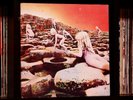
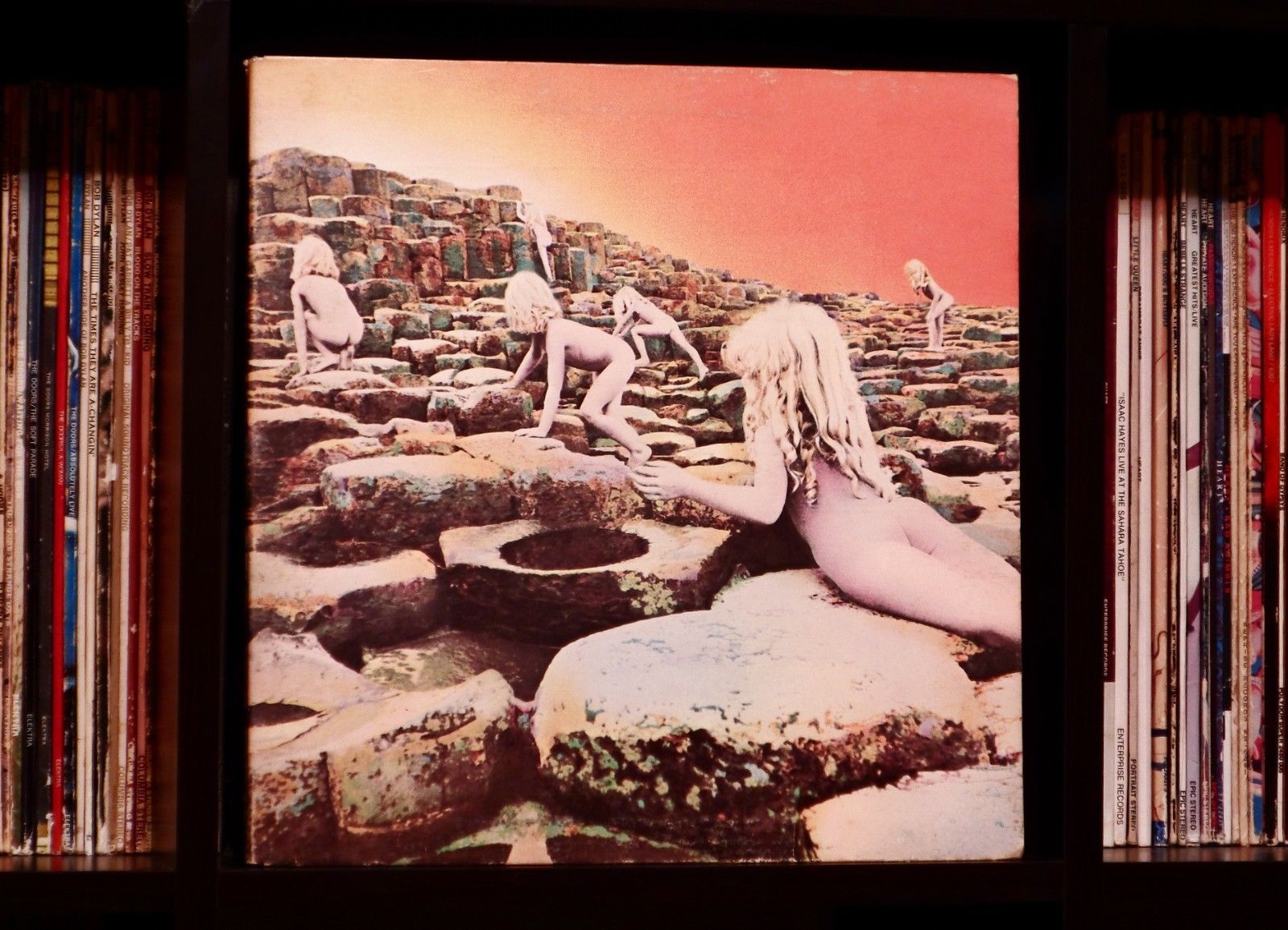
The cover art for Houses of the Holy was inspired by the ending of Arthur C. Clarke's novel Childhood's End. The cover is a collage of several photographs which were taken at the Giant's Causeway, Northern Ireland, by Aubrey Powell of Hipgnosis. This location was chosen ahead of an alternative one in Peru which was being considered.
The two children who modelled for the cover were siblings Stefan and Samantha Gates. The photo shoot was a frustrating affair over the course of ten days. Shooting was done first thing in the morning and at sunset in order to capture the light at dawn and dusk, but the desired effect was never achieved due to constant rain and clouds. The photos of the two children were taken in black and white and were multi-printed to create the effect of 11 individuals that can be seen on the album cover. The results of the shoot were less than satisfactory, but some accidental tinting effects in post-production created an unexpectedly striking album cover. The inner sleeve photograph was taken at Dunluce Castle nearby the Causeway.
In February 2010, Stefan Gates presented a half-hour BBC Radio 4 documentary entitled Stefan Gates's Cover Story, about his part in the making of the album cover. Gates claimed in the documentary to have felt there was something sinister about the image, although his sister disagreed. He also admitted never having heard the album. The programme ended with Gates returning to Giant's Causeway and listening to the album on a portable player, after which he claimed that a great weight had been lifted from him.
Like Led Zeppelin's fourth album, neither the band's name nor the album title was printed on the sleeve. However, manager Peter Grant did allow Atlantic Records to add a wrap-around paper title band to US and UK copies of the sleeve that had to be broken or slid off to access the record. This hid the children's buttocks from general display, but still the album was either banned or unavailable in some parts of the Southern United States for several years.
In 1974, the album was nominated for a Grammy Award in the category of best album package. The cover was rated #6 on VH1's 50 Greatest Album Covers in 2003.
Page has stated that the album cover was the second version submitted by Hipgnosis. The first, by artist Storm Thorgerson, featured an electric green tennis court with a tennis racket on it. Furious that Thorgerson was implying their music sounded like a "racket", the band fired him and hired Powell in his place. Thorgerson did, however, go on to produce the album artwork for Led Zeppelin's subsequent albums Presenceand In Through the Out Door.
Release and critical reaction
Professional ratings Aggregate scores Source Rating Metacritic 98/100 Review scores Source Rating AllMusic Robert Christgau A– Classic Rock 9/10 The Daily Telegraph Entertainment Weekly A Mojo MusicHound 4/5 Pitchfork Media 9.3/10 Rolling Stone (1973) (unfavourable) Rolling Stone (2003) Virgin Encyclopedia of Popular MusicThis was Led Zeppelin's final studio release on Atlantic Records before forming their own label, Swan Song Records, in 1974. It was also the only Led Zeppelin album that contained complete printed lyrics for each song.
The epic scale suited Zeppelin: They had the largest crowds, the loudest rock songs, the most groupies, the fullest manes of hair. Eventually excess would turn into bombast, but on Houses, it still provided inspiration.
—Gavin Edwards, Rolling StoneAlthough intended for release in January 1973, delays in producing the album cover meant that it was not released until March, when the band was on its 1973 European tour. The album was promoted heavily before the commencement of Led Zeppelin's subsequent North American Tour, ensuring that it had ascended the top of the American chart by the beginning of the tour. Because much of the album had been recorded almost a year previously, many of the songs which are featured on the album had already been played live by Led Zeppelin on their concert tours of North America, Japan, Europe and the UK in 1972–73.
Upon its release, the album received some mixed reviews, with much criticism from the music press being directed at the off-beat nature of tracks such as "The Crunge" and "D'yer Mak'er". However, the album was very successful commercially, entering the UK chart at number one, while in America its 39-week run (two of them spent at #1) on the Billboard Top 40 was their longest since their third album.
In 2012, the album was ranked #148 on Rolling Stone's 500 Greatest Albums of All Time.
Accolades
Publication Country Accolade Year Rank The Book of Rock Lists United States "The Top 40 Albums (1973)" 1981 13 Grammy Award United States "Grammy Award for Best Recording Package" 1974 Nominee Classic Rock United Kingdom "100 Greatest British Rock Album Ever" 2006 90 Rock and Roll Hall of Fame United States "The Definitive 200: Top 200 Albums of All-Time" 2007 51 Rolling Stone United States "The 500 Greatest Albums of All Time" 2012 148 Pitchfork Media United States "Top 100 Albums of the 1970s" 2004 75(*) designates unordered lists.
Track listing
Standard edition
Side one No. Title Writer(s) Length 1. "The Song Remains the Same"- Jimmy Page
- Robert Plant
- Page
- Plant
- Page
- Plant
- John Bonham
- John Paul Jones
- Page
- Plant
- Page
- Plant
- Bonham
- Jones
- Page
- Plant
- Jones
- Page
- Plant
- Bonham
- Jones
- Page
- Plant
price rating