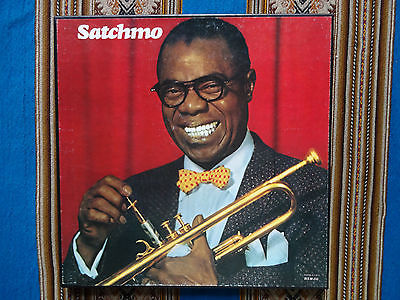
Louis Armstrong - Satchmo 1972 Original 4 LP Box Set Book Decca play EX++ to M-
$
32


Favourite Auctions
To save auctions to your favourites, please login
If you don't have an account, please register
Description
Louis Armstrong
Satchmo
1972 Original 1st pressing.
4 LP Box Set
Decca Records
Vinyl are EX++ to Mint-
Vinyl look EX++ to Mint-, mostly Mint- : a few, faint, light, inaudible ghost-marks on a few sides.
Vinyl play EX++ to Mint- : light background faint-crackle in some quiet passages.
Labels are EX++ to Mint-, mostly Mint- with a few, slight, minor imperfections.
Box is EX to EX+ : intact corner and edges; various, minor imperfections.
Book is EX++ to Mint-.
The 4 Original inner-sleeves have intact seams.
Includes HQ inner-sleeves (pictured) which the vinyl are stored in after being thoroughly machine-cleaned and professionally graded.
Out of print original set ~
"Louis Armstrong was the first important soloist to emerge in jazz, and he became the most influential musician in the music's history. As a trumpet virtuoso, his playing, beginning with the 1920s studio recordings made with his Hot Five and Hot Seven ensembles, charted a future for jazz in highly imaginative, emotionally charged improvisation. For this, he is revered by jazz fans. But Armstrong also became an enduring figure in popular music, due to his distinctively phrased bass singing and engaging personality, which were on display in a series of vocal recordings and film roles.
Armstrong had a difficult childhood. William Armstrong, his father, was a factory worker who abandoned the family soon after the boy's birth. Armstrong was brought up by his mother, Mary (Albert) Armstrong, and his maternal grandmother. He showed an early interest in music, and a junk dealer for whom he worked as a grade-school student helped him buy a cornet, which he taught himself to play. He dropped out of school at 11 to join an informal group, but on December 31, 1912, he fired a gun during a New Year's Eve celebration, for which he was sent to reform school. He studied music there and played cornet and bugle in the school band, eventually becoming its leader. He was released on June 16, 1914, and did manual labor while trying to establish himself as a musician. He was taken under the wing of cornetist Joe "King" Oliver, and when Oliver moved to Chicago in June 1918, he replaced him in the Kid Ory Band."...-allmusic
Note : there is some possible camera-glare on the cover and other surfaces.
Packaged protectively for safe and secure shipping with USPS tracking.
Thank you ~ All the Best
price rating