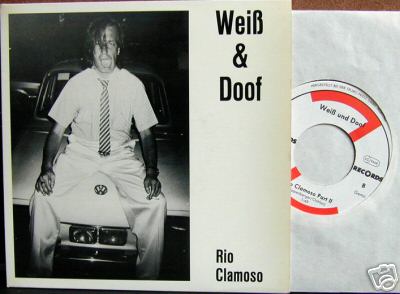
MARTIN KIPPENBERGER rare 7" vinyl record Weiß & Doof
€
113
$
131


€ 113
Sold For
Apr 16, 2006
Sold Date
Apr 6, 2006
Start Date
14
Number Of Bids
Germany
Country Of Seller
eBay
Auctioned at
Favourite Auctions
To save auctions to your favourites, please login
If you don't have an account, please register
Description
Artists
Weiß & Doof are Martin Kippenberger and Albert Oehlen
TitleRio Clamoso Pt. 1 and 2
LabelZ-Records, 66.11757-01
Format7", black vinyl, black and white glossy sleeve
ConditionMint, the record, comes from a collection who's owner hardly ever played the records
iBroken Music, page 158
Biographie
Martin Kippenberger (* 25. Februar 1953 in Dortmund; † 7. März 1997 in Wien) war ein deutscher Maler, Installationskünstler, Performancekünstler, Bildhauer und Fotograf.
1972 bis 1976 studierte er an der Hochschule für bildende Künste in Hamburg. Danach zog er nach Florenz um. 1977 macht er Bekanntschaft mit Werner Büttner, Albert und Markus Oehlen. 1978 folgte daher der Umzug nach Berlin, 1980 der Umzug nach Paris. 1984 trat er in die Lord Jim Loge - „Keiner hilft keinem" ein. 1988 nahm er an der Biennale in Venedig, 1992 gab er Unterricht an der Hochschule in Kassel. 1996 erhielt er den Käthe-Kollwitz-Preis. 1997 an der Documenta X in Kassel und an der Ausstellung Skulptur.Projekte in Münster teil. Kippenberger will durch seine provokanten und ironischen, teils auch absurden Installationen und Bilder neue Blickwinkel eröffnen.Tate Modern eröffnete am 8. Februar 2006 die erste umfassende Retrospektive von Martin Kippenbergers Werk in Großbritannien. Bis 14. Mai kann eine Auswahl des überaus produktiven Schaffens Kippenbergers im Londoner Museum besichtigt werden, darunter Selbstportraits aus 1988 oder zahlreiche Zeichnungen aus der Hotelbriefpapierserie. http://www.tate.org.uk/modern/exhibitions/kippenberger/(Quelle: wikipedia.de)
About Martin Kippenberger and his artText written by Patricia Ellis
Joseph Beuys said: “Everyone – each person – is an artist.”Martin Kippenberger said: “Every artist is a person.”
As one of the most prodigious artists of the 1980s and 90s, Martin Kippenberger epitomised the romantic notion of the artist in the late 20th century. Inventing himself as the centre of the art world, Martin Kippenberger’s practice was based on shameless self-promotion. Mythologizing himself as an Everyman-hero, Kippenberger's vast body of work is a testament to a larger-than-life character, a tragic-comic paladin, plagued as much by his own talent and success as by his ego and shortcomings.Martin Kippenberger always knew he’d be a something: deciding on a career as an artist only after failed stints as a novelist, actor, musician, and nightclub owner. This spirit of democracy – of inflicting himself creatively on the world in whatever form – is omnipresent throughout Kippenberger’s work. Bolstered by an unwavering self-belief that his every contribution was a masterpiece, Martin Kippenberger approached art with a sort of ‘free for all’ naivety, stripping away art’s glamour and hierarchy to expose its absurd dysfunctionality at every level.
Martin Kippenberger’s career has transformed into an almost cult-like legend, existing as much in lore-ish tradition as in the actual physical works. He’s the guy who bought a run-down gas station in Brazil and named it after a Nazi war criminal. He built an imaginary global subway system with real entrances installed in the Yukon, Leipzig, and a remote field in Greece (and working air vents at various points in between). He opened The Museum of Modern Art in an unused abattoir in Syros (MOMAS). He bought a Gerhard Richter painting to use as a coffee table. For Kippenberger, art wasn’t about disrespect: it was about what he could get away with.Painting figures highly in Martin Kippenberger’s work. Consciously aware of its power of legitimisation, Kippenberger made paintings ceaselessly throughout his career. As a painter, Martin Kippenberger was almost a prodigal talent: refusing to be identified by a ‘style’, each of his canvases demonstrates an immense understanding and control of representation, composition and gesture. Subjects as eclectic as his multi-facetted practice are often taken from the mundane and everyday. His favourite café in Berlin, the Chevrolet Capri, and abstract paintings constructed of beach towels all serve to underscore the idea of an art for all: democratic, easy and as infinitely limitless and valued as the most cultured treasure.
"People come along [in twenty years or so] and can say what the work and the artist were really all about. What people will say about me then -- or maybe not say -- will be the only thing that finally counts. Whether or not I contributed to spreading a good mood. What I'm working on is for people to be able to say that Kippenberger had this really good mood." - Martin Kippenberger, 1990. (Source: saatchi-gallery.co.uk/artists/martin_kippenberger_info.htm)price rating