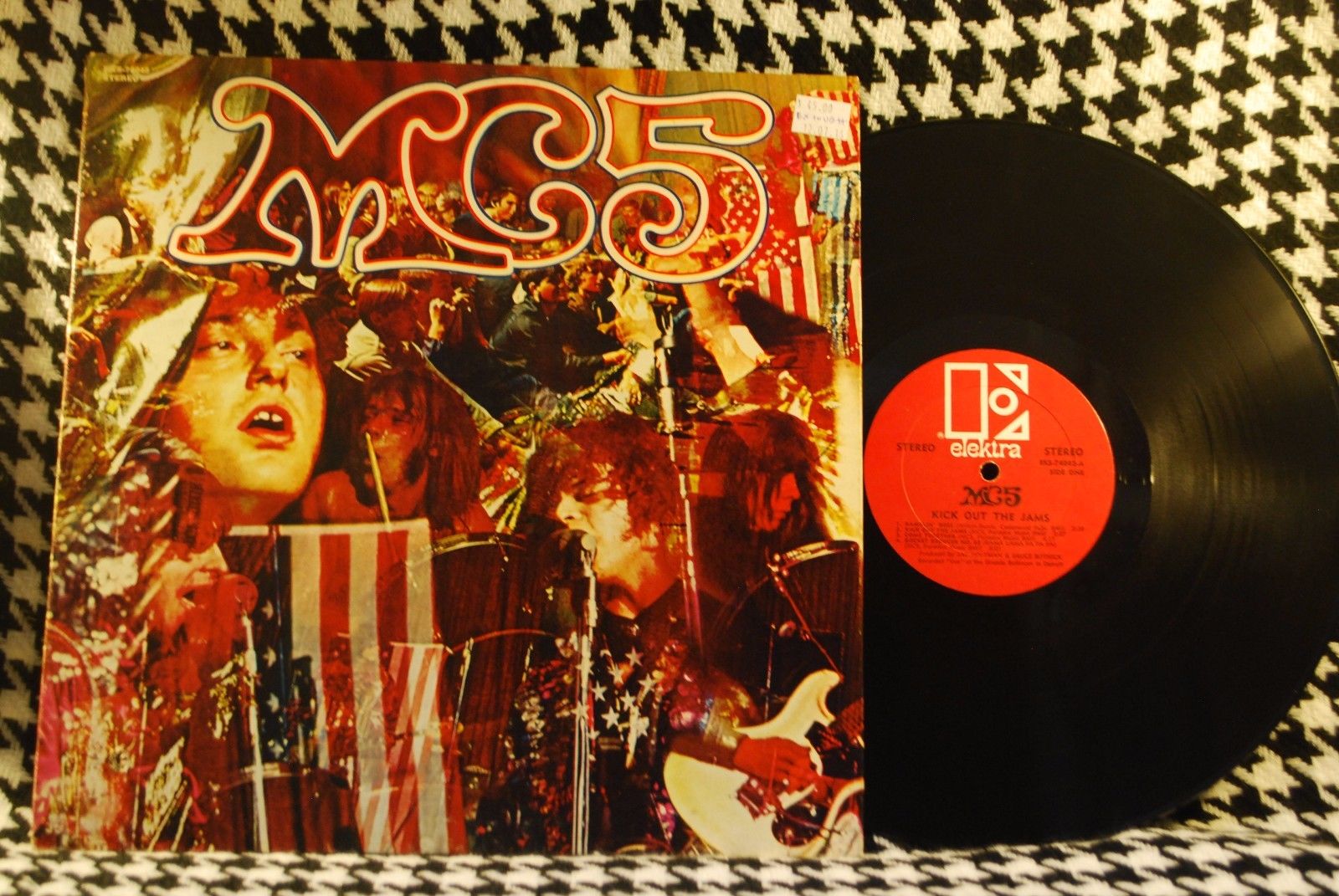
MC5 -" Kick Out The Jams"- Elektra EKS-74042- 1968- EX Copy
$
37


Favourite Auctions
To save auctions to your favourites, please login
If you don't have an account, please register
Description
ALL RECORDS ONLY VISUAL GRADES WE HAVE MORE VINYL AND OTHER STUFF YOU MIGHT LIKE IF YOUR LOOKING AT THIS. CLICK ON THE STORE TO SEE MORE. COMBINED SHIPPING AVAILABLE THANKS FOR LOOKING AND FEEL FREE TO CONTACT ME WITH ANY ?'S
ALL USA ORDERS WILL BE SENT VIA MEDIA MAIL. ALL USA ORDERS WILL INCLUDE DELIVERY CONFIRMATION AND ONLINE TRACKING FOR YOUR CONVENIENCE . __________________________________________________________________________________ Here is some wiki artist info for you!!!!!!!!!!!!!!!!!!!!!!!!!!!!!!!!!!!!
MC5
From Wikipedia, the free encyclopedia MC5 MC5 in 2005. Left to right: Wayne Kramer, Handsome Dick Manitoba, Dennis Thompson, Michael Davis and Gilby Clarke. Background information Also known as Bounty Hunters Origin Detroit, Michigan, United States Genres- Rock[1]
- garage rock[2]
- protopunk[3]
- blues rock[4]
- Elektra
- Atlantic
- Rhino
- Destroy All Monsters
- Sonic's Rendezvous Band
- The New Order
- New Race
MC5 was an American rock band from Lincoln Park, Michigan, formed in 1964. The original band line-up consisted of vocalist Rob Tyner, guitarists Wayne Kramer and Fred "Sonic" Smith, bassist Michael Davis, and drummer Dennis Thompson. "Crystallizing the counterculture movement at its most volatile and threatening",[1] according to AllMusic critic Stephen Thomas Erlewine, the MC5's far left political ties and anti-establishment lyrics and music positioned them as emerging innovators of the punk movement in the United States. Their loud, energetic style of back-to-basics rock and roll included elements of garage rock, hard rock, blues rock, and psychedelic rock.
MC5 had a promising beginning which earned them a January 1969 cover appearance in Rolling Stone and a story written by Eric Ehrmann before their debut album was released.[5] They developed a reputation for energetic and polemical live performances, one of which was recorded as their 1969 debut album Kick Out the Jams. Their initial run was short-lived, though. In 1972, just three years after their debut record, the band came to an end. MC5 was often cited as one of the most important American hard rock groups of their era.[6] Their three albums are regarded by many as classics, and their song "Kick Out the Jams" is widely covered.
Tyner died of a heart attack in late 1991 at the age of 46. Smith also died of a heart attack, in 1994 at the age of 45. The remaining three members of the band reformed in 2003 with The Dictators' singer Handsome Dick Manitoba as its new vocalist, and this reformed line-up occasionally performed live over the next nine years until Davis died of liver failure in February 2012 at the age of 68.
Contents
[hide]- 1First incarnation
- 1.1Early years
- 1.2Success in Detroit
- 1.3Radical political affiliations
- 1.4Recordings
- 1.4.1Kick Out the Jams
- 1.4.2Back in the USA
- 1.4.3High Time
- 1.5Record label controversy
- 1.6Late career and disbandment
- 1.7Post-break up
- 2Second incarnation
- 2.1First reunions
- 2.2Reformation
- 3Covers and tributes
- 4Personnel
- 4.1Members
- 4.2Timeline
- 5Discography
- 6Filmography
- 7See also
- 8References
- 9Further reading
- 10External links
First incarnation[edit]
Early years[edit]
The origins of MC5 can be traced to the friendship between guitarists Wayne Kramer and Fred Smith. Friends since their teen years, they were both fans of R&B music, blues, Chuck Berry, Dick Dale, The Ventures, and what would later be called garage rock: they adored any music with speed, energy and a rebellious attitude. Each guitarist/singer formed and led a rock group (Smith's Vibratones and Kramer's Bounty Hunters). As members of both groups left for college or straight jobs, the most committed members eventually united (under Kramer's leadership and the "Bounty Hunters" name) with Billy Vargo on guitar and Leo LeDuc on drums (at this point Smith played bass),[7] and were popular and successful enough in and around Detroit that the musicians were able to quit their day jobs and make a living from the group.
Kramer felt they needed a manager, which led him to Rob Derminer, a few years older than the others, and deeply involved in Detroit's hipster and left-wing political scenes. Derminer originally auditioned as a bass guitarist (a role which he held briefly in 1964, with Smith switching to guitar to replace Vargo and with Bob Gaspar replacing LeDuc), though they quickly realized that his talents could be better used as a lead singer: Though not conventionally attractive and rather paunchy by traditional frontman standards, he nonetheless had a commanding stage presence, and a booming baritone voice that evidenced his abiding love of American soul and gospel music. Derminer renamed himself Rob Tyner (after Coltrane's pianist McCoy Tyner). Tyner also invented their new name, MC5: it reflected their Detroit roots (it was short for "Motor City Five'). In some ways the group was similar to other garage bands of the period, composing soon-to-be historic workouts such as "Black to Comm" during their mid-teens in the basement of the home of Kramer's mother. Upon Tyner's switch from bassist to vocalist, he was initially replaced by Patrick Burrows, however the lineup was stabilised in 1965 by the arrival of Michael Davis and Dennis Thompson to replace Burrows and Gaspar respectively.
The music also reflected Smith and Kramer's increasing interest in free jazz—the guitarists were inspired by the likes of Albert Ayler, Archie Shepp, Sun Ra and late period John Coltrane, and tried to imitate the ecstatic sounds of the squealing, high-pitched saxophonists they adored.[8] MC5 even later opened for a few U.S. midwest shows for Sun Ra, whose influence is obvious in "Starship". Kramer and Smith were also deeply inspired by Sonny Sharrock, one of the few electric guitarists working in free jazz, and they eventually developed a unique interlocking style that was like little heard before: Kramer's solos often used a heavy, irregular vibrato, while Smith's rhythms contained an uncommon explosive energy, including patterns that conveyed great excitement, as evidenced in "Black to Comm" and many other songs.[citation needed]
Success in Detroit[edit]
Playing almost nightly any place they could in and around Detroit, MC5 quickly earned a reputation for their high-energy live performances and had a sizeable local following, regularly drawing sellout audiences of 1000 or more. Contemporary rock writer Robert Bixby stated that the sound of MC5 was like "a catastrophic force of nature the band was barely able to control", while Don McLeese notes that fans compared the aftermath of an MC5 performance to the delirious exhaustion experienced after "a street rumble or an orgy". (McLeese, 57)
Having released a cover of Them's "I Can Only Give You Everything" backed with original composition "One of the Guys" on the tiny AMG label over a year earlier, in early 1968 their second single was released by Trans-Love Energies on A-Square records (though without the knowledge of that label's owner Jeep Holland). Housed in a striking picture sleeve, it comprised two original songs: "Borderline" and "Looking at You". The first pressing sold out in a few weeks, and by year's end it had gone through more pressings totaling several thousand copies. A third single that coupled "I Can Only Give You Everything" with the original "I Just Don't Know" appeared at about the same time on the AMG label, as well.
That summer MC5 toured the U.S. east coast, which generated an enormous response, with the group often overshadowing the more famous acts they opened up for: McLeese writes that when opening for Big Brother and the Holding Company audiences regularly demanded multiple encores of MC5, and at a memorable series of concerts, Cream — one of the leading hard rock groups of the era — "left the stage vanquished". (McLeese, 65) This same east coast tour led to the rapturous aforementioned Rolling Stone cover story that praised MC5 with nearly evangelistic zeal, and also to an association with the radical group Up Against the Wall Motherfuckers.
MC5 became the leading band in a burgeoning hard rock scene, serving as mentors to fellow South-Eastern Michigan bands The Stooges and The Up, and major record labels expressed an interest in the group. As related in the notes for reissued editions of the Stooges' debut album, Danny Fields of Elektra Records came to Detroit to see MC5. At Kramer's recommendation, he went to see The Stooges. Fields was so impressed that he ended up offering contracts to both bands in September 1968. They were the first hard rock groups signed to the fledgling Elektra.
Radical political affiliations[edit]
According to Kramer, MC5 of this period was politically influenced by the Marxism of the Black Panther Party and Fred Hampton, and poets of the Beat Generation such as Allen Ginsberg and Ed Sanders, or Modernist poets like Charles Olson.[9] Black Panther Party founder Huey P. Newton prompted John Sinclair to found the White Panthers, a militant leftist organization of white people working to assist the Black Panthers. Shortly after, Sinclair was arrested for possession of marijuana.
Under the "guidance" of John Sinclair (who dubbed his enterprise "Trans-Love Energies" and refused to be categorized as a traditional manager), MC5 were soon involved in left-wing politics: Sinclair was active with the White Panther Party and Fifth Estate. In their early career, MC5 had a politically provocative stage show: they would appear onstage toting unloaded rifles, and at the climax of the performance, an unseen "sniper" would shoot down Tyner. The band members were also all using the drugs LSD and marijuana.
Hippies in Lincoln Park, Chicago. The band MC5 can be seen playingThe band performed as part of the protests against the Vietnam War at the 1968 Democratic National Convention in Chicago that were broken up by a police riot. The group's appearance at the convention is also notable for their lengthy performance. In an interview featured in the documentary Get Up, Stand Up, Kramer reported that while many musicians were scheduled to perform at a day-long concert, only the MC5 initially appeared. The MC5 played for over eight hours straight. Of the other scheduled performers, Kramer stated in Get Up, Stand Up that only Neil Young actually arrived, though due to the chaos at the convention, Young didn't perform. Dennis Thompson asserted years later that "Country Joe" McDonald (Country Joe and the Fish) was also present at the scene (Thompson, 2000). Other performers at the convention included the protest folk singer Phil Ochs.[10]
Recordings[edit]
Kick Out the Jams[edit]MC5 earned national attention with their first album, Kick Out the Jams, recorded live on October 30 and 31, 1968, at Detroit's Grande Ballroom. Elektra executives Jac Holzman and Bruce Botnick recognized that MC5 were at their best when playing for a receptive audience. The first song, a version of the obscure Ted Taylor R&B song "Ramblin' Rose," featured a ragged falsetto lead vocal from Kramer before Tyner joined the group onstage. Containing such songs as the proto-punk classics "Kick Out the Jams" and "Rama Lama Fa Fa Fa", the spaced-out "Starship" (co-credited to Sun Ra because the lyrics were partly cribbed from one of Ra's poems), and an extended cover of John Lee Hooker's "Motor City is Burning" wherein Tyner praises the role of Black Panther snipers during the Detroit Insurrection of 1967. The album has been rated the ninth best live rock and roll record ever:[citation needed] Critic Mark Deming writes that Kick out the Jams "is one of the most powerfully energetic live albums ever made ... this is an album that refuses to be played quietly."[11]
The album caused some controversy due to Sinclair's inflammatory liner notes and the title track's rallying cry of "Kick out the jams, motherfucker!" According to Kramer, the band recorded this as "Kick out the jams, brothers and sisters!" for the single released for radio play; Tyner claimed this was done without group consensus (Thompson, 2000). The edited version also appeared in some LP copies, which also withdrew Sinclair's excitable comments. The album was released in January 1969; reviews were mixed, but the album was successful, quickly selling over 100,000 copies, and appearing for several weeks on the Billboard Hot 100.
__________________________________________________________________________________ The winning bidder of this auction will have the item described in the title above shipped to them as depicted in the provided photo(s). You will receive no less than what is seen in the provided image(s), as all images are of the actual item(s) being bid upon. As such, items will not be represented by a stock image unless otherwise informed in the title or description!!!Questions??? Ask all you like! Answers are free and typically result in a well informed purchase. This in turn makes for an all around great experience for both consumer and seller alike...
Shipment: All items will be safely packaged in such a way I would expect them to arrive if I were the buyer. Shipment is typically made through the USPS & occasionally other services if the need should arise. In most cases shipment will take place within the same or next business day, but please allow up to 3 business days. Business days should be recognized as Mon. - Fri. excluding Holidays.
Payment: Please send or initiate payment within 3 consecutive days via a verified paypal account as this will enable prompt shipment of your item(s), and allow me to earn your positive feedback & 5 star rating!
As always, thank you for visiting and have a great day!
price rating