MFSL UHQR MFQR-1-507: Respighi - Feste Romane, PInes of Rome, MAAZEL 1982 JAPAN
C$
500
$
349


C$ 500
Sold For
Jun 8, 2020
Sold Date
Nov 8, 2019
Start Date
1
Number Of Bids
Canada
Country Of Seller
eBay
Sold at
Favourite Auctions
To save auctions to your favourites, please login
If you don't have an account, please register
Description
****Welcome to our listing, thanks very much for looking!
****See our own website! We have lots of out of print LPs and CDs! Find us on the web at -
hearthedifference.net
****Shipping cost is only an estimate - it depends on the actual weight and size of the package as well as the service required. We do not profit from shipping costs, so if we overcharge, we will refund the difference back to you. It's always best to wait for our invoice before paying for your item. We will combine shipping for multiple items purchased.
****Please see our other listings - new items added daily!
****To access our eBay store click on the little red door at the top right section of any of our eBay listings or, click on -
http://stores.ebay.com/Hear-The-Difference
Background -
As angular, dissonant, and jazz-steeped breezes swept through the musical climate of Europe following World War I, Ottorino Respighi confidently braced himself against the whipping storm with a salvo of his own. He wrote in 1932:"We take the stand against this art which cannot have and does not possess any human content and tends to be only a mechanical experiment and a cerebral conundrum. In the musical world today there reigns the biblical babel. For 20 years the most divese and disparate trends have been consolidated in an uninterrupted revolutionary chaos.... A logical connection must bind the past with the future, and the romanticism of yesterday must become the romanticism of tomorrow."
Respighi's steadfast sensibilities included most notably a particular sense of orchestral gigantism and real-as-life color, features abundantly on display in the Feste Romane (1928). This work, the last in the composer's trilogy of "Roman" tone poems (the previous two having celebrated the city's fountains and ancient sites) calls for, in addition to a standard configuration of instruments, a number of others intended to evoke those that might have been heard in earlier times: an organ, a mandolin, two tavolette (a sort of drum), and three buccine (a trumpet-like military instrument). The composer prefaced each movement with an elaborate written description to provide a sort of guided tour:
I. Circenses (The Circus Maximus). A threatening sky hangs of the Massimo Circus, but it is the people's holiday: "Ave Nero!" The iron doors are unlocked, the strains of a religious song and the howling of wild beasts float on the air. The crowd rises in agitation: unperturbed, the song of the martyrs develops, conquers, and is lost in the tumult.
II. Il Giubileo (The Jubilee). The pilgrims trail along the highway, praying. There finally appears from the summit of Monte Mario, to ardent eyes and gasping souls, the holy city: "Rome! Rome!" A hymn of praise bursts forth, the churches ring out their reply.
III. L'Ottobrata (The October Festival). The October festival in Roman Castelli covered with vines: hunting echoes, tinkling of bells, songs of love. Then in tender evenfall arises a romantic serenade.
IV. La Befana (The Epiphany). The night before Epiphany in the Piazza Navone: a characteristic rhythm of trumpets dominates the frantic clamor: above the swelling noise float, from time to time, rustic motives, saltarello cadenzas, the strains of a barrel-organ of a booth and the appeal of the proclaimer, the harsh song of the intoxicated and the lively stornello in which is expressed the popular feelings. "Lasstece pass! Semo Romani!" -- "We are Romans! Let us pass!” - Michael Rodman
Pines of Rome (Pini di Roma) is chronologically the second installment in Italian composer Ottorino Respighi's "Roman trilogy." It is a symphonic tone poem scored for a very large orchestra and cast in four movements, the musical content being representative of a literary plan. In Pines of Rome, Respighi succeeds spectacularly, producing a colorful and exciting montage of impressions that capture the imagination without wandering or becoming digressive.
"The Pines at the Villa Borghese" depicts a scene at a once-private resort, and Respighi's music captures the energy and irreverence of children at play, including a discordant trumpet "raspberry" towards the end. This is contrasted by an austere phrase of plainchant that begins "The Pines near the Catacombs." Meditative in mood, the movement leads to a climax built around an insistent, repeated figure stated in fifths in the strings. This leads seamlessly into the next section, "Pines of the Janiculum." Opening with a spray of color from the piano, the piece slowly evolves into a beautiful nocturne punctuated by the recorded sound of a nightingale's twittering, in one of the first instances where a recorded sound is specified for a concert score. This movement is successfully "impressionistic" without being particularly "French." "The Pines of the Appian Way" transforms from a slow, mysterious section into a loud, exciting march that evokes Ancient Rome, its gladiators, and its chivalry.
Italian music lovers in the early twentieth century more strongly resisted modern trends than those of greater Europe, as they were inclined toward opera and generally less enthusiastic about instrumental music. While Respighi was determined to lead Italian audiences, kicking and screaming if necessary, back to instrumental music, a field once dominated by Italian musicians, he was also keenly aware that it would not be an easy struggle. During the preparation of Pines of Rome for its 1924 premiere under conductor Bernardino Molinari, Respighi was quoted "Let them boo...what do I care?" And boo they did, at the raspberries in the "Villa Borghese," and at the sound of the recorded nightingale in the "Janiculum." But the triumphant march that concludes the work won the audience over, and the finale was greeted with an ovation.
Pines of Rome was soon played to great acclaim in the capitals of Europe, and even became a concert staple in the United States. Famous conductors such as Respighi's friend Toscanini, Koussevitzky, Fritz Reiner, Stokowski, and others, adopted Pines into their repertoires. The entire community of early Hollywood composers owes a huge debt of gratitude to Respighi for Pines and its scoring, which has been, time and again, acknowledged.
Nonetheless, many critics have condemned Respighi and Pines for being trashy, overblown, ultra-conservative and even fascistic. Time has borne out that Pines of Rome is a work that's here to stay; audiences love it, and it's the sort of work that, with a little effort, can make a good conductor sound like a great one. - Uncle Dave Lewis
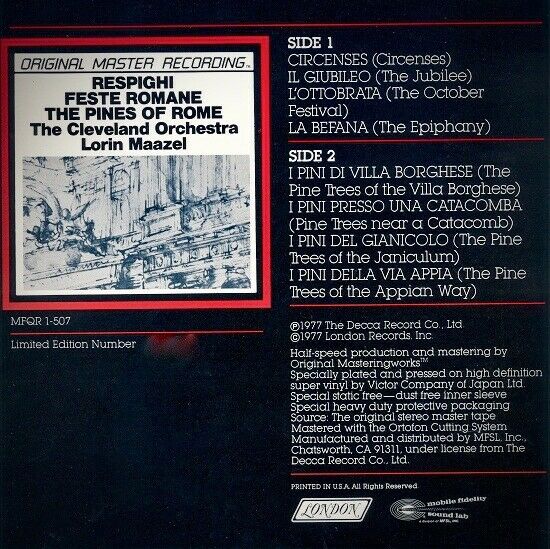
This listing is for a super rare, out of print, BOXED LP title - an OPENED and in near mint minus condition LP PRESSED and ISSUED by MFSL / MOFI Records of a highly collectible title from their catalog - a superb title featuring -
Respighi // Lorin Maazel
Title -
Feste Romane
Track Listing -Feste Romane (Roman Festivals) Symphonic Poem For Orchestra - 25:35
A1. Circenses (Circenses)
A2. Il Giubileo (The Jubilee)
A3. L'Ottobrata (The October Festival)
A4. La Befana (The Epiphany)
Pini Di Roma (Pines Of Rome) Symphonic Poem - 21:00
B1. I Pini Di Villa Borghese (The Pine Trees Of The Villa Borghese)
B2. I Pini Presso Una Catacomba (The Pine Trees Near A Catacomb)
B3. I Pini Del Gianicolo (The Pine Trees Of The Janiculum)
B4. I Pini Della Via Appia ( The Pine Trees Of The Appian Way)
Performers / Credits / Other Information -
• Conductor – Lorin Maazel
• Orchestra – The Cleveland Orchestra
Boxed 200g UHQR numbered release of 1977 Decca recording.
Signed and numbered Certificate of Authenticity.
The title is from the ultra-rare MFSL series of audiophile LPs.
- MFSL / MOFI / Mobile Fidelity Sound Lab RECORDS
- LP made in JAPAN
- Pressing is in STEREO
- Made with 200-gram vinyl, comes in a luxurious boxed set - numbered, Limited Edition of 5,000 copies.
- Record vintage = made in 1982
- LP catalog # MFQR 1-507
CONDITION Details:
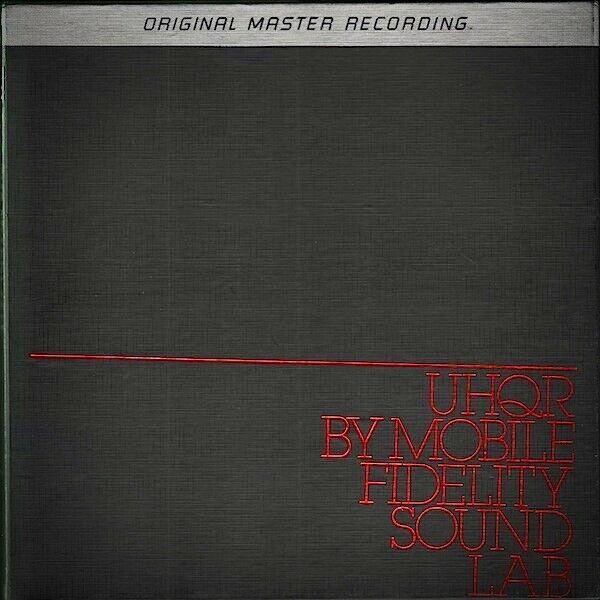
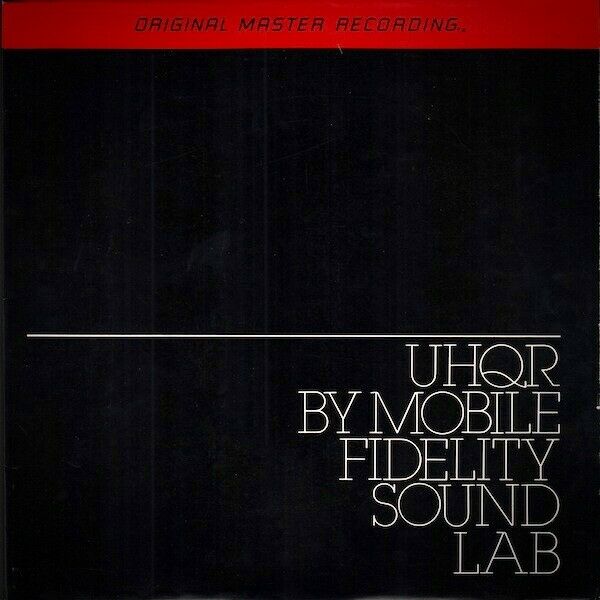
The LP box is in near mint minus overall condition! The box has NO splits or crushed corners! The corners and seams are solid with just some minor shelf wear along the seams and corners. The colors on the box are sharp and clean - see pictures with this listing as they are of the actual item.
The set comes complete with, 2 foam inserts, Technical Specifications Manual, UHQR Certificate of Authenticity, Jacket and large format box (see pictures for more detail).
The LP is in near mint minus condition! We found that the vinyl looked superb on this vintage LP set (glossy and appear never played). There are no significant marks and the LP retains virtually all of the original gloss and sheen - obviously well taken care of! There may have a bit of dust and perhaps a finger print or two on the LP so they should be cleaned before playing. There are NO serious spindle marks on the record labels either. Just beautifully made JVC Japanese Virgin Vinyl! That said, acquiring a vintage LP like this is for the performance and rarity of the LP, not necessarily for the sound quality.A Short Note About LP GRADING -
- Mint = Only used for sealed items.
- Near Mint = Virtually flawless in every way.
- Near Mint Minus = Item has some minor imperfections, some audible.
- Excellent = Item obviously played and enjoyed with some noise.
- Very Good Plus = Many more imperfections which are noticeable and obtrusive.
For best results, always thoroughly clean your LPs before playing them.
LPs can be audiophile quality pressings (any collector of fine MFSL, half speeds, direct to discs, Japanese/UK pressings etc., can attest to the difference a quality pressing can make to an audio system).
Don't let this rarity slip by!!!price rating