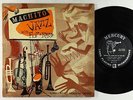
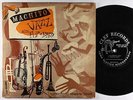
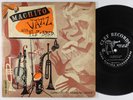
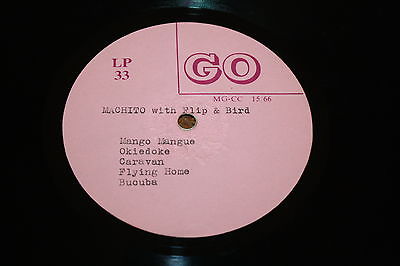
Machito with Flip and Bird / ACETATE / Charlie Parker and Flip Phillip Jazz
$
45


Favourite Auctions
To save auctions to your favourites, please login
If you don't have an account, please register
Description
Please wait for your invoice !
Postage is not $4.00
Machito Jazz with Flip & Bird
graded visual as vg+
double sided
POSTAGE IS NOT $4.00
$25.00 FOR USA/CANADA JAPAN AND AUSTRALIA
$16.00 FOR EUROPE
Machito Jazz was a personal project of Norman Granz, recorded under his supervision. To paraphrase his liners, not only was it an early meeting of jazz horns with exciting Afro-Cuban rhythms, but also there was significant contrast in the horns, Charlie Parker and Flip Phillips. While no great new standard or technique emerged from this session, the performance more than lives up to the concept. Unfortunately, the limitations of Afro-Cuban jazz (jazz horns soloing over conga rather than fusion) ultimately become apparent. But there is no denying the enjoyability of the combination, and count on "Caravan" to lend helpful familiarity. Partly reissued in the various-artists anthology Afro-Cuban Jazz (Verve VE-2-2522).
What is an acetate:
Runnin An acetate is a transitional stage between the master tape and the finished vinyl record.
Originally acetates were used for home recording in the days before tape recorders but since the advent of cassette tape & CDR are now no longer used for providing bands & their entourage copies of todays studio efforts. A machine actually cuts the grooves into the acetate like a lathe. The acetate is used to assess whether the music has been successfully transferred to disc.
It is checked by the sound engineer. There may be only one copy made of a particular recording sometimes more are cut and sent to the studio and band members for approval. The acetate comes before making the master and allows the sound to be checked without great expense.
It is unusual for more than a dozen to be manufactured so from the collectors point of view an acetate is a rare find indeed!
If the recording is rejected the acetate may be the only record that survives. The rejected cut may simply be poor quality however the artist may have opted to use a different take of the song if so the acetate becomes much more precious. An incredible find - possibly unique - and certainly one of only a handful.
price rating