Marlene Dietrich Lot(14) EP Picture Sleeve O.S.S. Lili Australia Sweden Imports
$
200

Favourite Auctions
To save auctions to your favourites, please login
If you don't have an account, please register
Description
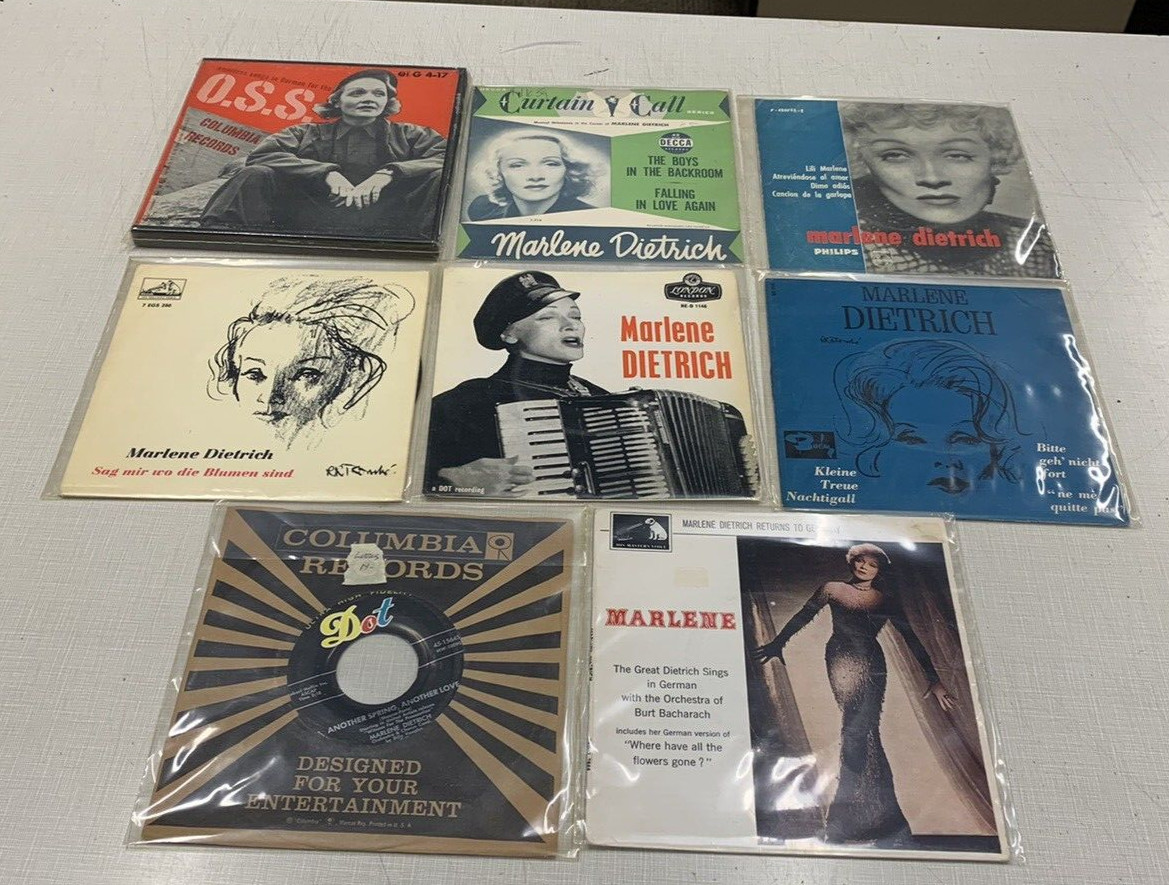
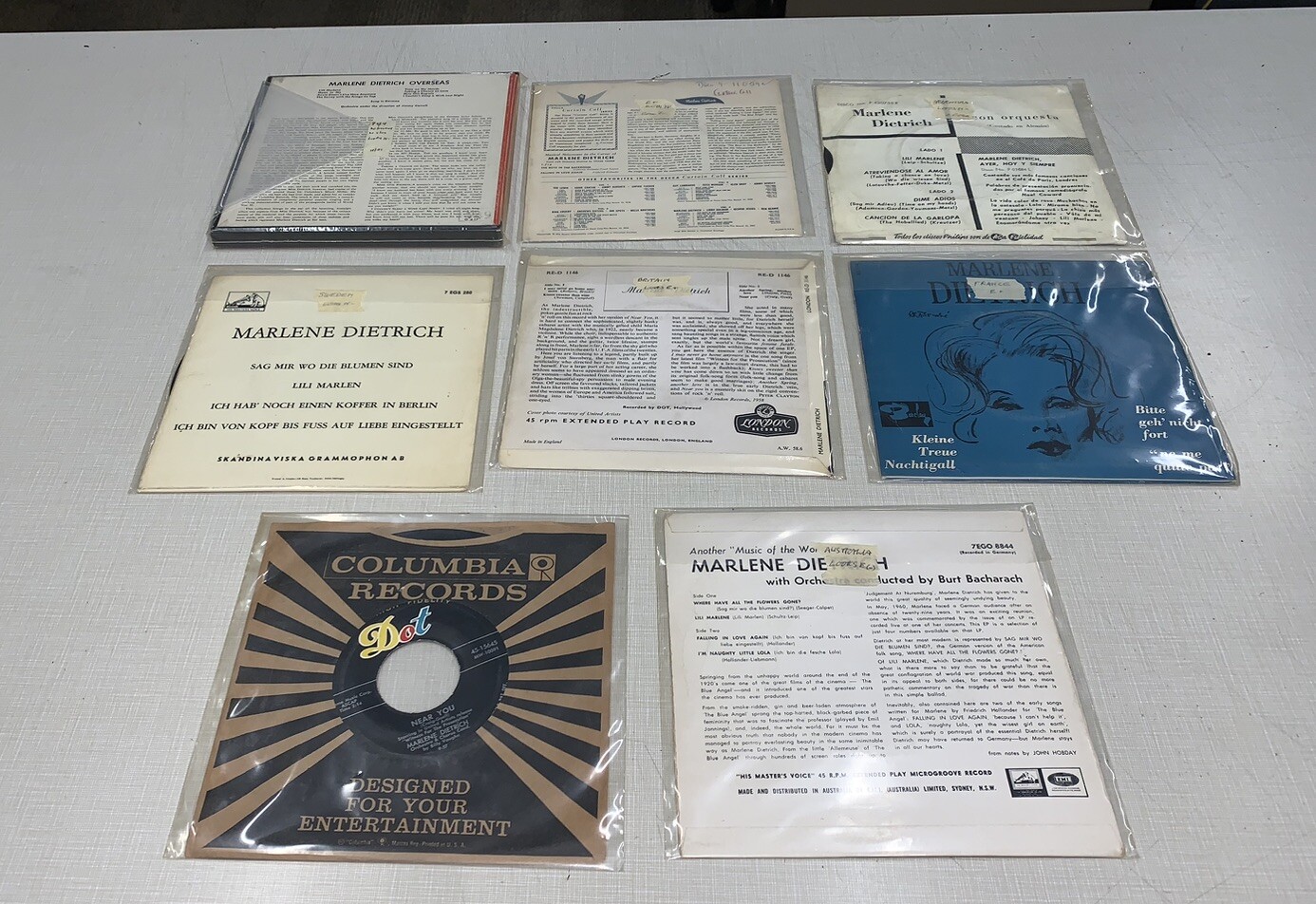
Marlene Dietrich – Marlene Dietrich Overseas American Songs In German For The O.S.S
Label: Columbia – G 4-17 Format: 4 x Vinyl, 7", 45 RPM, Album Box Set Country: US Released: 1952 Genre: Pop Style: Chanson A Lilli Marlene B Mean To Me C Annie Doesn't Live Here Anymore D The Surrey With The Fringe On Top E Time On My Hands F Taking A Chance On Love G Miss Otis Regrets H I Couldn't Sleep A Wink Last Night
Marlene Dietrich – The Boys In The Backroom
Label: Decca – 1-714, Decca – 9-11059 Series: Decca Curtain Call Series Format: Vinyl, 7", 45 RPM Country: US Released: 1959 Genre: Pop Style: Vocal A The Boys In The Backroom B Falling In Love Again
Marlene Dietrich Marlene Dietrich - Marlene Dietrich album cover More images
Label: London Records – RE-D 1146 Format: Vinyl, 7", 45 RPM, EP, Mono Country: UK Released: 1958 Genre: Jazz, Pop Style: Chanson A1 I May Never Go Home Anymore Written-By – Brooks*, Roberts* A2 Kisses Sweeter Than Wine Written-By – Newman*, Campbell* B1 Another Spring, Another Love Written-By – Shayne*, Noel Paris B2 Near You Written-By – Craig*, Goell*
Marlene Dietrich – Bitte Geh' Nicht Fort / Kleine Treue Nachtigall
Label: Barclay – 60394 Format: Vinyl, 7", 45 RPM, Single Country: France Released: 1968 Genre: Pop Style: Chanson A Bitte Geh' Nicht Fort = Ne Me Quitte Pas Written-By – Jacques Brel, Max Colpet 3:36 B Kleine Treue Nachtigall Written-By – Burt Bacharach, Max Colpet 2:46 Illustration – RR Bouché*
Marlene Dietrich – Sag Mir Wo Die Blumen Sind Marlene Dietrich - Sag Mir Wo Die Blumen Sind album cover More images
Label: His Master's Voice – 7-EGS 280, His Master's Voice – 7 EGS 280 Format: Vinyl, 7", 45 RPM Country: Sweden Released: Genre: Jazz Style: Easy Listening A1 Sag Mir Wo Die Blumen Sind Written-By – Colpet*, Seeger* A2 Lili Marlen Written-By – Leip*, Schultze* B1 Ich Hab' Noch Einen Koffer In Berlin Written-By – Pinelli*, Siegel* B2 Ich Bin Von Kopf Bis Fuss Auf Liebe Eingestellt Written-By – Holländer* Record Company – Skandinaviska Grammophon AB Printed By – AB Roos Tryckerier Published By – Copyright Control Illustration – RR Bouché*
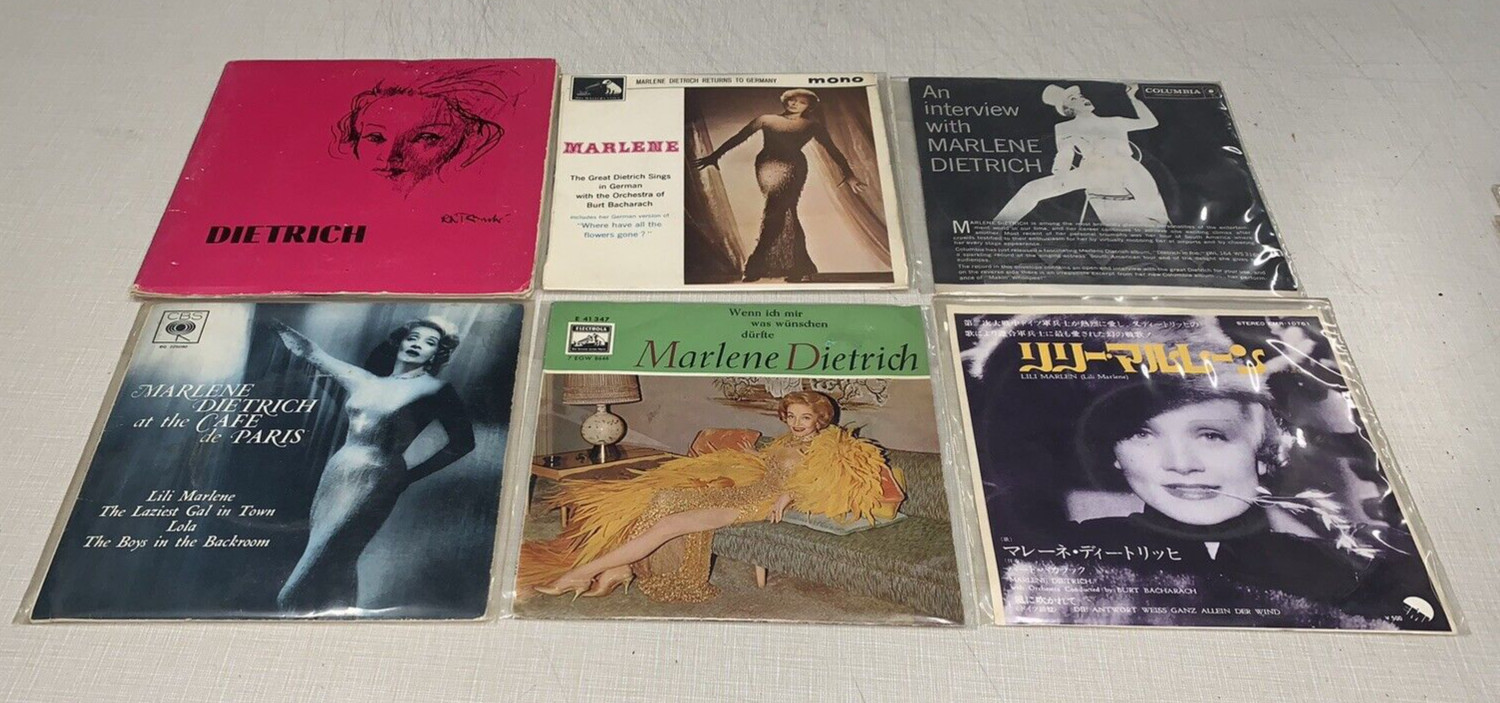
Marlene Dietrich – Marlene
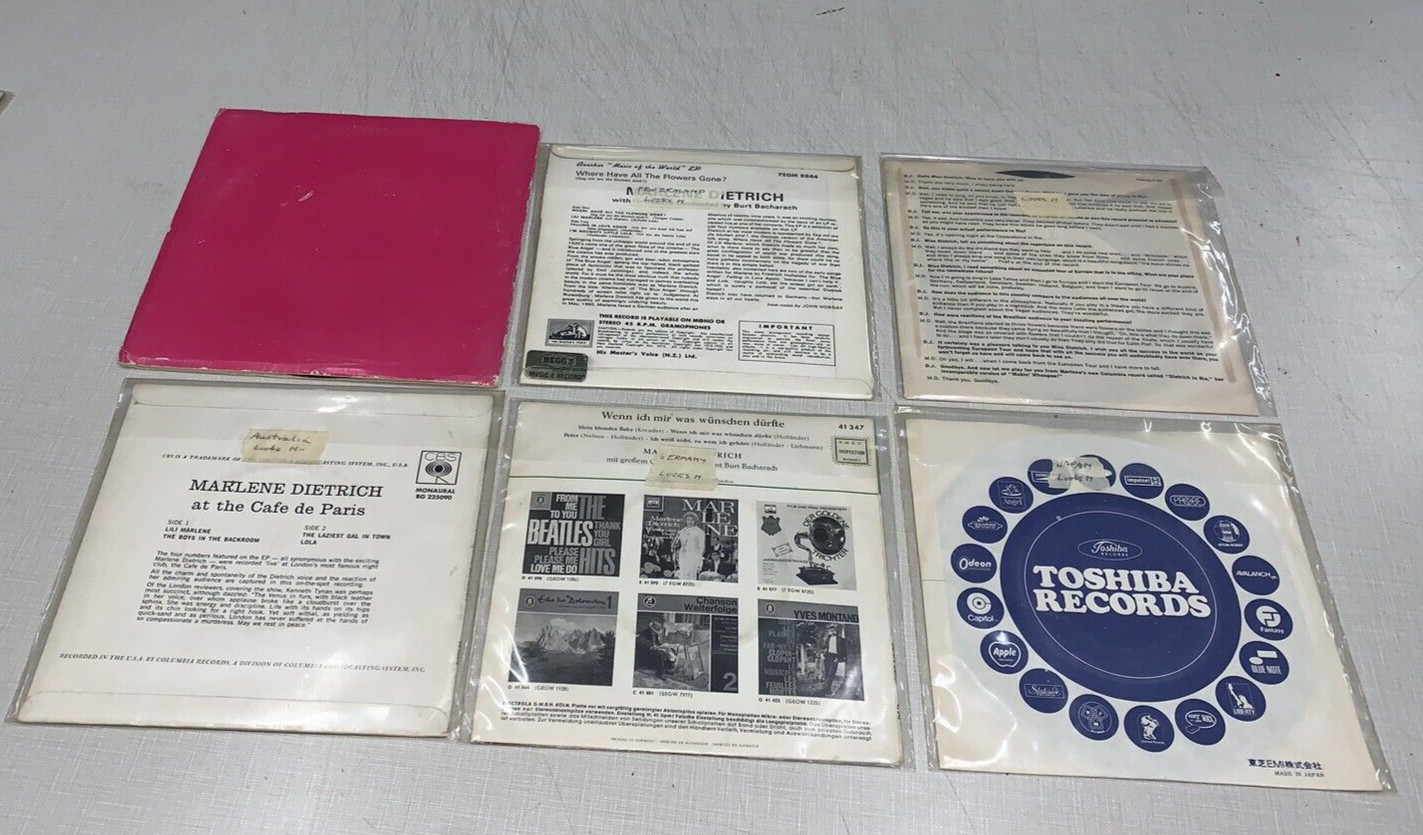
Label: His Master's Voice – 7EGO-8844 Format: Vinyl, 7", 45 RPM, EP Country: Australia Released: 1960 Genre: Jazz, Stage & Screen Style: Big Band A1 Where Have All The Flowers Gone? (Sag Mir Wo Die Blumen Sind?) Lyrics By – Colpet* Written-By – Seeger* A2 Lili Marlene Written-By – Leip*, Schultz* B1 Falling In Love Again (Ich Bin Von Kopf Bis Fuss Auf Liebe Eingestellt) Written-By – Hollander* B2 I'm A Naughty Little Lola (Ich Bin Die Fesche Lola) Written-By – Hollander*, Liebmann* Manufactured By – EMI (Australia) Limited Conductor – Burt Bacharach Marlene Dietrich returns to Germany. The Great Dietrich Sings in German with the Orchestra of Burt Bacharach Includes her German version of "Where have all the flowers gone?"
Marlene Dietrich – Another Spring, Another Love / Near You
Label: Dot Records – 45-15645 Format: Vinyl, 7", 45 RPM Country: US Released: Genre: Stage & Screen Style: Soundtrack A Another Spring, Another Love 2:18 B Near You 2:14 Conductor – Billy Vaughn Starring in United Artists release "Witness for the Prosecution".
Marlene Dietrich – Wenn Ich Mir Was Wünschen Dürfte Marlene Dietrich - Wenn Ich Mir Was Wünschen Dürfte album cover More images
Label: Electrola – E 41 347, Electrola – 7 EGW 8646 Format: Vinyl, 7", 45 RPM, EP Country: Germany Released: 1960 Genre: Pop Style: Chanson Wenn Ich Mir Was Wünschen Dürfte A1 Mein Blondes Baby A2 Wenn Ich Mir Was Wünschen Dürfte Wenn Ich Mir Was Wünschen Dürfte B1 Peter Written-By – Nelson* B2 Ich Weiß Nicht, Zu Wem Ich Gehöre Written-By – Liebmann* Accompanied By – Großes Orchester* Conductor – Burt Bacharach Written-By – Holländer*
Marlene Dietrich At The Cafe De Paris Marlene Dietrich - Marlene Dietrich At The Cafe De Paris album cover Label: CBS – BG-225090 Format: Vinyl, 7", 45 RPM, EP Country: Australia Released: Genre: Pop, Stage & Screen Style: Vocal A1 Lili Marlene 3:03 A2 The Boys In The Backroom 1:50 B1 The Laziest Gal In Town 2:45 B2 Lola 2:08 Published By – J. Albert & Son Pty. Ltd.
Marlene Dietrich – Makin' Whoopee! Marlene Dietrich - Makin' Whoopee! album cover More images
Label: Columbia – ZSP 49778 Format: Vinyl, 7", 45 RPM, Promo Country: US Released: Genre: Non-Music, Pop, Stage & Screen Style: Interview A Makin' Whoopee! 3:43 B Open End Interview With Marlene Dietrich
Marlene Dietrich – = Lili Marlen Marlene Dietrich - = Lili Marlen album cover More images
Label: EMI – EMR-10761 Format: Vinyl, 7", 45 RPM Country: Japan Released: 1975 Genre: Pop, Folk, World, & Country, Stage & Screen Style: Vocal A Lili Marlen (Lili Marlene) Conductor – Burt Bacharach 3:01 B Die Antwort Weiss Ganz Allein Der Wind (Blowin' In The Wind) Conductor – Burt Bacharach 3:57 Manufactured By – Toshiba EMI Ltd Phonographic Copyright ℗ – EMI Records Liner Notes [] –
Marie Magdalene "Marlene" Dietrich[4] (/mɑːrˈleɪnə ˈdiːtrɪx/, German: [maʁˈleːnə ˈdiːtʁɪç] ⓘ; 27 December 1901 – 6 May 1992)[5] was a German-born actress and singer whose career spanned from the 1910s to the 1980s.[6]
In 1920s Berlin, Dietrich performed on the stage and in silent films. Her performance as Lola Lola in Josef von Sternberg's The Blue Angel (1930) brought her international acclaim and a contract with Paramount Pictures. She starred in many Hollywood films, including six iconic roles directed by Sternberg: Morocco (1930) (her only Academy Award nomination), Dishonored (1931), Shanghai Express and Blonde Venus (both 1932), The Scarlet Empress (1934), The Devil Is a Woman (1935). She successfully traded on her glamorous persona and exotic looks, and became one of the era's highest-paid actresses. Throughout World War II, she was a high-profile entertainer in the United States. Although she delivered notable performances in several post-war films, including Billy Wilder's A Foreign Affair (1948), Alfred Hitchcock's Stage Fright (1950), Billy Wilder's Witness for the Prosecution (1957), Orson Welles's Touch of Evil (1958), and Stanley Kramer's Judgment at Nuremberg (1961), she spent most of the 1950s to the 1970s touring the world as a marquee live-show performer.
Dietrich was known for her humanitarian efforts during World War II, housing German and French exiles, providing financial support and even advocating their American citizenship. For her work on improving morale on the front lines during the war, she received several honors from the United States, France, Belgium, and Israel. In 1999, the American Film Institute named Dietrich the ninth greatest female screen legend of classic Hollywood cinema.[7]
Early life
Location of Marlene Dietrich's birthplace in Rote Insel in Berlin
Dietrich's birthplace in Leberstraße 65, Berlin-Schöneberg She was born Marie Magdalene Dietrich on 27 December 1901 at Leberstraße 65 in the neighborhood of Rote Insel in Schöneberg, now a district of Berlin. Her mother, Wilhelmina Elisabeth Josefine (née Felsing), was from an affluent Berlin family who owned a jewelry and clock-making firm. Her father, Louis Erich Otto Dietrich, was a police lieutenant. Dietrich had one sibling, Elisabeth (5 February 1900 – 8 May 1973).[8] Dietrich's father was born on 26 August 1867 and died in August 1908.[9][10] His best friend, Eduard von Losch, an aristocratic first lieutenant in the Grenadiers, courted Wilhelmina and married her in 1914, but he died in July 1916 from injuries sustained during the First World War.[4] Von Losch never officially adopted the Dietrich sisters, so Dietrich's surname was never von Losch, as has sometimes been claimed.[11]
Dietrich's family nicknamed her "Lena", "Lene", or "Leni" (IPA: [leːnɛ]).[12] Aged about 11, she combined her first two names to form the name "Marlene". Dietrich attended the Auguste-Viktoria Girls' School from 1907 to 1917[13] and graduated from the Victoria-Luise-Schule (today Goethe-Gymnasium) in Berlin-Wilmersdorf in 1918.[14] She studied the violin[15] and became interested in theater and poetry as a teenager. A wrist injury[16] curtailed her dreams of becoming a concert violinist, but by 1922 she had her first job playing violin in a pit orchestra for silent films at a Berlin cinema. She was fired after only four weeks.[17]
The earliest professional stage appearances by Dietrich were as a chorus girl on tour with Guido Thielscher's Girl-Kabarett vaudeville-style entertainments and in Rudolf Nelson revues in Berlin.[18] In 1922, Dietrich auditioned unsuccessfully for theatrical director and impresario Max Reinhardt's drama academy;[19] however, she soon found herself working in his theatres as a chorus girl and playing small roles in dramas.
Career beginnings Dietrich's film debut was a small part in the film The Little Napoleon (1923).[20] She met her future husband Rudolf Sieber on the set of Tragedy of Love in 1923. Dietrich and Sieber were married in a civil ceremony in Berlin on 17 May 1923.[21] Her only child, daughter Maria Elisabeth Sieber, was born on 13 December 1924.[22]
Dietrich continued to work on stage and in film both in Berlin and Vienna throughout the 1920s. On stage, she had roles of varying importance in Frank Wedekind's Pandora's Box,[23] William Shakespeare's The Taming of the Shrew[23] and A Midsummer Night's Dream,[24] and George Bernard Shaw's Back to Methuselah[25] and Misalliance.[26] It was in musicals and revues such as Broadway, Es Liegt in der Luft, and Zwei Krawatten, however, that she attracted the most attention. By the late 1920s, Dietrich was also playing sizable parts on screen, including roles in Café Elektric (1927), I Kiss Your Hand, Madame (1928), and The Ship of Lost Souls (1929).[27]
Career Association with von Sternberg
Marlene Dietrich as Lola: "She straddles a chair...imperiously, magisterially, fully the measurer of men in the audience..."[28] In 1929, Dietrich landed her breakthrough role of Lola Lola, a cabaret singer who caused the downfall of a hitherto respectable schoolmaster (played by Emil Jannings), in the UFA production of The Blue Angel (1930) shot at Babelsberg film studios.[29][30] Josef von Sternberg directed the film and thereafter took credit for having "discovered" Dietrich. The film introduced Dietrich's signature song "Falling in Love Again", which she recorded for Electrola. She made further recordings in the 1930s for Polydor and Decca Records.
In 1930, on the strength of The Blue Angel's international success, and with encouragement and promotion from Josef von Sternberg, who was established in Hollywood, Dietrich moved to the United States under contract to Paramount Pictures, the U.S. film distributor of The Blue Angel. The studio sought to market Dietrich as a German answer to Metro-Goldwyn-Mayer's Swedish star Greta Garbo. Sternberg welcomed her with gifts, including a green Rolls-Royce Phantom II. The car later appeared in their first U.S. film Morocco.[31]
Dietrich starred in six films directed by von Sternberg at Paramount between 1930 and 1935. Von Sternberg worked effectively with Dietrich to create the image of a glamorous and mysterious femme fatale. He encouraged her to lose weight and coached her intensively as an actress. She willingly followed his, sometimes imperious, direction in a way that a number of other performers resisted.[32]
In Morocco (1930) with Gary Cooper, Dietrich was again cast as a cabaret singer. The film is best remembered for the sequence in which she performs a song dressed in a man's white tie and kisses another woman, both provocative for the era. The film earned Dietrich her only Academy Award nomination. Morocco was followed by Dishonored (1931) with Victor McLaglen, a major success with Dietrich cast as a Mata Hari-like spy.
Josef von Sternberg used butterfly lighting to enhance Dietrich's features in Shanghai Express (1932). Shanghai Express (1932) with Anna May Wong, which was dubbed by the critics "Grand Hotel on wheels", was another major success, earning $1.5 million in worldwide rentals.[33]
Dietrich and von Sternberg again collaborated on the romance Blonde Venus (1932) with Cary Grant. Dietrich worked without von Sternberg for the first time in three years in the romantic drama Song of Songs (1933), playing a naïve German peasant, under the direction of Rouben Mamoulian. Dietrich and Sternberg's last two films, The Scarlet Empress (1934) with John Davis Lodge and The Devil Is a Woman (1935)—the most stylized of their collaborations—were their lowest-grossing films. Dietrich later remarked that she was at her most beautiful in The Devil Is a Woman.
Von Sternberg is known for his exceptional skill in lighting and photographing Dietrich to optimum effect, so much so, that even 50 years later, one of Shanghai Express's production stills became the inspiration of the cover of rock band Queen's album Queen II which was integrated into the music video of their single "Bohemian Rhapsody".
His signature use of light and shadow, including the impact of light passed through a veil or slatted window blinds, combined with the scrupulous attention to set design and costumes makes the films they made together among cinema's most visually stylish.[34]
Critics still vigorously debate how much of the credit belonged to von Sternberg and how much to Dietrich, but most would agree that neither consistently reached such heights again after Paramount fired von Sternberg and the two ceased working together.[35]
The collaboration of one actress and director creating seven films is still unmatched in motion pictures, with the possible exception of Katharine Hepburn and George Cukor, who made ten films together over a much longer period but which were not created for Hepburn the way the last six von Sternberg/Dietrich collaborations were.[36][37]
The later 1930s Dietrich's first film after the end of her partnership with von Sternberg was Frank Borzage's Desire (1936) with Gary Cooper, a commercial success that gave Dietrich an opportunity to try her hand at romantic comedy. Her next project, I Loved a Soldier (1936), ended in shambles when the film was scrapped several weeks into production due to script problems, scheduling confusion and the studio's decision to fire the producer Ernst Lubitsch.[38]
Extravagant offers lured Dietrich away from Paramount to make her first color film The Garden of Allah (1936) for independent producer David O. Selznick, for which she received $200,000, and to Britain for Alexander Korda's production, Knight Without Armour (1937), at a salary of $450,000, which made her one of the best paid film stars of the time. While both films performed decently at the box office, her vehicles were costly to produce and her public popularity had declined. By this time, Dietrich placed 126th in box office rankings, and American film exhibitors proclaimed her "box office poison" in May 1938, a distinction she shared with Greta Garbo, Joan Crawford, Mae West, Katharine Hepburn, Norma Shearer, Dolores del Río, and Fred Astaire among others.[39]
James Stewart and Marlene Dietrich in Destry Rides Again (1939) While in London, Dietrich later said in interviews, she was approached by Nazi Party officials and offered lucrative contracts, should she agree to return to be a foremost film star in Nazi Germany. She refused their offers and applied for U.S. citizenship in 1937.[40] She returned to Paramount to make Angel (1937), another romantic comedy directed by Ernst Lubitsch; the film was poorly received, leading Paramount to buy out the remainder of Dietrich's contract.
Dietrich, with encouragement from Josef von Sternberg, accepted producer Joe Pasternak's offer to play against type in her first film in two years: that of the cowboy saloon girl, Frenchie, in the western-comedy Destry Rides Again (1939), with James Stewart. This was a significantly less well paid role than she had been accustomed to.
The bawdy role revived her career and "See What the Boys in the Back Room Will Have", a song she introduced in the film, became a hit when she recorded it for Decca. She played similar types in Seven Sinners (1940) and The Spoilers (1942), both with John Wayne.
World War II
Dietrich and Rita Hayworth serve food to soldiers at the Hollywood Canteen (17 November 1942).
Dietrich with airmen of the 401st Bomb Group (29 September 1944)
Marlene Dietrich and U.S. Army Technician Fourth Grade Earl E. McFarland in Belgium (24 November 1944)
Dietrich and U.S. soldiers somewhere in France during her second USO tour (1944) Dietrich was known to have strong political convictions and the mind to speak them. In the late 1930s, Dietrich created a fund with Billy Wilder and several other exiles to help Jews and dissidents escape from Germany. In 1937, her entire salary for Knight Without Armor ($450,000) was put into escrow to help the refugees. In 1939, she became an American citizen and renounced her German citizenship.[5] In December 1941, the U.S. entered World War II, and Dietrich became one of the first public figures to help sell war bonds. She toured the U.S. from January 1942 to September 1943 (appearing before 250,000 troops on the Pacific Coast leg of her tour alone) and was reported to have sold more war bonds than any other star.[41][42]
During two extended tours for the USO in 1944 and 1945,[41] she performed for Allied troops in Algeria, Italy, the UK, France and Heerlen in the Netherlands,[43] then entered Germany with Generals James M. Gavin and George S. Patton. When asked why she had done this, in spite of the obvious danger of being within a few kilometers of German lines, she replied, "aus Anstand"—"out of decency".[44] Wilder later remarked that she was at the front lines more than Dwight Eisenhower. Her revue, with Danny Thomas as her opening act for the first tour, included songs from her films, performances on her musical saw (a skill taught to her by Igo Sym that she had originally acquired for stage appearances in Berlin in the 1920s) and a "mindreading" act that her friend Orson Welles had taught her for his Mercury Wonder Show. Dietrich would inform the audience that she could read minds and ask them to concentrate on whatever came into their minds. Then she would walk over to a soldier and earnestly tell him, "Oh, think of something else. I can't possibly talk about that!" American church papers reportedly published stories complaining about this part of Dietrich's act. [37][41]
In 1944, the Morale Operations Branch of the Office of Strategic Services (OSS) initiated the Musak project, musical propaganda broadcasts designed to demoralize enemy soldiers.[45] Dietrich, the only performer who was made aware that her recordings would be for OSS use, recorded a number of songs in German for the project, including "Lili Marleen", a favorite of soldiers on both sides of the conflict.[46] Major General William J. Donovan, head of the OSS, wrote to Dietrich, "I am personally deeply grateful for your generosity in making these recordings for us."[47]
At the war's end in Europe, Dietrich reunited with her sister Elisabeth and her sister's husband and son. They had resided in the German village of Belsen throughout the war years, running a cinema frequented by Nazi officers and officials who oversaw the Bergen-Belsen concentration camp. Dietrich's mother remained in Berlin during the war, while Dietrich vouched for her sister and her sister's husband, sheltering them from possible prosecution as Nazi collaborators.[48] However, Dietrich later omitted the existence of her sister and her sister's son from all accounts of her life, completely disowning them and claiming to be an only child.[49]
Dietrich received the Medal of Freedom in November 1947, for her "extraordinary record entertaining troops overseas during the war".[50] She said this was her proudest accomplishment.[45] She was also awarded the Légion d'honneur by the French government for her wartime work.[51]
Later film career While Dietrich never fully regained her former screen profile, she continued performing in motion pictures, including appearances for directors such as Mitchell Leisen in Golden Earrings (1947), Billy Wilder in A Foreign Affair (1948) and Alfred Hitchcock in Stage Fright (1950). Her appearances in the 1950s included films such as Fritz Lang's Rancho Notorious, (1952) and Wilder's Witness for the Prosecution (1957). She appeared in Orson Welles's Touch of Evil (1958). Dietrich had a kind of platonic love for Welles, whom she considered a genius.[52] Her last substantial film role was in Judgment at Nuremberg (1961) directed by Stanley Kramer; she also presented the narrative for the documentary Black Fox: The Rise and Fall of Adolf Hitler, which won the Academy Award for Best Documentary Feature in 1962.[53] She cut the ceremonial ribbon to celebrate the grand opening of the Paris Theater in New York City in 1948.[54]
Stage and cabaret
Dietrich often performed parts of her show in top hat and tails. Caricature by Hans Georg Pfannmüller showing Dietrich during a cabaret performance in 1954. From the early 1950s until the mid-1970s, Dietrich worked almost exclusively as a cabaret artist, performing live in large theatres in major cities worldwide.
In 1953, Dietrich was offered $30,000 per week[55] to appear live at the Sahara Hotel[56] on the Las Vegas Strip. The show was short, consisting only of a few songs associated with her.[56] Her daringly sheer "nude dress"—a heavily beaded evening gown of silk soufflé, which gave the illusion of transparency—designed by Jean Louis, attracted a lot of publicity.[56] This engagement was so successful that she was signed to appear at the Café de Paris in London the following year; her Las Vegas contracts were also renewed.[57]
Dietrich employed Burt Bacharach as her musical arranger starting in the mid-1950s; together, they refined her nightclub act into a more ambitious theatrical one-woman show with an expanded repertoire.[58] Her repertoire included songs from her films as well as popular songs of the day. Bacharach's arrangements helped to disguise Dietrich's limited vocal range—she was a contralto[59]—and allowed her to perform her songs to maximum dramatic effect;[58] together, they recorded four albums and several singles between 1957 and 1964.[60] In a TV interview in 1971, she credited Bacharach with giving her the "inspiration" to perform during those years.[61]
Bacharach then felt he needed to devote his time fully to songwriting. But she had also come to rely on him in order to perform, and wrote about his leaving in her memoir:
From that fateful day on, I have worked like a robot, trying to recapture the wonderful woman he helped make out of me. I even succeeded in this effort for years, because I always thought of him, always longed for him, always looked for him in the wings, and always fought against self-pity ... He had become so indispensable to me that, without him, I no longer took much joy in singing. When he left me, I felt like giving everything up. I had lost my director, my support, my teacher, my maestro.[62]
She often performed the first part of her show in one of her body-hugging dresses and a swansdown coat, and change to top hat and tails for the second half of the performance.[63] This allowed her to sing songs usually associated with male singers, like "One for My Baby" and "I've Grown Accustomed to Her Face".[58]
"She ... transcends her material," according to Peter Bogdanovich. "Whether it's a flighty old tune like 'I Can't Give You Anything But Love, Baby' ... a schmaltzy German love song, 'Das Lied ist Aus' or a French one 'La Vie en Rose', she lends each an air of the aristocrat, yet she never patronises ... A folk song, 'Go 'Way From My Window' has never been sung with such passion, and in her hands 'Where Have All the Flowers Gone?' is not just another anti-war lament but a tragic accusation against us all."[64]
Francis Wyndham offered a more critical appraisal of the phenomenon of Dietrich in concert. He wrote in 1964: "What she does is neither difficult nor diverting, but the fact that she does it at all fills the onlookers with wonder ... It takes two to make a conjuring trick: the illusionist's sleight of hand and the stooge's desire to be deceived. To these necessary elements (her own technical competence and her audience's sentimentality) Marlene Dietrich adds a third—the mysterious force of her belief in her own magic. Those who find themselves unable to share this belief tend to blame themselves rather than her."[65]
Her use of body-sculpting undergarments, nonsurgical temporary facelifts (tape),[66] expert makeup and wigs,[67] combined with careful stage lighting,[57] helped to preserve Dietrich's glamorous image as she grew older.
Marlene Dietrich, 1960 Dietrich in Jerusalem during a tour in Israel, 1960 Duration: 9 minutes and 49 seconds.9:49 Marlene Dietrich discusses her film and cabaret career in an interview recorded in Paris, 1959. Dietrich's return to West Germany in 1960 for a concert tour received a mixed reception—despite a consistently negative press, vociferous protest by Germans who felt she had betrayed her homeland, and two bomb threats, her performance attracted huge crowds. During her performances at Berlin's Titania Palast theatre, protesters chanted, "Marlene Go Home!"[68] On the other hand, Dietrich was warmly welcomed by other Germans, including Berlin Mayor Willy Brandt, who was, like Dietrich, an opponent of the Nazis who had lived in exile during their rule.[68] The tour was an artistic triumph, but a financial failure.[68] She was left emotionally drained by the hostility she encountered, and she left convinced never to visit again. East Germany, however, received her well.[69] She also undertook a tour of Israel around the same time, which was well-received; she sang some songs in German during her concerts, including, from 1962, a German version of Pete Seeger's anti-war anthem "Where Have All the Flowers Gone", thus breaking the unofficial taboo against the use of German in Israel.[67] She would become the first woman and German to receive the Israeli Medallion of Valor in 1965, "in recognition for her courageous adherence to principle and consistent record of friendship for the Jewish people". Dietrich in London, a concert album, was recorded during the run of her 1964 engagement at the Queen's Theatre.[70]
She performed on Broadway twice (in 1967 and 1968) and received a Special Tony Award in 1968. In November 1972, I Wish You Love, a version of Dietrich's Broadway show titled An Evening with Marlene Dietrich, was filmed in London.[71] She was paid $250,000 for her cooperation but was unhappy with the result. The show was broadcast in the UK on the BBC and in the U.S. on CBS in January 1973.[72]
Dietrich continued with a busy performance schedule until September 1975.[73] When Clive Hirschhorn asked her why she continued to perform, she said, "Do you think this is glamorous? That this is a great life, and that I do it for my health? Well, it isn't. It's hard work. And who would work if they didn't have to?"[74]
In her 60s and 70s, Dietrich's health declined: she survived cervical cancer in 1965[75] and suffered from poor circulation in her legs.[67] Dietrich became increasingly dependent on painkillers and alcohol.[67] A stage fall at the Shady Grove Music Fair in Maryland in 1973 injured her left thigh, necessitating skin grafts to allow the wound to heal.[76] She fractured her right leg in August 1974.[77]
Paris years Dietrich's show business career largely ended on 29 September 1975, when she fell on the stage and broke a thigh bone during a performance in Sydney, Australia.[78] The following year, her husband, Rudolf Sieber, died of cancer on 24 June 1976.[79] Dietrich's final on-camera film appearance was a brief appearance in Just a Gigolo (1978), starring David Bowie and directed by David Hemmings, in which she sang the title song.
Dietrich's gravestone in Berlin. The inscription reads "Hier steh ich an den Marken meiner Tage" (literally: "Here I am standing at the border stones of my days"), a line from the sonnet "Abschied vom Leben" ("Farewell to Life") by Theodor Körner. Dietrich withdrew to her apartment at 12 Avenue Montaigne in Paris. She spent the final 13 years of her life mostly bedridden, allowing only a select few—including family and employees—to enter the apartment. During this time, she was a prolific letter-writer and phone-caller. Her autobiography Nehmt nur mein Leben (Take Just My Life), was published in 1979.[80]
In 1982, Dietrich agreed to participate in a documentary film about her life, Marlene (1984), but refused to be filmed. The film's director is her former co-star from Judgment at Nuremberg (1961), Maximilian Schell, and even with that familiarity, he was still only allowed to record her voice. Schell used his interviews with her as the basis for the film, set to a collage of film clips from her career. The film won several European film prizes and received an Academy Award nomination for Best Documentary in 1984. Newsweek named it "a unique film, perhaps the most fascinating and affecting documentary ever made about a great movie star".[81]
price rating