Milan Knizak UNIQUE RECORD OBJECT Destroyed Music RARE
$
815


Favourite Auctions
To save auctions to your favourites, please login
If you don't have an account, please register
Description
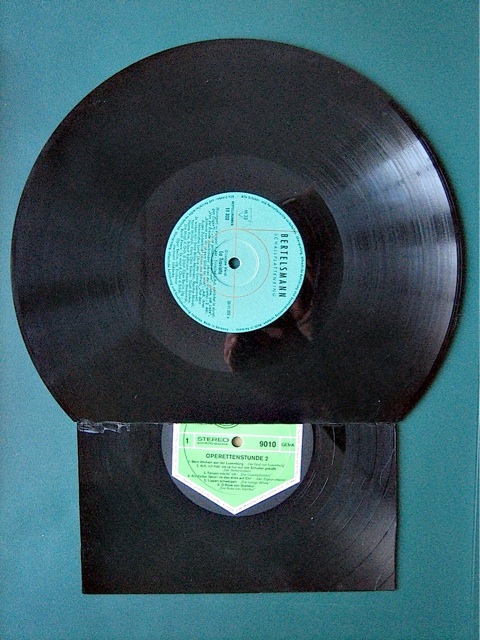
Milan Knizak UNIQUE RECORD OBJECT Destroyed Music RARE!
Milan Knizak
Untitled. 1985-1988
Unique Record Object (Destroyed Music / Broken Music).
Signed and dated on the backside.
This is a very rare opportunity to obtain one of Milan Knizak's unique artworks made of cut vinyl records.
I bought it a long time ago in a Czech antiquarian book and record store.
There is no documented provenance for this item, but I had a chance to compare it to some similar Knizak works in a private collection, and so I can say that it's definitely a genuine work by Milan Knizak.
No reserve on this auction!
(So please don't let me down....;-)
Destroyed music was something Knizak started to work on as early as 1963-4 He acquired a gramophone and collection of records and experimented by playing them speeded up or slowed down, and later dam-aging them by burning them, gluing layers on, putting together bits of different records, scratching and so on, He first presented this kind of music as the 2nd Manifestation of Topical Art in 965, and has been giving occasional concerts with a set of gramophones and synthesizers ever since. But Knizak was not to be satisfied with the mere playing of destroyed records, and he immediately set off from this starting line in three directions, which he combines in every possible way.
First, he regards a vinyl record treated in this way as a certain kind of musical notation in itself. The short text Destruovana hudba [Destroyed Music] (in. Novy raj) ends with the words, "Although music created by playing destroyed gramophone records cannot be transcribed into notes or another language (or only with great difficulty), the records themselves can be considered to be notation"
Second, Knizak decided to treat traditional scores in the same way as the records. By striking out or adding notes, signatures and other signs, changing the order of bars or directly collaging different pages of notation, he produced a "more exact" equivalent of his work with the records. Why more exact? Because there is always inevitably and element of chance in the work with records, while in work with written (printed) scores all the consequences of changing the score can be identified, One example of this kind of work was Fantasia "by a collective of composers", i.e, W.A. Mozart, F. Suppe, H. Lemoine, V. Polivka, M. Knizak, or Ouartet + Piano.
Third, the records have a visual, decorative aspect. At the end of the 1970s Knizak was indirectly inspired by Gino di Maggio to work on the records as art objects as well as musical products -- art objects in which the music is only present "latently". Examples included Knizak's Lenin installation at the Venice Biennial in 1990 or on the wall of the Prague Rudolfinum at the exhibition Hnizda her [Nest of Games]. All the jackets of the books and recordings on which the destroyed records are depicted fail into the same category, for instance the jackets for the albums Broken Music and The Ceremony of Burning Mind (part of the run was issued with an inserted record drilled with holes and inscribed with the words Kill Yourself And Fly")
quoted from Petr Ferenc: Milan Knizak the musician
see also Broken Music, pp. 161ff.
Shipping costs:
please ignore the amounts indicated in the Shipping and handling calculator.
It does not allow to set realistic amounts for auctions from outside the US.
Shipping costs are as follows (I don't charge handling fees, just the actual postage):
Versand innerhalb Deutschlands: Hermes-Paket (versichert) US$ 6
Shipping within Europe: airmail letter post US$ 9
Overseas shipping (North and South America, Asia, Australia): airmail letter post US$ 17
For registered mail add US$ 3 (recommended)
236 (GS 5.0.3 (236))