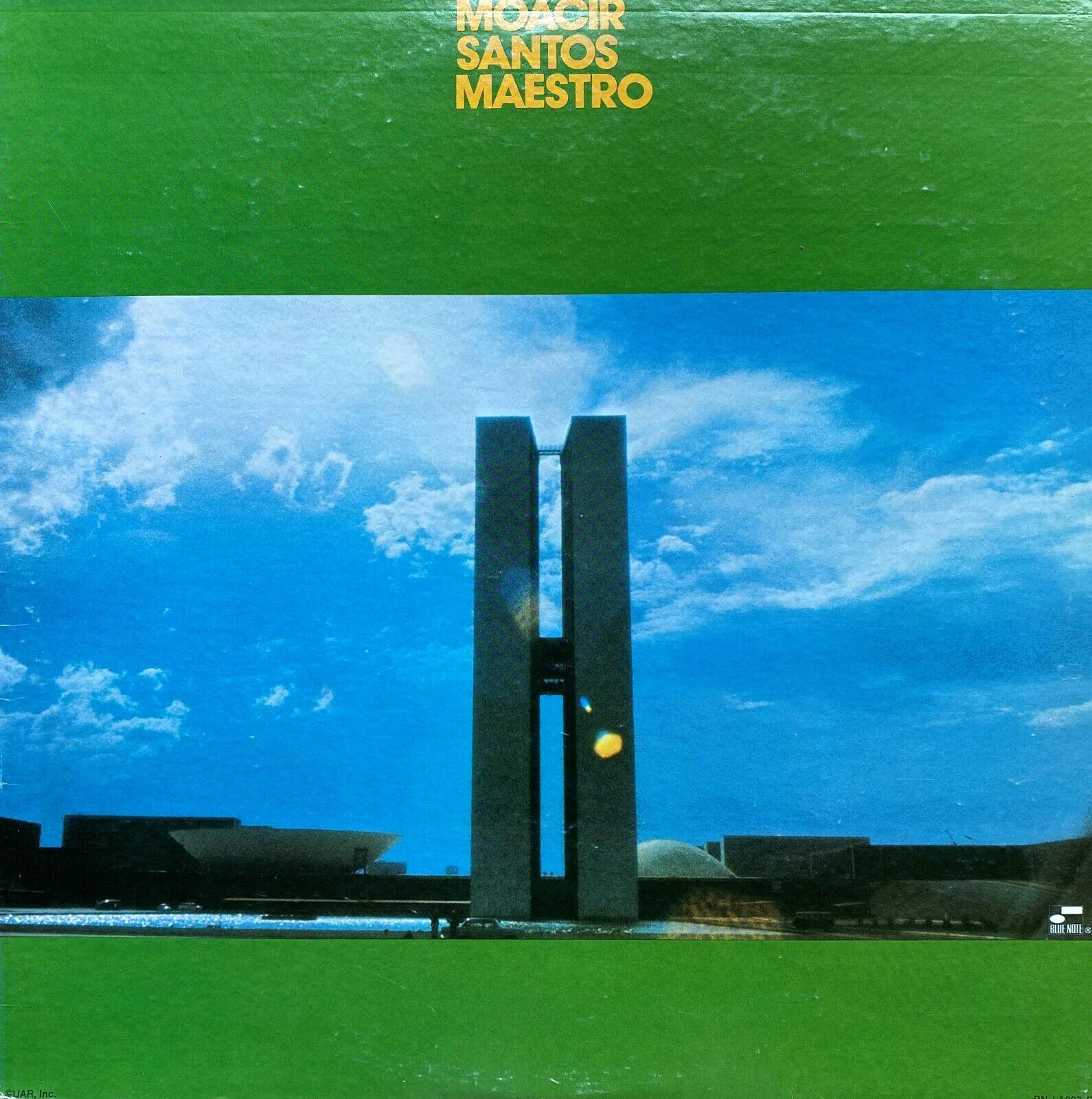
Moacir Santos: Maestro-1972 Blue Note United Artists on Label Stereo 12" Record
$
27


Favourite Auctions
To save auctions to your favourites, please login
If you don't have an account, please register
Description
1972 Blue Note "a Division of United Artists" on Label Stereo Release of Bandleader/Arranger/Composer/Baritone Saxophonist/World Vocalist Moacir Santos Entitled the Maestro, Produced by Reggie Andrews, Executive Producer Is George Butler, Engineer Is Chuck Britz at A & M Recording in Los Angeles, Mastering by Sol Kessler at Media Sound in New York City, Arrangements by Moacir Santos & Reggie Andrews - "One of the main Brazilian arrangers, having renovated the country's harmonic language in the '50s, the underrated Moacir Santos had nevertheless a highly influential role as he had as his pupils, in the '60s: Paulo Moura, Oscar Castro-Neves, Baden Powell, Maurício Einhorn, Geraldo Vespar, Bola Sete, Sérgio Mendes, Dom Um Romão, João Donato, Roberto Menescal, Carlos Lyra, Dori Caymmi, Airto Moreira, and Flora Purim, among others. In 1968, he was admitted into Henry Mancini's cinema music writing team and, four years later, he launched his first album in the American market, The Maestro, which was nominated for a Grammy award; it was followed by Saudade (1974), Carnival of the Spirits (1975), and Opus 3, No. 1 (1979). Owner of a distinctive Brazilian style as a composer and arranger, Santos' most-known tunes are "Nanã" (written with Mário Teles), which had over 150 different recordings (including those by Herbie Mann and Kenny Burrell); and "Coisas" (number one to 12); not to mention a series of compositions with Vinicius de Moraes ("Triste de Quem," "Menino Travesso," "Se Você Disser Que Sim," "Lembre-Se"), who praised him in his "Samba da Benção." Having written the arrangements for, among others, Vinicius de Moraes e Odete Lara (1963), Santos also composed the soundtracks for the films Love in the Pacific, Seara Vermelha (an adaptation of Jorge Amado's novel, directed by R. Aversa), Ganga Zumba (Cacá Diegues), O Santo Médico (Sacha Gordine), and Os Fuzis (Ruy Guerra), among others. Santos had contact with music very early in his life in the local band Flores do Pajeú (Pernambuco), taking classes with bandmaster Paixão and joining the group at 14 on the saxophone, clarinet, trumpet, banjo, guitar, and drums. Leaving home two years later, he played around northeastern Brazil until 1943, when he got a break at the Rádio Clube de Pernambuco. Having joined the Band of the Military Police of Paraíba in 1945, Santos replaced Severino Araújo (who had being invited to work in Rio de Janeiro) in the jazz band (a generic and common denomination at the time, not having to do with the repertory) of Rádio Tabajara da Paraíba, as a tenor/clarinetist. Two years later, he was appointed the conductor of the band and, in 1948, he moved to Rio de Janeiro, where his first job was at the gafieira Clube Brasil Danças, remaining there for 18 years as saxophonist and then as conductor/arranger. One month after his arrival in Rio he joined Rádio Nacional as a solo tenor of the Orquestra do Maestro Chiquinho, where he would work until 1967. Having studied under Hans Joachim Koellreutter's guidance, to whom Santos became an assistant, in 1951 he was invited by Rádio Nacional's A&R director, Paulo Tapajós, to be one of the regular conductors/arrangers of the cast. In 1954, Santos went to São Paulo, where he directed the orchestra of TV Record. Two years later, he returned to Rio de Janeiro, resuming his work at Rádio Nacional, also becoming Ary Barroso's assistant in the A&R direction of the Rozemblit recording company, and conductor at Copacabana Discos. At the peak of the success in Brazil, Santos released in 1965 his first solo album, Coisas. In the same year, he wrote the soundtrack of the film Love in the Pacific, having been honored by the Brazilian government with the payment of travel expenses to be present at the debut in New York, NY. In 1966, he was appointed as a member of ASCAP and in the next year he left Rádio Nacional. Moving to the U.S., Santos settled in Pasadena where he gave music classes at home until he was discovered by Horace Silver. In 1985, he opened with Radamés Gnattali, in Rio de Janeiro, the I Free Jazz Festival. In 1996, he was decorated by the President of the Republic of Brazil as Oficial da Ordem do Rio Branco. In the same year, Santos was paid tribute at the Brazilian Summer Festival (Ford Theater, Los Angeles, CA). His original arrangements for several of his compositions were transcribed by Mário Adnet and Zé Nogueira and recorded on the double-CD Ouro Negro (2001), which had the participation of Milton Nascimento, João Bosco, Joyce, João Donato, Djavan, Gilberto Gil, Ed Motta, and Santos himself. The album was launched with a show at the João Caetano theater, which was presented again at the Free Jazz Festival of that year." - "For his Blue Note debut, Maestro, Brazilian composer Moacir Santos assiduously avoids his homeland's familiar bossa nova and samba rhythms, instead reinventing lesser-known idioms like baiao and frevo to create his own complex yet pulsating signatures and cadences. Opening with "Nana," easily Santos' most familiar and oft-recorded composition, Maestro quickly proves an uncommonly vast canvas for a who's who of Los Angeles session greats including Joe Pass, Clair Fischer, and Don Menza, all of whom explore new territory throughout the LP. For all their depth and intricacy, Santos' songs never box in their players, but allow them the space and the tools necessary to spread out. Though little-heard on its original release, many of the songs that comprise Maestro were later re-recorded by an all-star Brazilian group for the 2001 Santos tribute effort Ouro Negro, reaffirming their timelessness and their vitality." - Sensational Personnel for the Various Lineups Include Legendary Composer Moacitr Santos on Baritone Saxophone and Vocals, Don Menza on Flute & Tenor Saxophone, Ray Pizzi on Soprano and Alto Saxophones, Frank Rosolino on Trombone, David Duke on French Horn, the Great Joe Pass on Guitar, the Amazing Clair Fischer on Organ, Hymie Lewak on Piano, John Heard on Bass & Sheila Wilkinson with Vocals! - Selections on Side 1 Are Monologue, the Moacir Santos/M.Telles/Y. Kotti Penned Nana at 4 Minutes 53 Seconds, Original Moacir Santos Composition Bluishmen, the Moacir Santos/J. Livingston/R. Evans Song Luanne and Moacir Santos' Astral Whine(an Elegy to Any War) - Tracks for Side 2 Consist of Original Moacir Santos Compositions Mother Iracema, Kermis, the Moacir Santos/J. Livingston/R. Evans Song April Child & the Moacir Santos Penned the Mirror's Mirror at 5 Minutes 35 Seconds - Used Copy, Cover Is Slightly Faded with a Light Surface Ring, Side 1 Has some Light Surface Wear, Side 2 Has some Light Surface Wear and a Couple of Light Marks - Stereo Recording, Product Code BN-LA007-F - California Residents Add 9.75% Sales Tax - International S & H Extra -
price rating