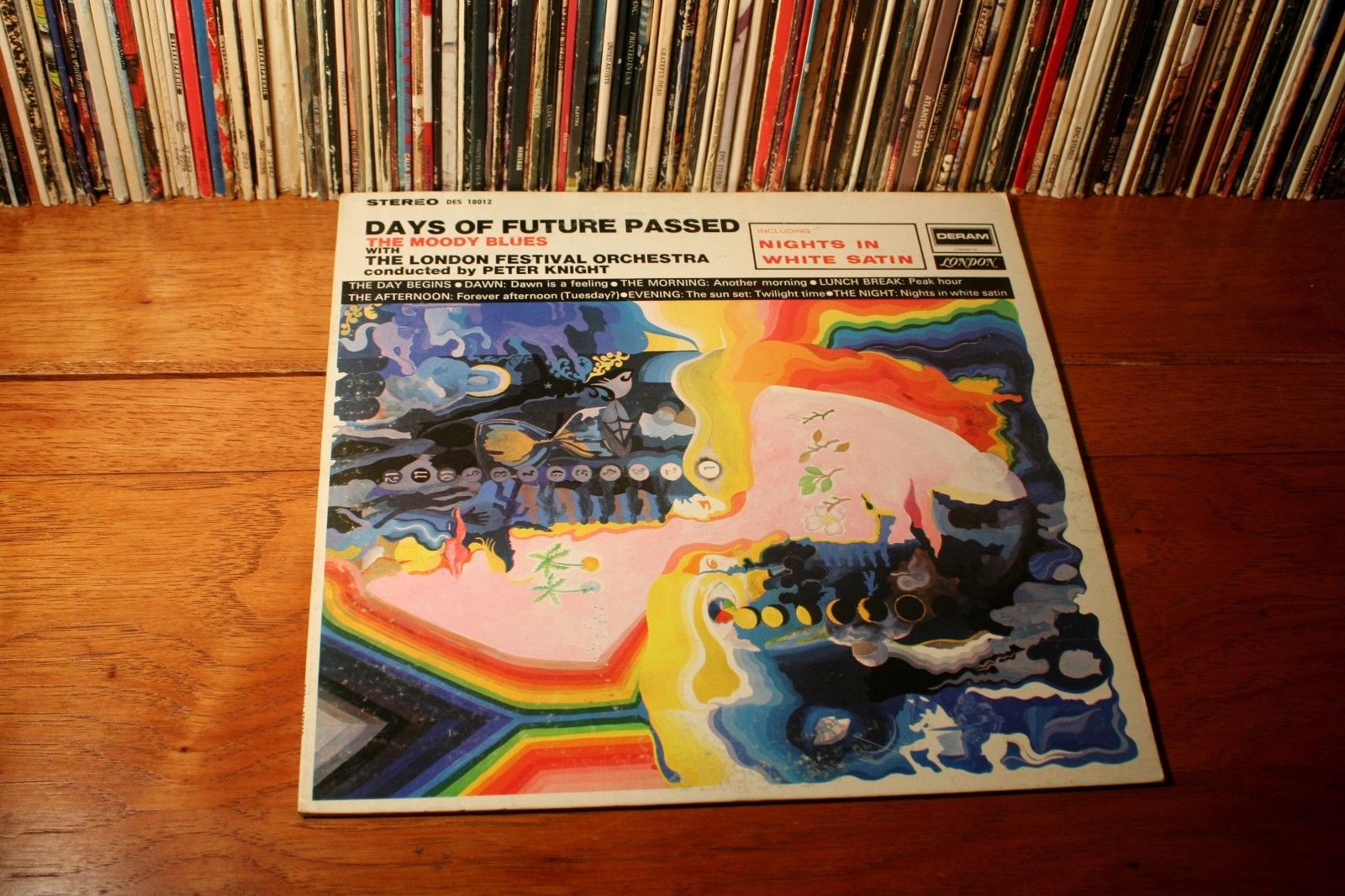
Moody Blues - Days Of Future Passed ? Rare NM 1967 Original Vinyl Record LP ?
$
15


Favourite Auctions
To save auctions to your favourites, please login
If you don't have an account, please register
Description
All my records have been cleaned and visually graded as accurately as possible. If you’re not completely satisfied with your purchase, please contact me for a refund. Will combine shipping on multiple purchases! Thanks for looking!
Days of Future Passed Studio album by The Moody Blues Released 10 November 1967 Recorded October – November 1967 Studio Decca Studios, London Genre
- Proto-prog
- art rock
- progressive rock[4]
- psychedelic rock[5]
- symphonic rock[6]
(1965) Days of Future Passed
(1967) In Search of the Lost Chord
(1968) Singles from Days of Future Passed
- "Nights in White Satin"
Released: 10 November 1967 - "Tuesday Afternoon"
Released: 19 July 1968
Days of Future Passed is the second album and first concept album by English rock band The Moody Blues, released in November 1967 by Deram Records.
With its fusion of classical and rock elements, it has been cited as one of the first examples of progressive rock.
Background and recording
After two years performing as a struggling white R&B band, The Moody Blues were asked by their record label in September 1967 to record an adaptation of Antonín Dvo?ák's Symphony No. 9 for the newly formed Deram Records division in order to demonstrate their latest recording techniques, which were named "Deramic Sound". Instead, the band (initially without the label's knowledge) decided to focus on an album based on an original stage show that they'd been working on. However, Decca recording engineer Derek Varnals disputes this story, claiming that even at the start of the sessions in 1967 there was no intent to record a Dvo?ák album and that talk of this project did not emerge until the mid-1970s.
Recording sessions for the album took place at Decca Studios in West Hampstead, London between 9 May and 3 November 1967. The band worked with record producer Tony Clarke, engineer Derek Varnals and conductor Peter Knight.
Content
The album's music features psychedelic rock ballads by singer-songwriter and guitarist Justin Hayward, Mellotron played by keyboardist Mike Pinder and orchestral interludes by the London Festival Orchestra. The band and the orchestra only actually play together during the last part of "Nights In White Satin."
Music writers cite the album as an early example of progressive rock music. Bill Holdship of Yahoo! Music remarks that the band "created an entire genre here." David Fricke cites it as one of the essential albums of 1967 and finds it "closer to high-art pomp than psychedelia. But there is a sharp pop discretion to the writing and a trippy romanticism in the mirroring effect of the strings and Mike Pinder's Mellotron." Will Hermes cites the album as an essential progressive rock record and opines that its use of the Mellotron, a tape replay keyboard, made it a "signature" element of the genre. An influential work of the counterculture period, AllMusic editor Bruce Eder calls the album "one of the defining documents of the blossoming psychedelic era, and one of the most enduringly popular albums of its era."
Original and later mix
In 1978 the album was remixed because of the apparent deterioration of the master tapes.[15] Digital releases of the album have used this remix. Some compilations, however, have used the original 1967 stereo mix for some songs.[16] The original mix of the entire album has been transferred digitally, for possible release, but has not been used in favour of the remix.[17]
The ways in which the later mix departs most noticeably from the original are:
- After the orchestral intro, "Dawn Is a Feeling" begins more abruptly, and there is less echo on Mike Pinder's vocal on the bridge, making it more prominent.
- On "Another Morning" Ray Thomas's double vocals are spread left and right in the stereo channel. The flute interlude is also played twice towards the end of the song before the orchestral segue.
- The orchestral intro "Lunch Break" goes on about 20 seconds longer before fading out.
- The bridges to "(Evening) Time to Get Away" have John Lodge singing alone; all the backing vocals on that part have been lost.
- The end of "(Evening) Time to Get Away" is missing a mellotron part and only repeats twice, instead of three times.
- "The Sun Set" is missing some piano parts, and the reverb on "through the night" is different.
- The backing vocals on "Twilight Time" are heard through the entire song instead of only coming in at certain points.
- At the beginning of "Nights in White Satin", as the orchestral prelude ends, there is one less beat of time before the rhythm section starts in.
- Some of the strings near the end of "Nights in White Satin" (before "Late Lament") are out of sync with the main body of the song.
Release
Professional ratings Review scores Source Rating AllMusic PopMatters Rolling Stone (1968) mixed Rolling Stone (2007) favorable Spin favorable Sputnikmusic 5/5 Uncut Yahoo! Music favorableDays of Future Passed was released on 10 November 1967 in the UK and 11 November in the US. It reached number 27 in the UK Albums Chart and number 3 in the US in 1972. Billboard chart.
Upon its release, Rolling Stone gave the album a mixed review, writing "The Moody Blues [...] have matured considerably since 'Go Now', but their music is constantly marred by one of the most startlingly saccharine conceptions of 'beauty' and 'mysticism' that any rock group has ever affected." The album has since received acclaim – Spin cited it as a classic of progressive rock, and in 2007 Rolling Stone included it in its list of essential albums of 1967.
Days of Future Passed was issued as a discrete Quadraphonic open reel tape in 1977. This master was also used for a 2001 dts 5.1 channel audio CD release and again for the 2006 SACD release referenced below.
Days of Future Passed was remastered into SACD in March 2006 and repackaged into a two-disc Deluxe Edition. This hybrid SACD also uses the source for the 1977 Quadraphonic open reel tape release cited above.
Track listing
Side A 1. "The Day Begins" (5:50)- "The Day Begins" (Peter Knight & The Moody Blues) — (4:08)
- "Morning Glory" (Graeme Edge) [unlisted track] — (1:42) (narrator: Mike Pinder)
- (Intro) (Peter Knight) [unlisted track] — (0:38)
- "Dawn Is a Feeling" (Mike Pinder) - (3:10) (lead singer: Justin Hayward, Bridge: Mike Pinder)
- (Intro) (Peter Knight) [unlisted track] — (0:21)
- "Another Morning" (Ray Thomas) — (3:34) (lead singer: Ray Thomas)
- (Intro) (Peter Knight) [unlisted track] — (1:53)
- "Peak Hour" (John Lodge) — (3:40) (lead singer: John Lodge)
- "Forever Afternoon (Tuesday?)" (Justin Hayward) — (5:06) (lead singer: Justin Hayward)
- "(Evening) Time to Get Away" (Lodge) — (3:17) (lead singer: John Lodge)
- (Intro) (Peter Knight) [unlisted track] — (0:38)
- "The Sunset" (Pinder) — (2:39) (lead singer: Mike Pinder)
- "Twilight Time" (Thomas) — (3:23) (lead singer: Ray Thomas)
- "Nights in White Satin" (Hayward) — (5:38) (lead singer: Justin Hayward)
- "Late Lament" (Edge, Knight) [unlisted track] — (1:46) (narrator: Mike Pinder)
price rating