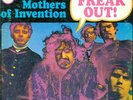
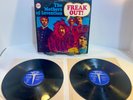
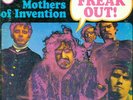
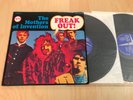
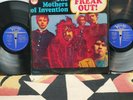
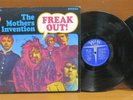
Mothers of Invention "Freak Out" 2x LP EX V6-5005-2 Frank Zappa
$
60


Favourite Auctions
To save auctions to your favourites, please login
If you don't have an account, please register
Description
Mothers of Invention "Freak Out" Gatefold LP Verve V6 5005-2 (US)
Vinyl is EX, Jacket is VG!
Original Press
In VRP sleeves
Track Listing:
A1 Hungry Freaks, Daddy 3:27 A2 I Ain't Got No Heart 2:30 A3 Who Are The Brain Police? 3:22 A4 Go Cry On Somebody Else's Shoulder 3:31 A5 Motherly Love 2:45 A6 How Could I Be Such A Fool 2:12 B1 Wowie Zowie 2:45 B2 You Didn't Try To Call Me 3:17 B3 Any Way The Wind Blows 2:52 B4 I'm Not Satisfied 2:37 B5 You're Probably Wondering Why I'm Here 3:37 C1 Trouble Comin' Every Day 6:10 Help, I'm A Rock (Suite In Three Movements) (8:37) C2.1 1st Movement: Okay To Tap Dance C2.2 2nd Movement: In Memoriam, Edgar Varese C2.3 3rd Movement: It Can't Happen Here The Return Of The Son Of Monster Magnet (Unfinished Ballet In Two Tableaus) (12:17) D1.1 I. Ritual Dance Of The Child-Killers D1.2 II. Nullis Pretii (No Commercial Potential)The Mothers of Invention were an American rock band from California that served as the backing musicians for Frank Zappa, a self-taught composer and performer whose diverse musical influences led him to create music that was often impossible to categorize. Their work is marked by the use of sonic experimentation, innovative album art, and elaborate live shows.
Originally an R&B band called The Soul Giants, the band's original lineup included Ray Collins, David Coronado, Roy Estrada and Jimmy Carl Black. Zappa was asked to take over as the band's guitarist following a fight between Collins and the band's original guitarist. Zappa insisted that the band perform original material, changing their name to The Mothers. Founded in 1964, the band first became popular playing in California's underground music scene in the late 1960s. Under Zappa's leadership, the band signed to Verve Records, releasing a début album, Freak Out! (1966), with a lineup which consisted of Zappa, Collins, Black, Estrada and Elliot Ingber.
Under Zappa's leadership and a fluctuating lineup, the band released a series of acclaimed albums, including Absolutely Free, We're Only in It for the Money and Uncle Meat, before being disbanded by Zappa in 1969. In 1970, Zappa formed a new lineup of The Mothers which included Ian Underwood, Jeff Simmons, George Duke, Aynsley Dunbar and singers Mark Volman and Howard Kaylan, formerly of The Turtles, who were credited as The Phlorescent Leech & Eddie for contractual reasons. Later adding another ex-Turtle, bassist Jim Pons, this lineup lasted until the end of 1971, when Zappa was injured by an audience member during a concert.
Zappa focused on big-band and orchestral music while recovering from his injuries, and later formed the Mothers' final lineup in 1973, which included Ralph Humphrey, Sal Marquez, George Duke, Tom and Bruce Fowler and Ruth and Ian Underwood. The final album using the Mothers as a backing band, Bongo Fury (1975), featured guitarist Denny Walley and drummer Terry Bozzio, who continued to play for Zappa on non-Mothers releases.
The Mothers of Invention played in New York in late 1966 and were offered a contract at the Garrick Theater during Easter 1967. This proved successful and Herb Cohen extended the booking, which eventually lasted half a year. As a result, Zappa and his wife, along with The Mothers of Invention, moved to New York. Their shows became a combination of improvised acts showcasing individual talents of the band as well as tight performances of Zappa's music. Everything was directed by Zappa's famous hand signals. Guest performers and audience participation became a regular part of the Garrick Theater shows. One evening, Zappa managed to entice some U.S. Marines from the audience onto the stage, where they proceeded to dismember a big baby doll, having been told by Zappa to pretend that it was a "gook baby".
Situated in New York, and only interrupted by the band's first European tour, The Mothers of Invention recorded the album widely regarded as the peak of the group's late 1960s work, We're Only in It for the Money (released 1968). It was produced by Zappa, with Wilson credited as executive producer. From then on, Zappa produced all albums released by The Mothers of Invention and as a solo artist. We're Only in It for the Money featured some of the most creative audio editing and production yet heard in pop music, and the songs ruthlessly satirized the hippie and flower power phenomena. The cover photo parodied that of The Beatles' Sgt Pepper's Lonely Hearts Club Band. The cover art was provided by Cal Schenkel whom Zappa met in New York. This initiated a lifelong collaboration in which Schenkel designed covers for numerous Zappa and Mothers albums.
Reflecting Zappa's eclectic approach to music, the next album, Cruising with Ruben & the Jets (1968), was very different. It represented a collection of doo-wop songs; listeners and critics were not sure whether the album was a satire or a tribute. Zappa has noted that the album was conceived in the way Stravinsky's compositions were in his neo-classical period: "If he could take the forms and clichés of the classical era and pervert them, why not do the same ... to doo-wop in the fifties?" A theme from Stravinsky's The Rite of Spring is heard during one song.
Zappa and The Mothers of Invention returned to Los Angeles in the summer of 1968. Despite being a success with fans in Europe, The Mothers of Invention were not faring well financially. Their first records were vocally oriented, but Zappa wrote more instrumental jazz and classical oriented music for the band's concerts, which confused audiences. Zappa felt that audiences failed to appreciate his "electrical chamber music".
In 1969 there were nine band members and Zappa was supporting the group himself from his publishing royalties whether they played or not. 1969 was also the year Zappa, fed up with MGM's interference, left MGM Records for Warner Bros. Records' Reprise Records subsidiary where Zappa/Mothers recordings would bear the Bizarre Records imprint. In late 1969, Zappa broke up the band. He often cited the financial strain as the main reason, but also commented on the band members' lack of sufficient effort. Many band members were bitter about Zappa's decision, and some took it as a sign of Zappa's concern for perfection at the expense of human feeling. Others were irritated by 'his autocratic ways', exemplified by Zappa's never staying at the same hotel as the band members. Several members would, however, play for Zappa in years to come. Remaining recordings with the band from this period were collected on Weasels Ripped My Flesh and Burnt Weeny Sandwich (both released in 1970).
All records are shipped in professional 7” & 12” box mailers. All CDs are shipped in padded bubble mailers. Buy multiple items and save on shipping. Thanks for Visiting!!
price rating