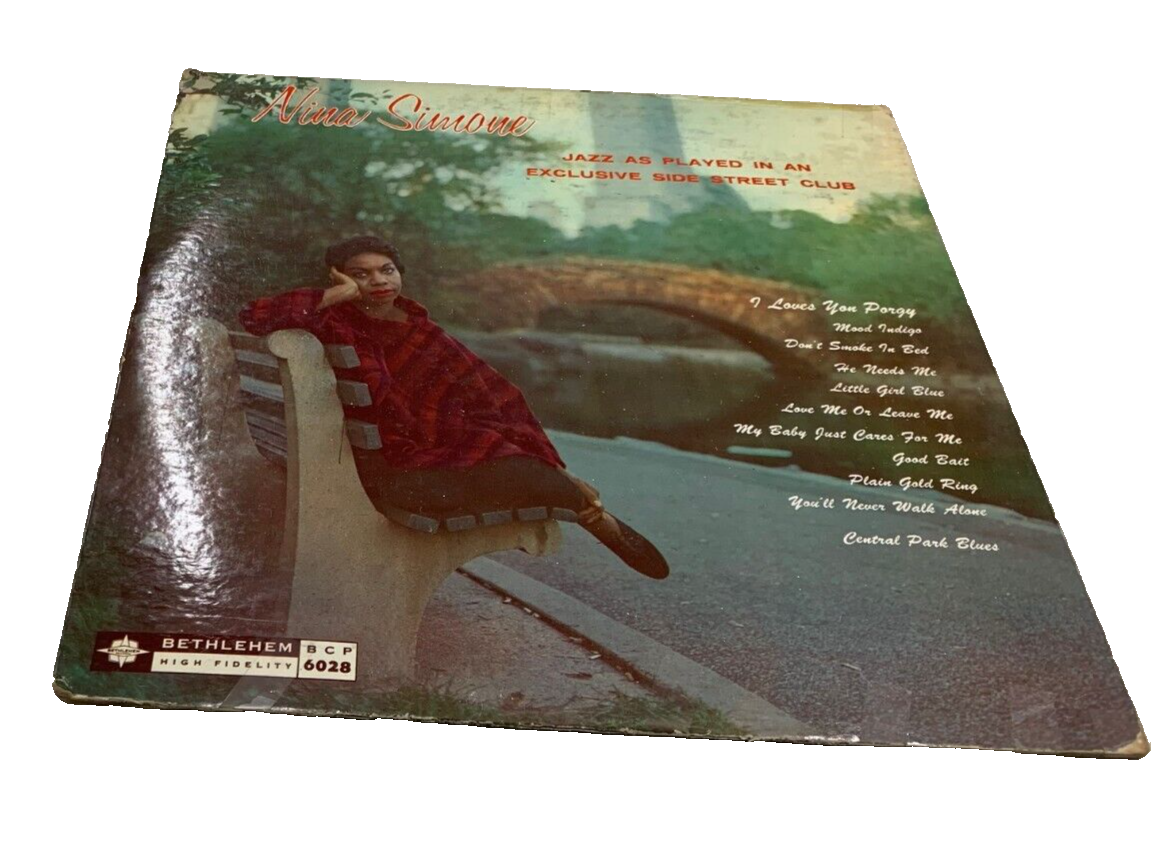
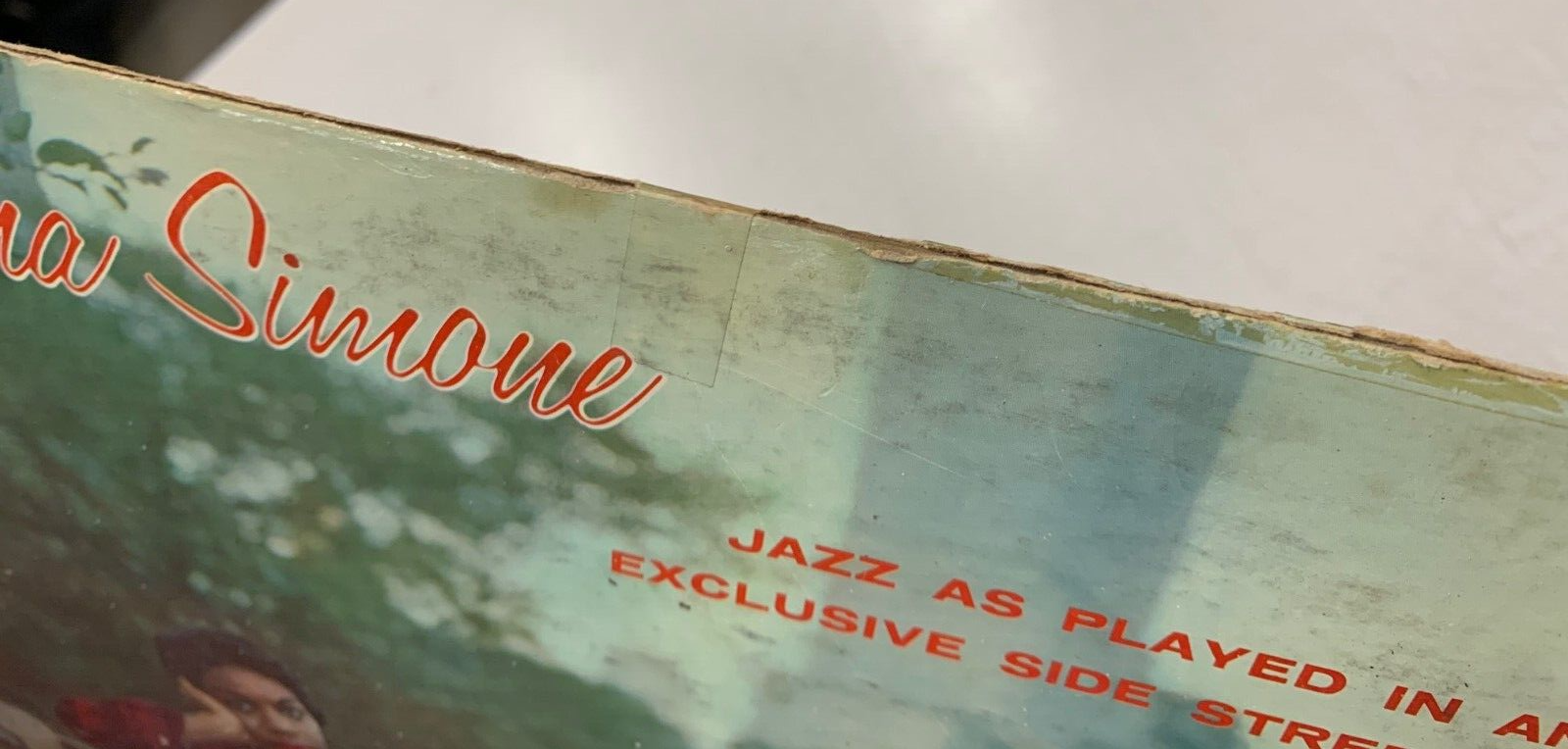
Nina Simone Little Girl Blue Bethlehem BCP-6028 1959 Mono Rare Debut Album
$
30


Favourite Auctions
To save auctions to your favourites, please login
If you don't have an account, please register
Description
Nina Simone – Little Girl Blue
Label: Bethlehem Records – BCP-6028, Bethlehem Records – BCP 6028 Format: Vinyl, LP, Album, Mono Country: US Released: Feb 1959 Genre: Jazz Style: Soul-Jazz A1 Mood Indigo 4:00 A2 Don't Smoke In Bed 3:09 A3 He Needs Me 2:26 A4 Little Girl Blue 4:12 A5 Love Me Or Leave Me 3:18 A6 My Baby Just Cares For Me 3:33 B1 Good Bait 5:25 B2 Plain Gold Ring 3:50 B3 You'll Never Walk Alone 3:58 B4 I Loves You Porgy 4:03 B5 Central Park Blues 3:05 Bass – Jimmy Bond Drums – Al Heath* Liner Notes – Joseph Muranyi* Piano, Vocals – Nina Simone This album is also known as "Jazz As Played In An Exclusive Side Street Club." However, the back cover and vinyl label read "Little Girl Blue."
Nina Simone (born Eunice Kathleen Waymon; February 21, 1933 – April 21, 2003) (/ˌniːnə sɪˈmoʊn/)[1] was an American singer, songwriter, pianist, composer, arranger and civil rights activist. Her music spanned styles including classical, folk, gospel, blues, jazz, R&B, and pop.
The sixth of eight children born into a poor family in North Carolina, Simone initially aspired to be a concert pianist.[2] With the help of a few supporters in her hometown, she enrolled in the Juilliard School of Music in New York City.[3] She then applied for a scholarship to study at the Curtis Institute of Music in Philadelphia, where, despite a well received audition, she was denied admission,[4] which she attributed to racism. In 2003, just days before her death, the Institute awarded her an honorary degree.[5]
To make a living, Simone started playing piano at a nightclub in Atlantic City. She changed her name to "Nina Simone" to disguise herself from family members, having chosen to play "the devil's music"[4] or so-called "cocktail piano". She was told in the nightclub that she would have to sing to her own accompaniment, which effectively launched her career as a jazz vocalist.[6] She went on to record more than 40 albums between 1958 and 1974, making her debut with Little Girl Blue. She released her first hit single in the United States in 1958 with "I Loves You, Porgy".[2] Her piano playing was strongly influenced by baroque and classical music, especially Johann Sebastian Bach,[7] and accompanied expressive, jazz-like singing in her contralto voice.[8][9]
Biography 1933–1954: Early life Simone was born on February 21, 1933, in Tryon, North Carolina. Her father, John Divine Waymon, worked as a barber and dry-cleaner as well as an entertainer, and her mother, Mary Kate Irvin, was a Methodist preacher.[10] The sixth of eight children[11] in a poor family, she began playing piano at the age of three or four; the first song she learned was "God Be With You, Till We Meet Again".[12] Demonstrating a talent with the piano, she performed at her local church. Her concert debut, a classical recital, was given when she was 12. Simone later said that during this performance, her parents, who had taken seats in the front row, were forced to move to the back of the hall to make way for white people.[13] She said that she refused to play until her parents were moved back to the front,[14][15] and that the incident contributed to her later involvement in the civil rights movement.[16] Simone's music teacher helped establish a special fund to pay for her education.[17] Subsequently, a local fund was set up to assist her continued education. With the help of this scholarship money, she was able to attend Allen High School for Girls in Asheville, North Carolina.[citation needed]
After her graduation, Simone spent the summer of 1950 at the Juilliard School as a student of Carl Friedberg, preparing for an audition at the Curtis Institute of Music in Philadelphia.[18] Her application, however, was denied. Only 3 of 72 applicants were accepted that year,[19] but as her family had relocated to Philadelphia in the expectation of her entry to Curtis, the blow to her aspirations was particularly heavy. For the rest of her life, she suspected that her application had been denied because of racial prejudice, a charge the staff at Curtis have denied.[20] Discouraged, she took private piano lessons with Vladimir Sokoloff, a professor at Curtis, but never could re-apply. At the time the Curtis institute did not accept students over 21. She took a job as a photographer's assistant, found work as an accompanist at Arlene Smith's vocal studio, and taught piano from her home in Philadelphia.[18]
1954–1959: Early success In order to fund her private lessons, Simone performed at the Midtown Bar & Grill on Pacific Avenue in Atlantic City, New Jersey, whose owner insisted that she sing as well as play the piano, which increased her income to $90 a week. In 1954, she adopted the stage name "Nina Simone". "Nina", derived from niña, was a nickname given to her by a boyfriend named Chico,[18] and "Simone" was taken from the French actress Simone Signoret, whom she had seen in the 1952 movie Casque d'Or.[21] Knowing her mother would not approve of playing "the Devil's music," she used her new stage name to remain undetected. Simone's mixture of jazz, blues, and classical music in her performances at the bar earned her a small but loyal fan base.[22]
In 1958, she befriended and married Don Ross, a beatnik who worked as a fairground barker, but quickly regretted their marriage.[23] Playing in small clubs in the same year, she recorded George Gershwin's "I Loves You, Porgy" (from Porgy and Bess), which she learned from a Billie Holiday album and performed as a favor to a friend. It became her only Billboard top 20 success in the United States, and her debut album Little Girl Blue followed in February 1959 on Bethlehem Records.[24][25][26] Because she had sold her rights outright for $3,000, Simone lost more than $1 million in royalties (notably for the 1980s re-release of her version of the jazz standard "My Baby Just Cares for Me") and never benefited financially from the album's sales.[27]
price rating



![Twin Peaks [Original Television Soundtrack] [LP] by Angelo Badalamenti (Vinyl, …](https://www.popsike.net/php/thumbnail.php?url=https://www.popsike.pics/pix/20170531/222529844304.jpg)