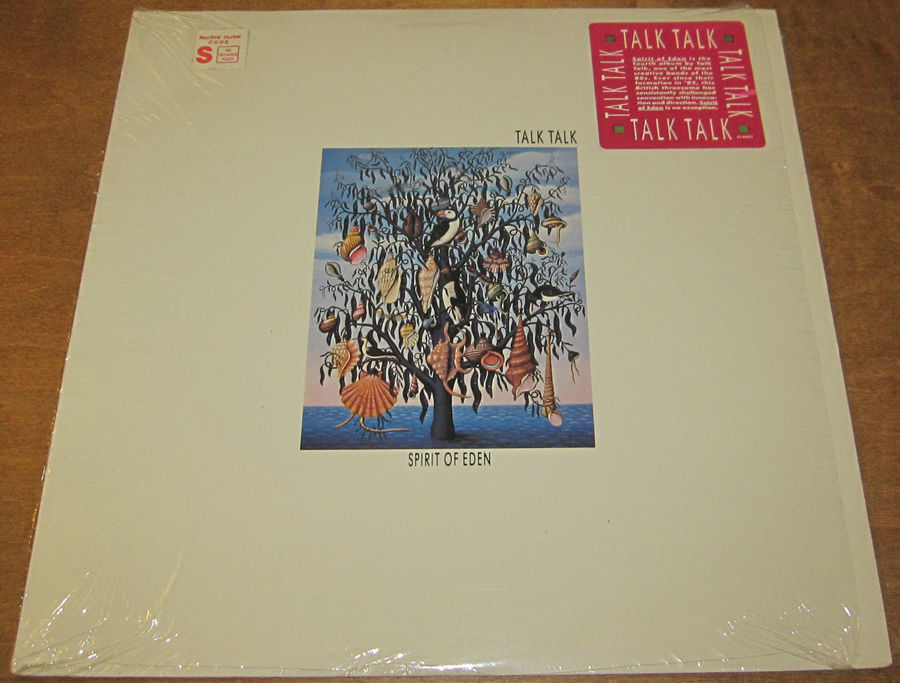
Original 1988 Talk Talk “Spirit of Eden” Vinyl LP
$
41


Favourite Auctions
To save auctions to your favourites, please login
If you don't have an account, please register
Description
This original vinyl LP, Spirit of Eden by Talk Talk, was issued by EMI/Capitol Records in 1988. The album has had the same owner since the 1980s and has been handled with meticulous care. The record itself, the sleeve, and the album jacket (which still has the original plastic wrapping on it) are all in excellent condition.
The record features the following tracks:
Side A
- The Rainbow – 9:05
- Eden – 6:37
- Desire – 7:08
Side B
- Inheritance – 5:16
- I Believe in You – 6:24
- Wealth – 6:35
Shipping is $4, which includes tracking. If you win any of our other auctions as well, we’re happy to combine the shipping for all items.
The following is from the Wikipedia entry for Spirit of Eden:
Spirit of Eden is the fourth album by the English New Wave band Talk Talk, released in 1988 on EMI Records. The album found neither critical acclaim nor commercial success on release, but has since become a cult favorite.
The songs were mostly written by vocalist Mark Hollis and producer Tim Friese-Greene, and the album was compiled from a lengthy recording process at London's Wessex Studios between 1987 and 1988. Often working in darkness, the band recorded many hours of improvised performances which were heavily edited and re-arranged into an album in mostly digital format. The songs contain elements of rock, jazz, classical, and ambient music.
Critics often view Spirit of Eden as a departure from Talk Talk's earlier and more accessible albums. Compared to their 1986 hit The Colour of Spring, it was a commercial disappointment. However, a plurality of critical reviews laud the album.
Background
Talk Talk, led by singer Mark Hollis, formed in England in the early 1980s. From the start, Hollis cited jazz and classical artists like Miles Davis, John Coltrane, Béla Bartók, and Claude Debussy as major influences. But Talk Talk's first two albums, The Party's Over (1982) and It's My Life (1984), did not readily reflect such influences; critics compared the band to contemporary new wave groups, especially Duran Duran. Hollis partly attributes the shortcomings of their early music to a financial need to use synthesizers in place of acoustic instruments.
Although critics did not favor the band's early output, the first two albums were commercially successful in Europe. This gave Talk Talk the money needed to hire additional musicians to play on their next album, The Colour of Spring (1986). The band no longer had to rely on synthesizers. Instead, musicians improvised with their instruments for many hours, then Hollis and producer Tim Friese-Greene edited and arranged the performances to get the sound they wanted. A total of 16 musicians appeared on the album. The Colour of Spring became Talk Talk's most successful album, selling over two million copies and prompting a major world tour. At the same time, minimalist songs like "April 5th," "Chameleon Day," and the B-side "It's Getting Late in the Evening" pointed toward the band's next direction.
Recording
For the success of The Colour of Spring, EMI rewarded Talk Talk with an open budget and schedule for the recording of their next album, Spirit of Eden. Talk Talk were given complete control over the recording process; their manager and EMI executives were barred from studio sessions. Recording for Spirit of Eden began in 1987 at Wessex Studios, London and took about a year to complete.
Engineer Phill Brown said that the album, along with its successor, was "recorded by chance, accident, and hours of trying every possible overdub idea."
Contract Dispute with EMI
By early March 1988, the band had finished recording Spirit of Eden and had sent a cassette of the album to EMI. After listening to the cassette, EMI representatives doubted that it could be commercially successful. They asked Hollis to re-record a song or replace material, but he refused to do so. By the time the masters were delivered later in the month, however, the label conceded that the album had been satisfactorily completed.
Despite their reservations towards Spirit of Eden, EMI chose to exercise their option to extend the recording contract. The band, however, wanted out of the contract. "I knew by that time that EMI was not the company this band should be with," manager Keith Aspden told Mojo. "I was fearful that the money wouldn't be there to record another album." EMI and Talk Talk went to court to decide the issue.
The case centered on whether EMI had notified the band in time about the contract extension. As part of the agreement, EMI had to send a written notice within three months after the completion of Spirit of Eden. The band said that EMI had sent the notice too late, arguing that the three-month period began once recording had finished; EMI argued that the three-month period did not begin until they were satisfied with the recording. Justice Andrew Morritt ruled in favor of EMI, but his decision was overturned in the Court of Appeal of England and Wales. Talk Talk were released from the contract and later signed to Polydor.
Marketing and Release
Spirit of Eden's moody, experimental nature made it a challenge to promote; one critic said it "is the kind of record which encourages marketing men to commit suicide.” Evaluating some masterpieces of the ‘80s in a 2004 article for The Guardian, John Robinson calls Spirit of Eden, like David Sylvian's Brilliant Trees, "triumphant, [but] completely unmarketable."
Although the band did not originally plan to release a single, EMI issued a radio edit of "I Believe In You" in September 1988 (the previously unreleased "John Cope" was included as the B-side). The single failed to breach the UK Singles Chart Top 75. Around November, Tim Pope directed a music video for "I Believe in You," featuring Hollis sitting with his guitar, singing the lyrics. "That was a massive mistake," said Hollis. "I thought just by sitting there and listening and really thinking about what it was about, I could get that in my eyes. But you cannot do it. It just feels stupid."
The band did not tour in support of the album. Hollis explained, "There is no way that I could ever play again a lot of the stuff I played on this album because I just wouldn't know how to. So, to play it live, to take a part that was done in spontaneity, to write it down and then get someone to play it, would lose the whole point, lose the whole purity of what it was in the first place.” The band would never tour again.
Spirit of Eden was released worldwide in 1988. It did not enjoy nearly as much commercial success as The Colour of Spring. The album spent five weeks on the UK Albums Chart, peaking at #19. The album cover depicts a tree festooned with seashells, snails, birds, and insects. It was illustrated by James Marsh, who did Talk Talk's artwork throughout its recording career. The booklet provides reproductions of Hollis' handwritten lyrics. The album was digitally remastered by Phill Brown and Denis Blackham in 1997.
Critical Reception
Spirit of Eden has been both acclaimed and panned by numerous music critics. Marcus Berkmann of The Spectator in a 2001 retrospective felt that the album was "almost wilfully obscure," with a musical style close to free-form jazz that was too far removed from The Colour of Spring for fans to enjoy. Roy Wilkinson of Sounds felt that the band had "evolved into contemplative muso-techs," and while their lyrics were a weak point and the second side did not fully work, the first side achieved "magnificence."
In the 1992 Rolling Stone Album Guide, J.D. Considine rated the album 1 star out of 5: "Instead of getting better or worse, this band simply grew more pretentious with each passing year. . . . By Spirit of Eden, Mark Hollis's Pete Townshend-on-Dramamine vocals had been pushed aside by the band's pointless noodling." Simon Williams of NME found the album “aimless,” but admitted "they're resolute and determined, flaunting commercial rules with fascinating disregard for understanding or acceptance.” A review in Q criticized the band for not attempting to create more commercial music, but concluded that "If Spirit of Eden often recalls the pastoral epics of the early ‘70s, it has a range, ambition, and self-sufficiency that enables Hollis and company to step out of time and into their own.” PopMatters's retrospective review named Spirit of Eden "an album for the ages.” Pitchfork Media named Spirit of Eden the 34th best album of the 1980s. In 2006, Q magazine placed the album at No. 31 in its list of "40 Best Albums of the '80s.” In 2012, Slant magazine listed the album at No. 56 on its list of "Best Albums of the 1980s.” In 2013, NME placed it as number 95 in its list of NME's The 500 Greatest Albums of All Time.
Legacy
Some music critics consider Spirit of Eden and its 1991 follow-up Laughing Stock influential to post-rock, a music genre that developed in Britain and North America in the 1990s. In a review of Bark Psychosis' album Hex, where the term "post-rock" was coined, Simon Reynolds opined that Hex aspires to the "baroque grandeur" of Spirit of Eden. Andy Whitman of Paste magazine argues that Spirit of Eden represents the beginning of post-rock: "The telltale marks of the genre — textured guitars, glacial tempos, an emphasis on dynamics, electronica, ambience and minimalism — were all in place, and paved the way for bands like Sigur Rós, Mogwai, Godspeed You! Black Emperor, Low, and latter-period Radiohead." Simon Harper of the Birmingham Post observed how "their combination of jazz, classical, rock, and the spacey echoes of dub, using silence almost as an instrument in its own right, lends itself to the vernacular of post-rock, and there can be little argument that Tortoise and their Chicago-based compatriots would hardly sound the same were it not for the staggering achievements of Hollis and Tim Friese-Greene.” Numerous bands and artists, including Graham Coxon, Doves, and Elbow, have praised Spirit of Eden or have cited it as an influence.
In 2008 Alan McGee wrote: "Spirit of Eden has not dated; it's remarkable how contemporary it sounds, anticipating post-rock, The Verve, and Radiohead. It's the sound of an artist being given the keys to the kingdom and returning with art."
price rating