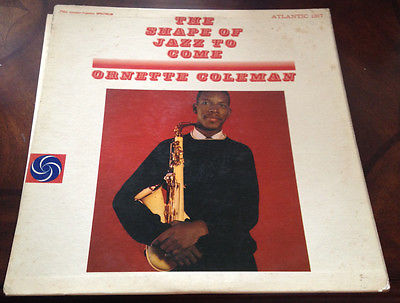
Ornette Coleman ?The Shape Of Jazz To Come Atlantic 1317 Mono Bullseye Free Jazz
$
100


Favourite Auctions
To save auctions to your favourites, please login
If you don't have an account, please register
Description
Ornette Coleman ?– The Shape Of Jazz To Come Label: Atlantic ?– 1317 Format: Vinyl, LP, Album, Mono Country: US Released: 1959 Genre: Jazz Style: Tracklist A1 Lonely Woman 4:59 A2 Eventually 4:20 A3 Peace 9:04 B1 Focus On Sanity 6:50 B2 Congeniality 6:41 B3 Chronology 6:05 Credits Alto Saxophone – Ornette Coleman Cornet – Don Cherry Double Bass – Charlie Haden Drums – Billy Higgins Engineer [Recording] – Bones Howe 1959 was a notably productive year for Coleman. His last release on Contemporary was Tomorrow Is the Question!, a quartet album, with Shelly Manne on drums, and excluding the piano, which he would not use again until the 1990s. Next Coleman brought double bassist Charlie Haden – one of a handful of his most important collaborators – into a regular group with Cherry and Higgins. (All four had played with Paul Bley the previous year.) He signed a multi-album contract with Atlantic Records who released The Shape of Jazz to Come in 1959. It was, according to critic Steve Huey, "a watershed event in the genesis of avant-garde jazz, profoundly steering its future course and throwing down a gauntlet that some still haven't come to grips with."[8] While definitely – if somewhat loosely – blues-based and often quite melodic, the album's compositions were considered at that time harmonically unusual and unstructured. Some musicians and critics saw Coleman as an iconoclast; others, including conductor Leonard Bernstein and composer Virgil Thomson regarded him as a genius and an innovator.[9] Coleman's quartet received a lengthy – and sometimes controversial – engagement at New York City's famed Five Spot jazz club. Such notable figures as the Modern Jazz Quartet, Leonard Bernstein and Lionel Hampton were favorably impressed, and offered encouragement. (Hampton was so impressed he reportedly asked to perform with the quartet; Bernstein later helped Haden obtain a composition grant from the John Simon Guggenheim Memorial Foundation.) Opinion was, however, divided. Trumpeter Miles Davis famously declared Coleman was "all screwed up inside",[10] although Davis later recanted this comment and became a proponent of Coleman's musical innovations.[11] Roy Eldridge stated, "I'd listened to him all kinds of ways. I listened to him high and I listened to him cold sober. I even played with him. I think he's jiving baby."[12] Coleman's unique early sound was due in part to his use of a plastic saxophone. He had first bought a plastic horn in Los Angeles in 1954 because he was unable to afford a metal saxophone, though he didn't like the sound of the plastic instrument at first.[13] Coleman later claimed that it sounded drier, without the pinging sound of metal. In later years, he played a metal saxophone.[14] On the Atlantic recordings, Coleman's sidemen in the quartet are Cherry on cornet or pocket trumpet, Haden, Scott LaFaro, and then Jimmy Garrison on bass, and Higgins or his replacement Ed Blackwell on drums.