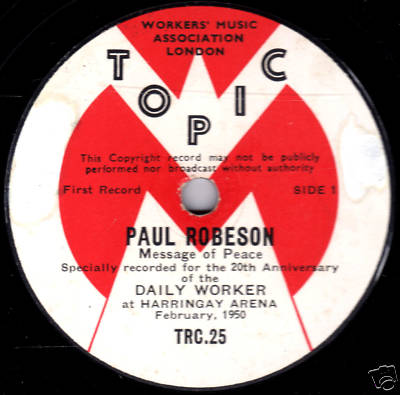
PAUL ROBESON "MESSAGE OF PEACE" 2 RECORD SET
£
22
$
29


Favourite Auctions
To save auctions to your favourites, please login
If you don't have an account, please register
Description
A MEGA RARE SET OF TWO 12" RECORDS OF PAUL ROBESON'S "MESSAGE OF PEACE"
SPECIALLY RECORDED FOR THE 20th ANNIVERSARY OF THE DAILY WORKER AT HARRINGAY ARENA FEBRUARY 1950
Paul Robeson(1898–1976), influential African American singer, actor, and social activist. Paul Robson was born in Princeton, New Jersey, and was the child of a clergyman who had been born a slave. After winning a scholarship competition, Robeson attended Rutgers University, distinguishing himself as both scholar and athlete. While at Rutgers he augmented his scholarship income by offering concerts and dramatic performances. After graduating from Columbia Law School in 1923, Robeson turned to dramatic and musical theater where he became internationally celebrated. His roles in Eugene O'Neill's All God's Chillun Got Wings (1924) and Emperor Jones (1924 in New York and 1925 in London) catapulted him to prominence as a serious actor when opportunities for African Americans on stage were generally limited to the comic or to racist stereotypes. Robeson's performances in productions of Shakespeare, particularly Othello, were enormously popular and won him enthusiastic critical acclaim.
Robeson was always acutely conscious of the complex racial politics of the American scene (even as early as his Rutgers years). From the mid-1930s on Robeson became increasingly interested in Communism, particularly as it seemed to speak to the plight of African Americans. In this respect, the trajectory of Robeson's life mirrors that of many African American artists and intellectuals, such as Richard Wright and Ralph Ellison. Robeson's interest in radical politics deepened over the years, even as it limited his opportunities to perform. This limitation became especially pronounced in the early 1950s, given the advent of explicit conflict between the United States and the Soviet Union. Unlike Wright, who renounced Communism in favor of a more generalized anticolonialism, Robeson continued his interest in the politics of Communism, bringing him into conflict with the government of the United States, which revoked his passport (in 1950), though it was restored in 1958. Robeson spent the latter years of his life in ill health, living in Europe and later in the United States.
Topic issued its first record in 1939 as a record club label of the Workers Music Association (WMA), formed three years earlier by the composer Alan Bush, following a meeting of five London socialist choirs.
Bush is an under-rated composer who, like contemporaries such as Michael Tippett. was politically engaged. He joined the Independent Labour Party in 1924, when it was still affiliated to the Labour Party. On its disaffiliation in 1929, he resigned to join the Labour Party. Bush devoted much time and effort to organising politically-oriented popular choirs such as the London Labour Choral Union, and in 1934 he staged “The Pageant of Labour” in collaboration with Tippett. In 1935 he joined the Communist Party.
Through the 1930s, the Stalinised Communist Party attracted into its ranks many artists who were concerned at the growth of fascism. However, it was the Popular Front policies pursued by the Communist Parties that helped lead to the victory of fascism in Germany and Spain. Rather than mobilising the working class independently against the bourgeoisie and its fascist representatives, Stalinism insisted that the struggle against the fascist danger took priority over the struggle for socialism. The CPs demanded the subordination of workers’ organisations to a broad coalition of “anti-fascist” forces that were the political representatives of the supposedly democratic bourgeoisie. Workers were disarmed, and the way left open for fascism to seize power.
The Popular Front took specific cultural forms, with the promotion of national “people’s”, or “folk”, music and poetry. The WMA was formed in 1936 to promote the composition and performance of music “which expresses the ideals and aims of mankind towards the improved organisation of society; music which exerts an influence against the social injustices of our present society,” as the book puts it. It won support from many of the leading artistes of the day, such as Benjamin Britten, Peter Pears, and John Ireland.
The WMA established Topic to release “gramophone records of historical and social interest.” Its first release was the socialist anthem The Internationale matched with The Man That Waters the Workers’ Beer, both included here.
Much of the documentation for this early period has been lost, but a survey of the accompanying complete 1939-2009 catalogue shows the political line of the early years. Alongside pieces originating in Unity shows, and the occasional item by a contemporary composer, a substantial number of the records were versions of songs from the Soviet Union and across Europe.
In 1950 Topic issued this 2-disc set of Paul Robeson’s “Message of Peace,” recorded at a rally to mark the 20th anniversary of the CP’s paper The Daily Worker.
DISC DETAILS:UK TOPIC TRC 25/26 12" 78rpm SHELLAC
CONDITION: THE ACTUAL PLAYING SURFACE OF BOTH DISCS IS EXCELLENT or EX+
However, there is slight water mark damage around the edges of the labels and there is a small rim flake on side 1 of TRC25. This does not enter the playing surface and does not affect play.
DON'T MISS OUT ON THIS MEGA RARE AND HISTORIC TWO RECORD SET
BID NOW!!
POSTAGE STUFF
I AM HAPPY TO OFFER A POSTAGE REBATE FOR EVERY EXTRA 78rpm RECORD BOUGHT THAT GOES IN THE SAME POSTAL PACKET WHERE POSTAGE IS LISTED AS "FREE" in the UK.
12" 78 RPM RECORDS NEED CAREFULLY PACKING, AND THE PRICE QUOTED INCLUDES POSTAGE AND PACKING IN THE UK - HENCE THE APPARANTLY HIGH START PRICE TO THIS AUCTION ITEM.
Pay instantly with your debit or credit card through PayPal.
price rating