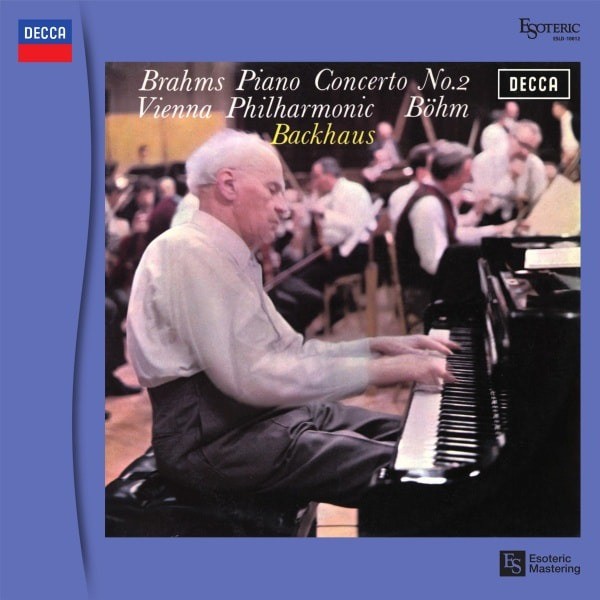
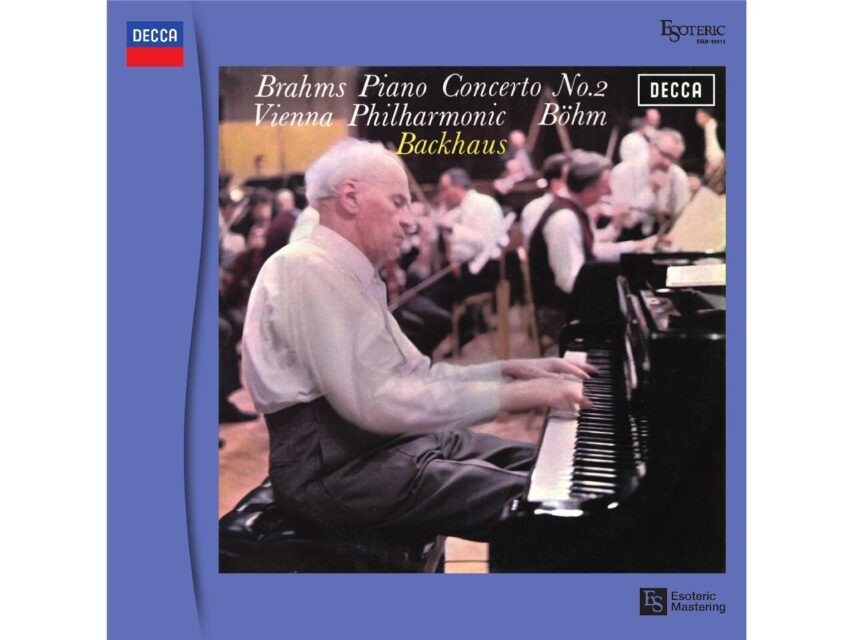
PSL ESOTERIC ESLD-10012 Karl Bohm BRAHMS Piano Concerto No.2 Backhaus Vinyl
$
75



Favourite Auctions
To save auctions to your favourites, please login
If you don't have an account, please register
Description
Click here to see all products in our store!
* International Buyers - Please Note:
Import Duties & Taxes Policy
United States
All shipments to the U.S. are sent DDP (Delivered Duty Paid). Import duty, taxes and brokerage are prepaid — no extra payment at delivery.
Other Countries
Unless duties/taxes are already collected by eBay at checkout, shipments are sent DDU (Delivered Duty Unpaid) and the buyer is responsible for import VAT/GST, duty, and carrier fees on delivery.
* Description
Brahms: Piano Concerto No. 2
The ultimate Brahms by a super-veteran who mastered music born in the LP era
Johannes Brahms
Piano Concerto No. 2 in B-flat major, Op. 83
Side A
1. First Movement: Allegro non troppo
2. Second Movement: Allegro appassionato
Side B
1. Movement 3: Andante - Più adagio
2. Movement 4: Allegretto grazioso - Un poco più presto
[Performers] Wilhelm Backhaus (Piano), Emanuel Brabetz (Cello), Vienna Philharmonic Orchestra
[Conductor] Karl Böhm
[Recording] April 1967, Vienna, Sofiensaal
Though half a century has passed since this recording, it remains a unique performance, unfolding before us as a presentation of what this work should be.
Wilhelm Backhaus (1884–1969) was a master pianist representing 20th-century Germany, a musician who embodied German spiritualism.
In his youth, he was a virtuoso who flaunted dazzling technique, earning him the nickname “Lion of the Keyboard.” Yet, as he aged, he shed external beauty, transforming in his later years into a performer whose hallmark was a ruggedness that could be called the pinnacle of masculinity.
His performances, combining unparalleled grandeur with sublime humanity, represented the very essence of German music. In his repertoire of Bach, Mozart, Haydn, Beethoven, Brahms, and others, he delivered interpretations that mastered unparalleled depths of artistry.
Backhaus's recording of Brahms's Piano Concerto No. 2 with the Vienna Philharmonic conducted by the great Karl Böhm (1894-1981) for Decca in 1967 is truly an evergreen masterpiece that has never disappeared from the catalog since its release.
As a boy, Backhaus studied under the great pianist Darbel, who taught him the traditions of German music, particularly Beethoven interpretation.
He was also an early proponent of recording, beginning in 1908 during the era of mechanical recording, and making numerous recordings for EMI during the era of electrical recording.
What cemented Backhaus's worldwide fame was a series of recordings he made under contract with Decca in 1948, coinciding with the advent of LP records.
From his recital in Ossiach, Austria, on June 28, 1969, until his death at age 85 on July 5, he recorded the complete Beethoven piano sonatas and concertos twice, along with major repertoire from Bach to Brahms, primarily in Geneva and Vienna. After World War II, he moved to Decca, continuing to record his late-career mastery through monaural and stereo formats, captured in Decca's signature clear and three-dimensional sound.
Brahms' Piano Concerto No. 2 was one of Backhaus's most celebrated concertos. He recorded it twice before: in 1939 during the SP era with Böhm and the Staatskapelle Dresden, and in 1952 during the monaural era with Schuricht and the Vienna Philharmonic. His 1967 stereo recording with Böhm and the Vienna Philharmonic marked his third recording of this work.
More than half a century after its recording, it remains cherished by many as a supreme masterpiece. It is also the final recording featuring the collaboration of two giants who carried on the tradition of Brahms' masterpiece since its premiere, truly deserving of the title of a historic recording.
Bachhaus was already 83 at the time of this recording, while conductor Böhm was ten years his junior.
Böhm debuted at the Graz State Opera in 1917, served as Music Director of the Dresden Staatskapelle (State Opera) from 1934, and held the position of Music Director at the Vienna State Opera from 1943-45 and again from 1954-56.
After that, Böhm was active primarily in Vienna, as well as at the Salzburg Festival, the Bayreuth Festival, the Metropolitan Opera, and with major opera houses and orchestras worldwide. He was a beloved maestro who frequently visited Japan with the Vienna Philharmonic until the year before his death in 1981, cherished by many fans.
This collaboration between the two is truly the ultimate combination. The performance unfolds as the ideal for this piece in every aspect: sound, tempo, and sense of breathing.
The production was handled by Ray Mintschal, who oversaw recordings of Britten and Kertész for Decca, working in tandem with engineer Mike Miles for the recording.
From 1956 until the 1980s, the Sofienhalle, which became Decca's home ground for stereo sessions in Vienna, was built as a bathhouse in the first half of the 19th century and was later used as a ballroom, where Johann Bogner-Strauß also frequently performed.
This hall was ideal for Decca's recording policy of capturing and reproducing even the smallest details with clarity, and it produced a series of legendary recordings that became synonymous with the Decca sound, including Solti's legendary Ring cycle.
This Brahms recording is one such example. Centered on the beautiful, restrained solo piano (Bösendorfer), it clearly and three-dimensionally reproduces the silky yet rich string section, the aromatic brilliance of the brass, and the distinctive sounds of the woodwinds, such as the Viennese oboe and clarinet. Even now, nearly half a century after its recording, the appeal of its vivid sound has not faded.
* Shipping
We ship using FedEx, DHL and UPS or Japan Post.
* Payment
We usually ship within 3〜7 business days of receiving cleared payment.
price rating