Paul McCartney "McCartney" Apple PCS 7102 UK 1st 3U/3U g/fold 1970 + Apple inner
£
16
$
21


Favourite Auctions
To save auctions to your favourites, please login
If you don't have an account, please register
Description
McCartney "McCartney" Apple Records ?PCS 7102 UK 1st press
Vinyl, LP, released, in 1970, in a gate-fold cover with a plain white Apple inner sleeve, carrying a patent caption at the bottom left.
The vinyl appears to have been lightly played and is in great shape. It played through beautifully on my elderly stereo - no hop, stick or jump. The LP is housed in its original plain white Apple inner sleeve, carrying a patent caption at the bottom left. The inner is in lovely condition - no rips or writing. The gate-fold sleeve has some slight lifting of the laminate but, that apart, is in good shape again, with no rips or writing. The spine is intact and legible. Matrix / Runout Side 1 : YEX 775 - 3U Matrix / Runout Side 2 : YEX 776 - 3U
"McCartney" is Paul McCartney's debut solo album. It was issued on Apple Records in April 1970 after McCartney had resisted attempts by his Beatles bandmates to have the release delayed to allow for Apple's previously scheduled titles, notably the band's "Let It Be" album. McCartney recorded his album during a period of depression and confusion, following John Lennon's private announcement in September 1969 that he was leaving the Beatles, and the conflict over its release further estranged McCartney from his bandmates. A press release in the form of a self-interview, supplied with UK promotional copies of "McCartney", led to the announcement of the group's break-up on 10 April 1970.
McCartney recorded the album in secrecy, mostly using basic home-recording equipment set up at his house in St John's Wood. Mixing and some later recording took place at professional studios in London, which McCartney booked under an alias to maintain anonymity. Apart from occasional contributions by his wife, Linda, he performed the entire album by himself, playing every instrument via overdubbing on four-track tape. In its preference for loosely arranged performance over polished production, McCartney eschewed the sophistication of the Beatles' work with George Martin in favour of a back-to-basics style that partly suggested McCartney's original concept for the Beatles' "Let It Be" project (then titled "Get Back") in 1969.
On release, the album received an unfavourable response from the majority of music critics, partly as a result of McCartney's role in officially ending the Beatles' career. Many reviewers criticised the inclusion of half-finished songs and McCartney's reliance on instrumental pieces, although the love song "Maybe I'm Amazed" was consistently singled out for praise. Commercially, "McCartney" benefited from the publicity surrounding the break-up; it held the number 1 position for three weeks on the US chart compiled by Billboard magazine and peaked at number 2 in Britain.
Following John Lennon's announcement in a band meeting on 20 September 1969 that he wanted a "divorce" from the Beatles, Paul McCartney withdrew to his farm in Campbeltown, Scotland. Author Robert Rodriguez describes his frame of mind as: "brokenhearted, shocked, and dispirited at the loss of the only job he had ever known". While the announcement was not made official, partly for business reasons, McCartney's period in seclusion with his family coincided with widespread rumours in America that he had died – an escalation of the three-year-old "Paul Is Dead" rumour. The rumour was broken only by journalists from BBC Radio and Life magazine tracking him down at his farm, High Park.
McCartney's months in Scotland created an estrangement between him and his bandmates, further to the division caused by their appointment of Allen Klein as business manager in May that year. McCartney later cited Klein's appointment as the first "irreconcilable difference" within the Beatles, since he continued to favour New York lawyers Lee Eastman and John Eastman – father and brother, respectively, of his wife Linda. For McCartney, the period following Lennon's departure was also marked by a bout of severe depression, during which, in his own estimation, he came close to suffering a nervous breakdown.
In his book 'Fab: An Intimate Life of Paul McCartney' (2010), Howard Sounes writes of the McCartneys' exile at High Park: "This was grim for Linda. She had a seven-year-old and a baby to look after, with a husband who was depressed and drunk. She later told friends it was one of the most difficult times in her life, while Paul reflected that he might have become a rock 'n' roll casualty at this point in his career." With Linda's encouragement, McCartney began to consider a future outside the Beatles, by writing or finishing songs for his first solo album, "McCartney".
McCartney and his family returned to London shortly before Christmas 1969, and he started work on the album at his home in Cavendish Avenue, St John's Wood. The recordings were carried out on a recently delivered Studer four-track tape recorder, without a mixing desk, and therefore without VU displays as a guide for recording levels. In the commentary he later supplied with the album, McCartney described his home-recording set-up as "Studer, one mike, and nerve".
On 12 February, McCartney took his Studer tapes to Morgan Studios, in the north-west London suburb of Willesden, in order to copy all the four-track recordings onto eight-track tape, to allow for further overdubbing. Keen to maintain secrecy about the project, McCartney worked at Morgan under the pseudonym "Billy Martin".
On 21 February 1970, McCartney moved to the more familiar Abbey Road Studios, with the booking again under the name of Billy Martin. There, he carried out further mixing on the previously recorded material, as well as taping new selections.
With his debut solo album, McCartney eschewed the musical sophistication that had distinguished the Beatles' work with producer George Martin, particularly the band's 1969 album "Abbey Road". According to The New Rolling Stone Encyclopedia of Rock & Roll, McCartney is "a one-man-studio-band LP" with "a pronounced homemade quality; it was spare and sounded almost unfinished". Rodriguez writes that in his avoidance of the Abbey Road studio aesthetic, "In his own way, [McCartney] was fulfilling the 'as-nature-intended' theme of the aborted 'Get Back' sessions, albeit as a one-and-a-half man band." McCartney played all the musical instruments on the album – from acoustic and electric guitars and bass to keyboards, drums and various percussion instruments – with Linda supplying backing vocals on some songs, most noticeably on "Man We Was Lonely". She also contributed the breathing and animal-like sounds, with McCartney, on the album-closing "Kreen-Akrore". McCartney has said that Linda was instrumental in bolstering his spirits and confidence during the making of "McCartney".
On 23 March, while American producer Phil Spector began mixing the Get Back tapes for release as the Beatles' "Let It Be" album in Abbey Road's Studio 4, McCartney completed work on his eponymous album in Studio 2. Although McCartney has frequently maintained that he was ignorant of Spector's involvement until receiving an acetate copy of "Let It Be" for approval, author Peter Doggett writes that after "several weeks", McCartney had finally "answered the string of messages he'd received about Phil Spector" and had agreed to let him prepare "Let It Be" for release.
For the album's gate-fold cover, artist Gordon House and designer Roger Huggett worked on a design concept by McCartney. Photos by Linda McCartney featured throughout the packaging, including a collage of 21 family snapshots in the jacket's inner spread. The images depicted Paul, Linda, seven-year-old Heather (Linda's daughter by her first marriage), newborn Mary, and the McCartneys' sheepdog, Martha. The gate-fold cover of "McCartney" was the first of close to 30 years of albums by her husband to feature Linda McCartney's photography.
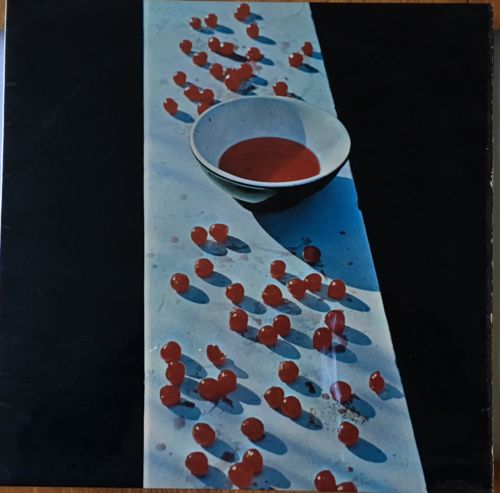
Set against a black background, the front cover image consisted of a bowl of cherry-red liquid placed on a cream-coloured counter and surrounded by loose red cherries, as if the fruit had been emptied from the bowl. On the back cover, a photo taken by Linda in Scotland showed her husband with Mary tucked inside his fur-lined leather jacket. Madinger and Easter comment that, unlike Lennon, McCartney did not feel the need to include his wife on the cover, and her back-cover photo was a "stunning" contribution from the former professional photographer. In a 2013 news article recalling the album's release, the Philadelphia radio station WMMR described the photo of McCartney and his baby daughter as "iconic" and reflective of "his ultimate message: 'Home, family (and) love'."
McCartney has said that he "boycotted" Apple's offices after Klein's arrival in 1969. His continued isolation in 1970 led to Lennon, Harrison and Starr making business decisions without McCartney's input. One decision concerned the release of the "Let It Be" documentary, a necessity in order to fulfil the Beatles' contractual obligations to film company United Artists. McCartney had privately agreed to a mid-April release date for McCartney with Apple Records executive Neil Aspinall, one of the few people associated with the Beatles who was aware of the project. Its late addition to Apple's schedule clashed with the imminent release of the "Let It Be" album, and of Starr's solo debut, "Sentimental Journey", which was due out on 27 March. On 25 March, after discovering that Klein had already arranged to have the release of "McCartney" postponed, McCartney received an assurance from Harrison, as a director of Apple Records, that his solo album would be issued on 17 April, as planned.
The situation then changed when Spector reported that work on the "Let It Be" album was almost complete, meaning that it could be issued to coincide with the film's world premiere, which was scheduled for 28 April, in New York. Doggett writes that "the solution was obvious", since "Let It Be" was "a multimedia package" and, as a band venture rather than a solo album, it "should automatically take precedence". Harrison and Lennon therefore wrote to McCartney on 31 March to say that they had instructed EMI, Apple's parent label, to postpone his album until 4 June; they also explained the need to stagger the various new releases, particularly in America, where the "Hey Jude" compilation had been issued on 26 February. Rather than have a member of staff deliver the letter to McCartney at Cavendish Avenue, Starr decided to take it to him personally.
McCartney later described the tone of Starr's message as "the party line", to which he reacted badly: "I told [Starr] to get out. I had to do something like that in order to assert myself because I was just sinking ... I was getting pummelled about the head, in my mind anyway." According to Starr, McCartney "went crazy", threatening: "I'll finish you now. You'll pay!" Although the other Beatles backed down over the release of "McCartney", the confrontation initiated what Rodriguez terms "a three-against-one war" within the band.
On 9 April, McCartney released a Q&A package to the British press, in which he explained his reasons for making his solo album and described its overall theme as "Home, Family, Love". Compiled with the help of Apple executives Derek Taylor and Peter Brown, the self-interview also contained questions McCartney imagined he would be asked regarding the possibility of the Beatles splitting up. While stopping short of saying that the band was finished, McCartney stated that he did not know whether his "break with the Beatles" would be temporary or permanent and that it was based on business, personal and creative differences. He also said that he had not missed Starr's drumming, nor any of his bandmates' contributions, when making the album, and could not envisage a time when he and Lennon would write together again. When asked whether Klein and his company ABKCO would be "in any way involved with the production, manufacturing, distribution or promotion of this new album", McCartney said, "Not if I can help it", and he stressed that Klein was in no way his business representative. Although McCartney later recalled that he was responding to questions put to him, Brown said that McCartney wrote all the questions, as did Taylor.
That same day, McCartney called Lennon at the clinic where he was undergoing primal scream therapy with his wife, Yoko Ono. McCartney told him that he was following Lennon's example and leaving the Beatles, but he made no mention of announcing it. Doggett suggests that McCartney's intention was not necessarily to break up the band, and cites Beatles confidant Ray Connolly's recollection that McCartney was "devastated" by the media's interpretation of his self-interview. The first reaction from the press was a piece by Don Short of the Daily Mirror, on 10 April, titled "PAUL IS QUITTING THE BEATLES". From there, in author Mark Hertsgaard's description, "newspaper headlines around the world reduced the story to screaming variations of PAUL BREAKS UP THE BEATLES".
McCartney was released in Britain on 17 April 1970 (as Apple PCS 7102), and three days later in America (Apple STAO 3363). Although McCartney's standing among Beatles fans had plummeted as a result of his announcement, news of the band's break-up ensured that the album was highly publicised. Adding to this exposure in the US, McCartney commissioned a second set of print advertisements for the album, to counter what Doggett describes as Klein's "incendiary statement of fact" in the official advertisements that Apple was "an ABKCO-managed company".
In the UK, "McCartney" debuted at number 2, where it remained for three weeks behind the best-selling album of 1970, Simon and Garfunkel's "Bridge Over Troubled Water". By 15 May, "McCartney" had sold over 1 million copies in the US, and from 23 May, began a three-week stay at number 1 on the Billboard Top LPs chart, eventually going double platinum. Despite "Maybe I'm Amazed" receiving considerable airplay on US radio, McCartney refused to issue it or any other song from the album as a single.
McCartney's former bandmates viewed his break-up announcement as a betrayal in light of how Lennon had acquiesced to the group's interests by staying silent about his departure the previous year, and as McCartney using the end of the Beatles as a way to promote his solo album. When asked for his opinion of the album shortly after its release, Harrison described "Maybe I'm Amazed" and "That Would Be Something" as "great", but the rest, he said, "just don't do much for me". Harrison added that, unlike Lennon, Starr and himself, McCartney was probably too "isolated" from other musicians, such that: "The only person he's got to tell him if the song's good or bad is Linda." In a December 1970 interview with Rolling Stone editor Jann Wenner, which was re-published the following year as the book "Lennon Remembers", Lennon dismissed "McCartney" as "rubbish" and "Engelbert Humperdinck music"; he said that his primal therapy-inspired album "John Lennon/Plastic Ono Band" would "probably scare [McCartney] into doing something decent". Lennon refuted Wenner's interpretation of the back cover portrait as a possible reference to Ono's recent miscarriage; instead, he read it as an example of the McCartneys slavishly following his and Ono's lead by releasing a family-oriented album.
On release, "McCartney" was widely criticised for being under-produced and for its unfinished songs. In addition, according to Nicholas Schaffner in his 1977 book The Beatles Forever, McCartney's attempt to use the Beatles' break-up to promote his solo album, while presenting himself as a happy family man, "apparently backfired", since "many observers found the whole thing contrived, tasteless, and rather vicious."
In a favourable assessment, for the NME, Alan Smith wrote that while on first listen he found "McCartney" "too harmlessly mild", his view had changed with time, such that: "Listening to it is like hearing a man's personal contentment committed to the sound of music. Most of the sounds, effects and ideas are sheer brilliance; much of the aura is of quiet songs on a hot summer night; and virtually all of the tracks reflect a kind of intangible roundness. 'Excitement' is not a word to use for this album ... 'warmth' and 'happiness' are."
Writing for Rolling Stone, Langdon Winner found the songs "distinctly second rate" relative to McCartney's best compositions as a Beatle, with only "Maybe I'm Amazed" "even com[ing] close" to matching that high standard, but he admired McCartney's vocals and added: "if one can accept the album in its own terms, "McCartney" stands as a very good, although not astounding, piece of work." Winner admitted to being repelled by the "tawdry propaganda" surrounding the release, however, about which he emphasised: "Remember, this is all stuff that Paul himself deliberately included [in the album's press kit], not just some idle comments he let slip to a probing journalist." The reviewer concluded: "I like "McCartney" very much. But I remember that the people of Troy also liked that wooden horse they wheeled through their gates until they discovered that it was hollow inside and full of hostile warriors."
In 1999, Neil Young inducted McCartney into the Rock and Roll Hall of Fame and praised "McCartney", saying: "I loved that record because it was so simple. And there was so much to see and to hear. It was just Paul. There was no adornment at all ... There was no attempt made to compete with the things he had already done. And so out he stepped from the shadow of the Beatles." McCartney subsequently told Rolling Stone that, given the album's homemade qualities, he considered it to be rock music's first indie album, adding: "Y'know, it's now what would be called an 'indie' thing. To me, then, it was just ... knockin' around experimentin' with some sounds and not worrying how it was gonna turn out. I think that was one of the secrets."
price rating