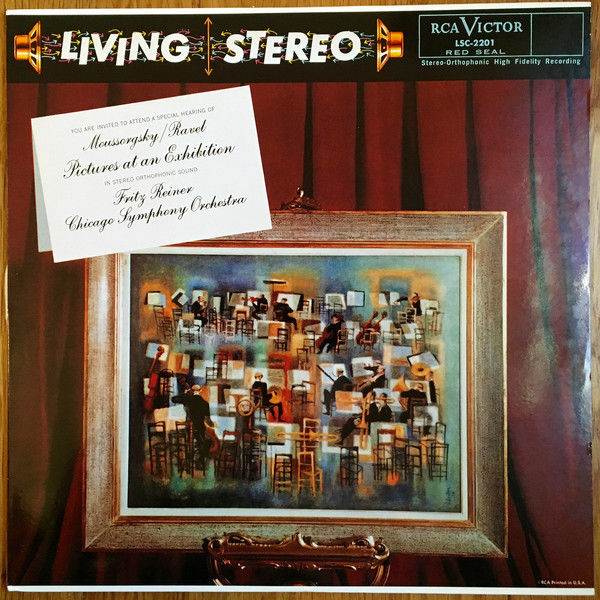
Pictures at an Exhibition REINER Living Stereo Analogue Productions LSC-2201 (M)
$
24


Favourite Auctions
To save auctions to your favourites, please login
If you don't have an account, please register
Description
Moussorgsky Pictures at an Exhibition REINER / CSO Living Stereo Analogue Productions AAPC 2201 200 gram QRP pressing
Tracklist
Pictures At An Exhibition A1a Promenade A1b Gnomus A1c Promenade A1d Il Vecchio Castello A1e Promenade A1f Tuileries A1g Bydlo A1h Promenade A1i Ballet Of The Chicks In Their Shells A1j Samuel Goldenburg Und SchmuyleB1a The Market Place At Limoges B1b Catacombae B1c Sepulchrum Romanum B1d Con Mortuis In Lingua Mortua B1e The Hut On Fowl's Legs B1f The Great Gate Of Kiev
- Pressed By – Quality Record Pressings
- Composed By – Modest Moussorgsky*
- Conductor – Fritz Reiner
- Orchestra – Chicago Symphony Orchestra*
- Orchestrated By – Maurice Ravel
- Sleeve Notes – Alfred Frankenstein
Notes
Remastered and cut at 33 1/3 RPM by Ryan Smith at Sterling Sound
Lacquers plated by Gary Salstrom and pressed on 200-gram vinyl at Quality Record Pressings
Barcode: 753088220111
RCA Living Stereo classical LPs — the gold standard for top quality orchestral performance and sound!
Remastered from the original master tape and cut at 33 1/3 RPM by Ryan Smith at Sterling Sound
Lacquers plated by Gary Salstrom and pressed on 200-gram vinyl at Quality Record Pressings!
Acoustic Sounds customer Alan Hendler has this to say about the first three RCA reissues: "Just received your new vinyl of Scheherazade, Pictures and Pines and Fountains of Rome. After listening I have never heard anything that comes close to the glorious sound of these records. I have original vinyl, CD's, SACD's, XRCD's, Chesky and Classic Records remasters and nothing comes close to how good these sound. The overall balance of all the sections of the orchestra is superb. Wood winds are gorgeous. I will be buying more."
"These records are definitive." — Michael Fremer, editor, AnalogPlanet.
Winner of a Gruvy Award, chosen by AnalogPlanet's editor, Michael Fremer, for vinyl records that are musically and sonically outstanding and are also well mastered and pressed.
"These are the best vinyl releases of RCA LPs I've yet heard." — Jonathan Valin, executive editor, The Absolute Sound
"Grade: A+. Once again, as good as I've heard this record sound. Gorgeous strings, superb bass, avalanche dynamics with that same tape-like ease, sensational inner detail. The authority of the CSO is really something on fortissimo tuttis, of which there are many in Pictures." — Jonathan Valin, The Absolute Sound.com, June 11, 2013.
Another sonic and musical blockbuster from the unbeatable combo of Reiner and RCA (and Mohr & Layton). Recorded in 1957 at Chicago's Orchestra Hall; the original analog session tapes were used in mastering for LPs and SACDS. Mussorgsky's inspiration for Pictures was the death of his dear friend, the architect and visual artist Victor Hartman. Having died at age 39, Hartman had not yet had the opportunity to realize any of his architectural visions, and Mussorgsky was angered that his friend would have no legacy. The Architects' Society arranged an exhibition of some of Hartman's sketches — some of architecture, others of characters or scenes from everyday life. The tribute was enough to give Mussorgsky ideas for his composition, but not enough to give Hartman any lasting place in history. Today, of all of the sketches that were captured in music, only six can be positively identified.
The piece is known today primarily through the orchestral version created by Maurice Ravel in 1922. In fact, the work had already been orchestrated multiple times, by a variety of lesser names. Some conductors today find that Ravel's version, in spite of its color, sacrifices some of the coarse nature inherent in Mussorgsky's piano original. Furthermore, Ravel worked from Rimsky-Korsakov's edited version of the piano part — the only one available at the time — which changed some notes and rhythms.
None of the orchestrations, however, change the fundamental spirit of the piece. Mussorgsky imagines himself making his way down the hallway that showcased his late friend's work, with his stately procession represented by the Promenade that opens the piece and returns several times. Upon stopping at each image, he reflects on what he sees. Between the early movements, the promenade returns regularly, as Mussorgsky is conscious of moving from one scene to the next. As the work progresses, however, he becomes less aware of the interval between pictures, and more immersed in the continuous psychological experience of moving from one state of mind to the next. By the end, the composer sees himself transformed by the connection with Hartman through his visual expressions of Russian pride and humanity.
price rating