Question Mark & the Mysterians:96 Tears LP/Stereo promo/NM vinyl/1966 garage
$
35


Favourite Auctions
To save auctions to your favourites, please login
If you don't have an account, please register
Description
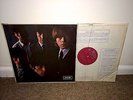
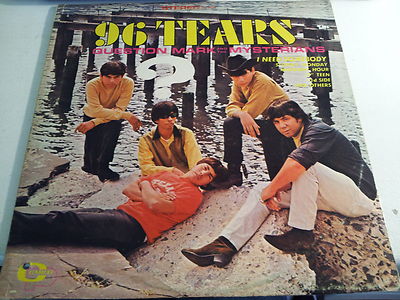
Question Mark and the Mysterians : 96 Tears LP. Cameo SC 2004 Stereo LP from 1966. Cover has SC 2004 and matrix stamps say "SC 2004 A" and "SC 2004 B" but the labels on the record say "C-2004-A" and "C-2004-B". Contains the all-time classic "96 Tears" and many others - see listing below from Discogs. Promo hole in bottom left of sleeve and Cameo promo "+" impression in top right corner. VG+/NM condition. Vinyl is top notch and there are no spindle marks on the labels. This is a rare one to begin with - this condition is even harder to come by!
No. Title Length 1. "I Need Somebody" (Rudy Martinez) 2:13 2. "Stormy Monday" (T-Bone Walker) 2:20 3. "You're Telling Me Lies" 2:31 4. "Ten O'Clock" 2:03 5. "Set Aside" 3:03 6. "Up Side" 2:50 7. "8 Teen" 2:45 8. "Don't Tease Me" 1:37 9. "Don't Break This Heart of Mine" 1:57 10. "Why Me" 1:26 11. "Midnight Hour" (Martinez) 2:36 12. "96 Tears" (Martinez) 2:56
And from Allmusic...
It only took one song, the organ-driven number one smash "96 Tears," to make ? & the Mysterians into garage rock legends. Eccentric frontman Question Mark (actually spelled "?," once he had his name legally changed) cultivated an aura of mystery by never appearing in public without a pair of wraparound sunglasses; he frequently claimed he had been born on Mars and lived among the dinosaurs in a past life, and that voices from the future had revealed he would be performing "96 Tears" in the year 10,000. On a more earthly level, the Mysterians' sound helped lay down an important part of the garage rock blueprint, namely the low-budget sci-fi feel of the Farfisa and Vox organs (most assumed that "96 Tears" had featured the former, but ? later remembered using the latter). What was more, they were one of the first Latino rock groups to have a major hit, and ?'s sneering attitude made him one of the prime suspects in the evolution of garage rock into early punk. the Mysterians were formed in 1962 by bassist Larry Borjas, his cousin, guitarist Bobby Balderrama, and drummer Robert Martinez; they soon added vocalist ? (the general consensus is that he was actuallyRudy Martinez, Robert's brother, though a few sources identified him as Reeto Rodriguez) and organistFrank Rodriguez. By most accounts, all the musicians were born in Texas, of Mexican descent, and grew up in Michigan in the Saginaw/Bay City area. Taking their name from a Japanese science fiction film, the band played its first gigs in the small Michigan town of Adrian in 1964, and soon moved its home base from Saginaw to Flint. Larry Borjas and Robert Martinez were both forced to leave the band for military duty, and were replaced by bassist Frank Lugo and the Martinez brothers' brother-in-law, drummer Eddie Serrato. Shortly afterward, ? wrote the lyrics a song he called "Too Many Teardrops" and showed them to the rest of the band; the title was changed first to "69 Tears," and then the less suggestive "96 Tears." The song became a hit at the Mt. Holly ski lodge/dancehall, where the band played regularly, and in early 1966 they recorded it for the small local label Pa-Go-Go, owned by the band's manager. It became a regional hit in Flint and Detroit, attracting interest from several major record companies; ?decided to sign with the Philadelphia-based Cameo-Parkway, chiefly because their label was his favorite color, orange. Now blessed with national distribution, "96 Tears" raced up the pop charts and went all the way to number one in the fall of 1966, becoming one of garage rock's all-time classics. The band's first album, naturally also titled 96 Tears, was released by the end of the year, as was its follow-up single, "I Need Somebody," which just missed the Top 20. Released in early 1967, "Can't Get Enough of You Baby" was a minor hit, but the group's second album, Action, sold disappointingly; moreover, Cameo-Parkway was experiencing financial difficulties, and was later taken over by ABKCO chief Allen Klein. the Mysteriansdeparted, recording singles for Capitol in 1968 and Tangerine and Super K in 1969, to no commercial avail (during this period, bassist Mel Schacher served a short stint in the group prior to joining Grand Funk Railroad). They also cut an album for Ray Charles' TRC label that went unreleased. ? regrouped the band in the early '70s and tried again, recording singles for Chicory in 1972 and Luv in 1973 to no response. Bobby Balderrama formed a short-lived band called Inflight during the '70s, and ? left music to become a dog breeder. ? & the Mysterians reconvened in 1978 to cut some demos with producer Kim Fowley, and played a reunion concert in Dallas in 1984, the tapes of which were later released by ROIR; that year they also opened some gigs for Tex-Mex rocker Joe "King" Carrasco. In 1997, ? was directed by the voices he heard from the future to reunite the group again, with a lineup of Balderrama,Rodriguez, Lugo, and brother Robert. Since Allen Klein refused to reissue any of the group's original recordings (or even license "96 Tears" for compilations -- hence its absence from Rhino's mostly comprehensive garage rock box set Nuggets), they re-recorded their debut album for Collectables and released it as Question Mark & the Mysterians. In 1998, they issued a live album on Norton Records, Do You Feel It Baby?, that was recorded at Coney Island High and received warmly by their cult fan base of garage rock aficionados. 1999 brought the release of another, somewhat better-produced two-disc set of re-recordings, More Action, this time released on Cavestomp (it was later condensed into the 2001 single-disc release Feel It!: The Very Best of Question Mark & the Mysterians). Meanwhile, Balderrama formed the Robert Lee Band, a blues outfit that played around Michigan and recorded an eponymous album for the local Bullfrog label. Unfortunately, there remains no official CD release of the Mysterians' original recordings.
See my other auctions to combine shipping.
SHIPPING INFORMATION
United States : Shipping in the US is USPS Media Mail. $4.00 for 1-4 LPs in the US. Each additional LP is $1. $3.00 for 1-3 45s. 50 cents for each additional 45. Any additional services are additional - contact me.
Canada : $8.00 for 1 LP, $2.50 for each additional LP.
Mexico : $10.00 for 1 LP, $2.50 for each additional LP.
South America : $13 for 1 LP, $5 for each additional.
Rest of World : $15 for 1 LP, $6 for each additional.
RECORD GRADINGS : FROM GOLDMINE
NEAR MINT or NM, M- : this record appears virtually flawless A very minor scuff and very little else can appear on the vinyl. It should play without any noise over the flaw. The flaw is very hard to see. The cover looks as close to perfect with only minor signs of wear and or age. Minor impressions to the cover (due to the outer edge of the vinyl resting inside) may be acceptable, however the artwork is be as close to perfect as can be.
EXCELLENT or EX or VG++ : minor scuffs which are only slightly visible. There may be more than a few scuffs and NO Scratches COVER: Artwork is still as close to perfect as can be. Some impression to the cover (minor outer ring wear) but no ink wear! Some slight creases to the corners, but not wrinkled and obtrusive to the eye. The corners can show white (where the artwork pasted slick was) meaning, slight wear. No seam splits or writing on the cover or taped repairs can make this grade.
VERY GOOD PLUS or VG+ record shows wear, surface scuffs. The vinyl still has a great luster, but the flaws will be noticeable to the naked eye. COVERS: A virtually clean cover, but may have small writing on it.The artwork looks clean with slightly more aging. The back of the cover usually gives away the age of the cover. Flat white paper will be somewhat yellow yet no stains or mildew from water damage. Some minor wear to the seams or spine, but no tears or holes popping through. The corners will be slightly dog eared yet no crackly bends, defacing the artwork. In essence, a VG+ cover should have no more than 3 flaws mentioned.
VERY GOOD or VG: this record is a record that is good enough. They are not really going to look very good,. There will almost always be some surface noise when they are played. The Dynamics should still be excellent, overpowering the surface noise. A VG record will appear well have been played but still have some luster. VG covers will look worn, used. There may be some seam splitting . There will be some ring wear, where the ink has begun to wear off. Giving the cover a look of snow falling. If the artwork looks snowy all over, it is less than VG condition. There may be some writing on the cover (still, no Large letters in magic marker). It will look aged and more yellowish due to contamination's in the air (sometimes looking like cigarette smoke). Still it should be decent.
GOOD or G A good record will look very well played, dull, grayish and possibly abused. However a Good record should still play. It will have distracting surface noise. Such as crackle that is continuous or some hiss. Will also have some loss of dynamics caused from grooves being worn. It should play without any skips or any obtrusively loud pops or repeated clicks, caused by deep scratches. Good means that it will play with some form of decency, so one can still enjoy the music even though you can still hear noise caused from the wear. A Good cover will have just about everything wrong with it. It will have seam splits (possibly taped repaired, but only with scotch tape. No duct tape or masking tape repairs. These are big turn offs. May have magic marker writing on the cover but still if they are in huge letters, it is a big turn off.In essence, the cover will looked virtually trashed, but some artwork will still be noticed. If the artwork is worn, it is POOR and the cover is worthless.
PAYMENT INFORMATION
Payment can be made by Paypal, check or cash in a registered letter.
Posted with the eBay Android app
price rating