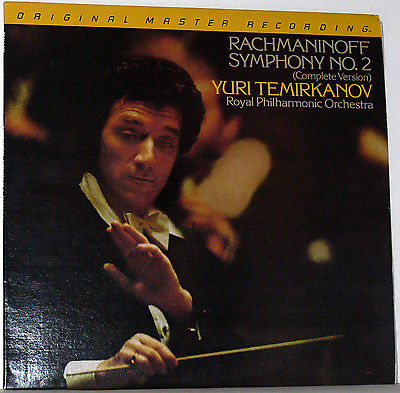
RACHMANINOFF Sym. No. 2 (complete ver.) TEMIRKANOV Mobile Fidelity MFSL 1- 521
$
30


$ 30
Sold For
Dec 8, 2014
Sold Date
1
Number Of Bids
USA
Country Of Seller
eBay
Sold at
Favourite Auctions
To save auctions to your favourites, please login
If you don't have an account, please register
Description
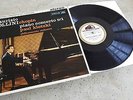
RACHMANINOFF Symphony No. 2 In E Minor Op. 27 (complete version) YURI TEMIRKANOV conducting the Royal Philharmonic Orchestra (Mobile Fidelity Sound Lab MFSL 1- 521) Half-speed mastered from the original analog master tape by Stan Ricker - Pressed by Victor Company of Japan on high definition super vinyl.
Tracklist
Beginning 28:31 A1 Largo-Allegro Moderato A2 Allegro Molto Conclusion 27:38 B1 Adagio B2 Allegro Vivace*(all photos are of the actual item)
- Composed By – Sergei Vasilyevich Rachmaninoff (Rachmaninov)
- Conductor – Yuri Temirkanov
- Design – Marvin Schwartz
- Engineer – Neville Boyling
- Orchestra – Royal Philharmonic Orchestra, The
- Photography By – Roy Round
- Producer – John Willan
Notes
Half-speed re-mastering of 1978 EMI/Angel release, using Ortofon cutting system. Produced on High Definition Super Vinyl by Victor Company of Japan. Rachmaninoff’s Second Symphony has become a concert favorite with audiences. Filled with as many rich and lyrical melodies as the composer’s even more popular Second Piano Concerto, it is constructed on a grand scale. It is in the same category as that launched by Beethoven’s Ninth and continued by Bruckner and Mahler – a symphony that runs over an hour. Yet it has not always been so. Prior to the 1960s most conductors used a cut version which did little to make the symphony feel any briefer. In fact there is a cut in the first movement used by conductor Kats here. Now the work is normally restored to its intended length.Because of its formidable length, Symphony No. 2 was subjected to many revisions, particularly in the 1940s and 1950s, that reduced the piece from nearly an hour to 35 minutes. Prior to 1970, the piece was usually performed in one of its revised (i.e., shorter) versions. Since then, orchestras have used the complete version almost exclusively, though sometimes with the omission of a repeat in the first movement.
First movement The first movement begins with a slow introduction followed by an allegro in sonata form. Rachmaninoff's choice to compose a movement in sonata-allegro form (including a full repeat of the exposition) is an indicator of his pronounced conservatism compared to other symphonists during the early twentieth century.
The second movement is a quick scherzo played Allegro molto. Second movement This movement really only resembles a scherzo insofar as it relates to the early- to mid-Romantic tradition of symphonic movements, i.e. first movement allegro, slow movement, fast scherzo, and final allegro. The movement opens with a lively ostinato in the upper strings.
Third movement This theme, again related to the work’s motif, sings through primarily in the first violin, echoed by a solo clarinet and the oboe section. The symphony reaches its climax in this movement, this development is considered the complement for the first movement Largo introduction.
The beginning of the Allegro vivace finale Fourth movement The final movement is set in sonata form. The development incorporates ideas from the previous movements.
price rating