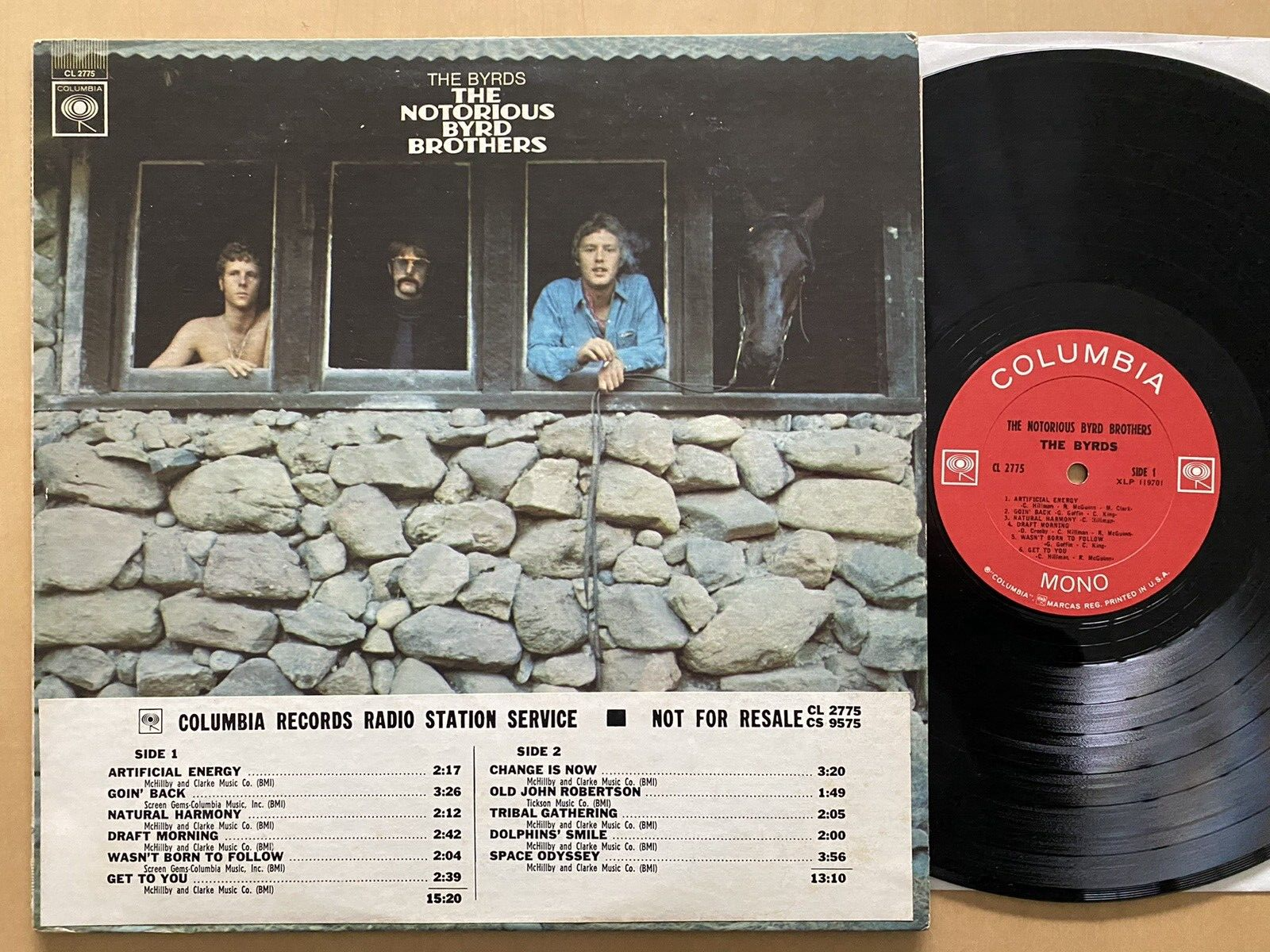
RARE 1968 MONO PROMO THE BYRDS THE NOTORIOUS BYRD BROTHERS RURAL PSYCH NICE VG+
$
100


$ 100
Sold For
Feb 20, 2024
Sold Date
Feb 19, 2024
Start Date
1
Number Of Bids
USA
Country Of Seller
eBay
Sold at
Favourite Auctions
To save auctions to your favourites, please login
If you don't have an account, please register
Description
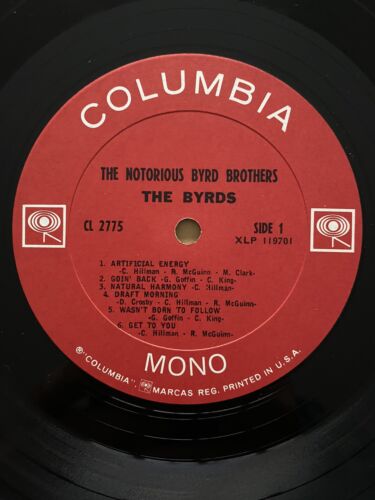
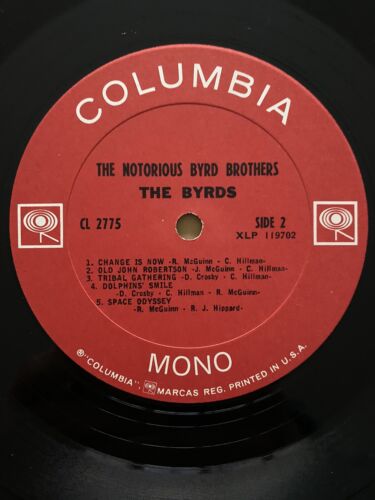
"THE BYRD- THE NOTORIOUS BYRD BROTHERS"
1968 Columbia CL 2775 label
The condition of the cover is VG+ with minor fraying on the spine and mild wear (see photos). Has the RARE PROMO DJ TIMING STRIP on the front cover! The condition of the disc is a conservative VG+ with only a minimal amount of light sleeve scuffs present. The vinyl still exhibits a brilliant gloss and it plays nicely in the rare MONO mix!
- The Notorious Byrd Brothers was released January 1968 on Columbia Records stereo.... the MONO version was ONLY released for radio stations and remains quite rare.
- The lead single from the album was "Goin' Back". The recording of the album was fraught with tension and resulted in the loss of two members of the band. Additionally, original band member, Gene Clark, who had left the band in early 1966, rejoined for three weeks during the album's recording, before leaving again. After the release of "Lady Friend" in July of '67, the band released a less experimental single, "Goin' Back." By the time the song was released in late October, Crosby was no longer with the band. In fact, although he was still a Byrd when "Goin' Back" was recorded, Crosby hated the song and declined to participate in its recording. (He knew at the time that the song was in competition with his "Triad" for a slot on the next LP.) Thus, this song can be considered the first release by the third incarnation of the Byrds: McGuinn, Hillman and Clarke, with hired gun Jim Gordon subbing the drumming for Clarke. The Notorious Byrd Brothers was finally released on January 3, 1968, its title evoking the old West. Despite the mentioned band upheavals, and the slighting of some strong work by Crosby, the album that emerged was cohesive, consistently challenging, and thematically unified. On past albums, the band would do a pop number, then a countryish number, then an electronic-rock experiment. But on Notorious, almost every song combined two or more of these elements, along with the orchestration and studio gimmickry (supplied mostly by producer Gary Usher) that became almost obligatory after Sgt. Pepper's Lonely Heats Club Band (Capitol, 1967). The Crosby songs are immediately identifiable, but Hillman and McGuinn have woven together his work, and their own, almost seamlessly.
The lyrical themes are a roster of hippie styles: harmony, togetherness, youthful innocence, tolerance, non-conformity, the immorality of war, the beauty of nature. But the band uses these motifs throughout the album so ingeniously that the result isn't a relic of the wide-eyed past -- it's a wistful reminder of the shared values that briefly unified many of the young throughout much of the Western world. And it's not all peace and love: through the LP are acknowledgements of the darker elements that had already begun to erode that youth movement from within, including violence and drug abuse.
In fact, the album leads off with "Artifical Energy," about the trouble with amphetamines. A Hillman/McGuinn/Clarke song, this is the last sixties Byrds track Michael Clarke would play on. As in "Eight Miles High," substance abuse is linked with air travel, this time explicitly. But here the result isn't just disorientation and alienation, it's murder, hard time and a heavy sense of doom. After the album version of "Goin' Back" comes another post-Crosby song by Chris Hillman, "Natural Harmony," sort of a sequel to "Thoughts and Words," Hillman's earlier foray into psychedelia. Hillman imitates the vocal style of Crosby, who may have been the intended lead vocalist given the high tenor part. McGuinn's expensive toy Moog squeals along with the lead vocal, and phasers and other electronic processing fade in and out.
That song segues smoothly into "Draft Morning," one of Crosby's best songs. Unfortunately, Crosby himself does not sing on the song, although he probably plays guitar on it. McGuinn and Hillman recorded the vocals after Crosby's departure, altering the lyrics (much to Crosby's chagrin), and claiming co-writing credit (also much to Crosby's chagrin). Still, the final product is unassailable. McGuinn's arpeggiated picking and Hillman's sensitive bass work complement the lyrics, which suggest that being forced to kill may be worse than death. The elegiac feel of the song is heightened by a droning harmony vocal One possible solution to the dilemma of that draftee was suggested by the next song, "Wasn't Born to Follow." It chronicled the desire to escape convention and hit the road. The song had enough street credibility to be featured prominently on the soundtrack of Easy Rider in 1969.
As on "Goin' Back," Clarence White provides some terrific rural-style picking. As with "Old John Robertson," a radically different bridge interrupts the light rural arrangement, in a somewhat raga guitar solo and cool phasing.Side One wraps up with a more optimistic look at aviation, the Hillman/McGuinn song "Get to You" (which also dates from after Crosby's departure). It's a country waltz with string section -- violins, not fiddles. The vocal on the hook ("Ah, that's a little better") is nearly incomprehensible, having been processed through the whirling cones of Lesly Speakers (another studio gimmick borrowed from the Beatle handbook).
Side Two opens with "Change is Now" and the LP version of "Old John Robertson," both of which contain Crosby's harmony vocals as well as phaser effects that complements White's guitar work perfectly. Two Crosby compositions follow. The first, "Tribal Gathering," co-written by Hillman, is a sort of sequel to "Renaissance Fair." Like that song, this one is based on an actual event -- a large counter-cultural happening and free concert known as "The Human Be-In -- A Gathering of Tribes," which filled San Francisco's Golden Gate Park on January 12, 1967. Like "Renaissance Fair," this song is not particularly tuneful, but contains some nice jazzy guitar work by McGuinn. The most interesting feature of the song is the heavy guitar riff that presumably signifies the sinister Hell's Angels, who attended the event in question. It's difficult to tell whether McGuinn or Crosby is playing that riff, although it anticipates the heavier sound of several songs on the post-Crosby LP, "Dr. Byrds & Mr. Hyde."
The next Crosby number, "Dolphin's Smile," is the first of many songs Crosby would eventually write celebrating the freedom of the open seas he enjoyed so much. McGuinn imitates the cry of a dolphin on his guitar.
The final track, McGuinn "Space Odyssey," is about aliens who interfere in Earth's ancient history, the song juxtaposes the modal melody and deliberate, funereal pacing of ancient Scottish folk ballads with fuzzed guitar and Moog noodling that sounded futuristic in 1968. The Notorious Byrd Brothers was an ambitious, experimental work -- a classic Byrds album.
RARE 1968 MONO PROMO IN NICE KEEPER CONDITION!
COMBINED SHIPPING RECOMMENDED! INTERNATIONAL: $5 PER ADDITIONAL LP'S UP TO 4 POUNDS & DOMESTIC: IS $1 PER ADDITIONAL LP'S
ALL LP'S SHIPPED IN A PROFESSIONAL LP MAILER WITH STIFF INSERTS
THANK YOU & GOOD LUCK!
price rating