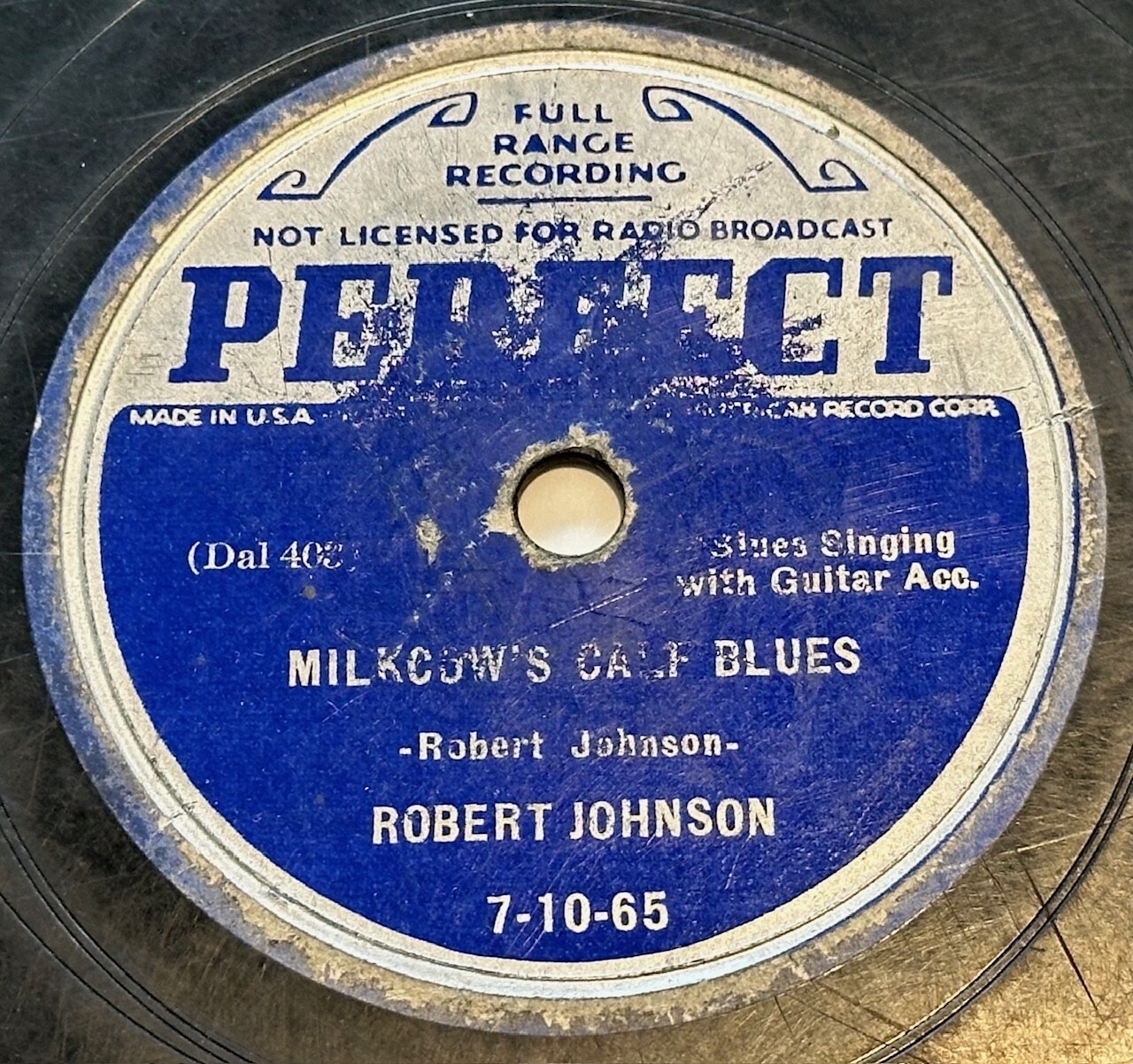
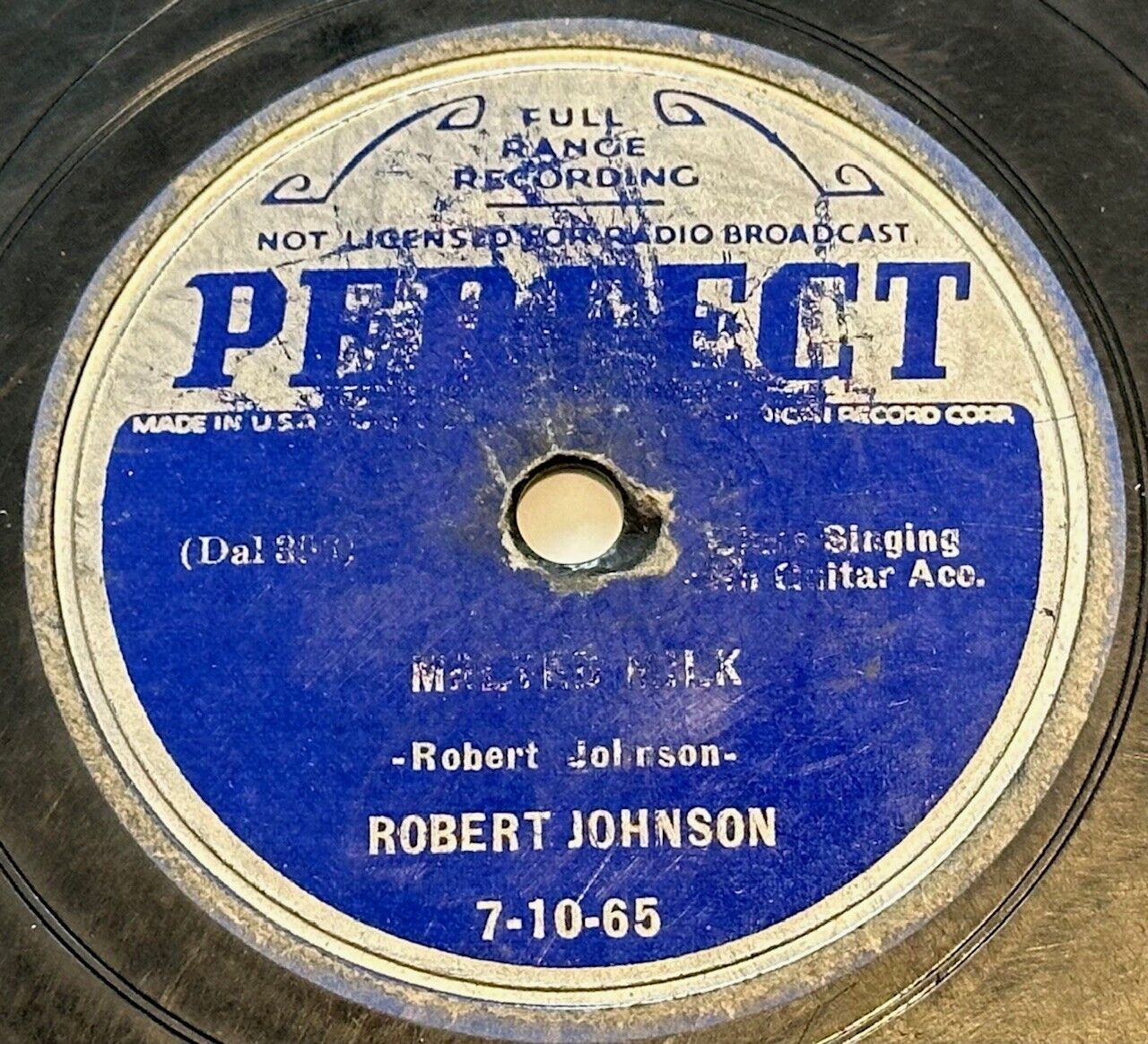
RARE Robert Johnson Malted Milk Milkcow's Calf Blues 1937 10" PERFECT 78 Record
$
2,544

Favourite Auctions
To save auctions to your favourites, please login
If you don't have an account, please register
Description
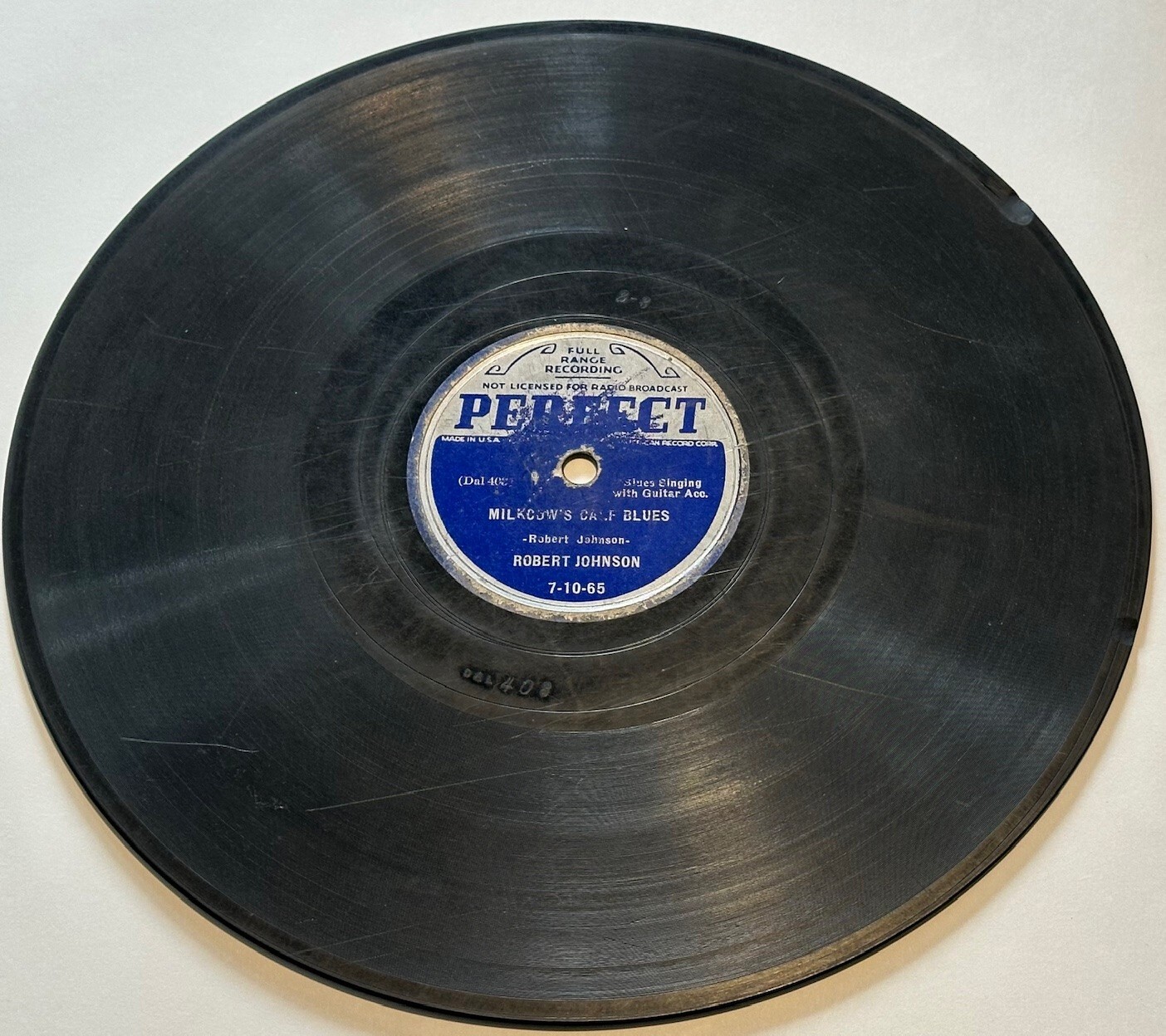
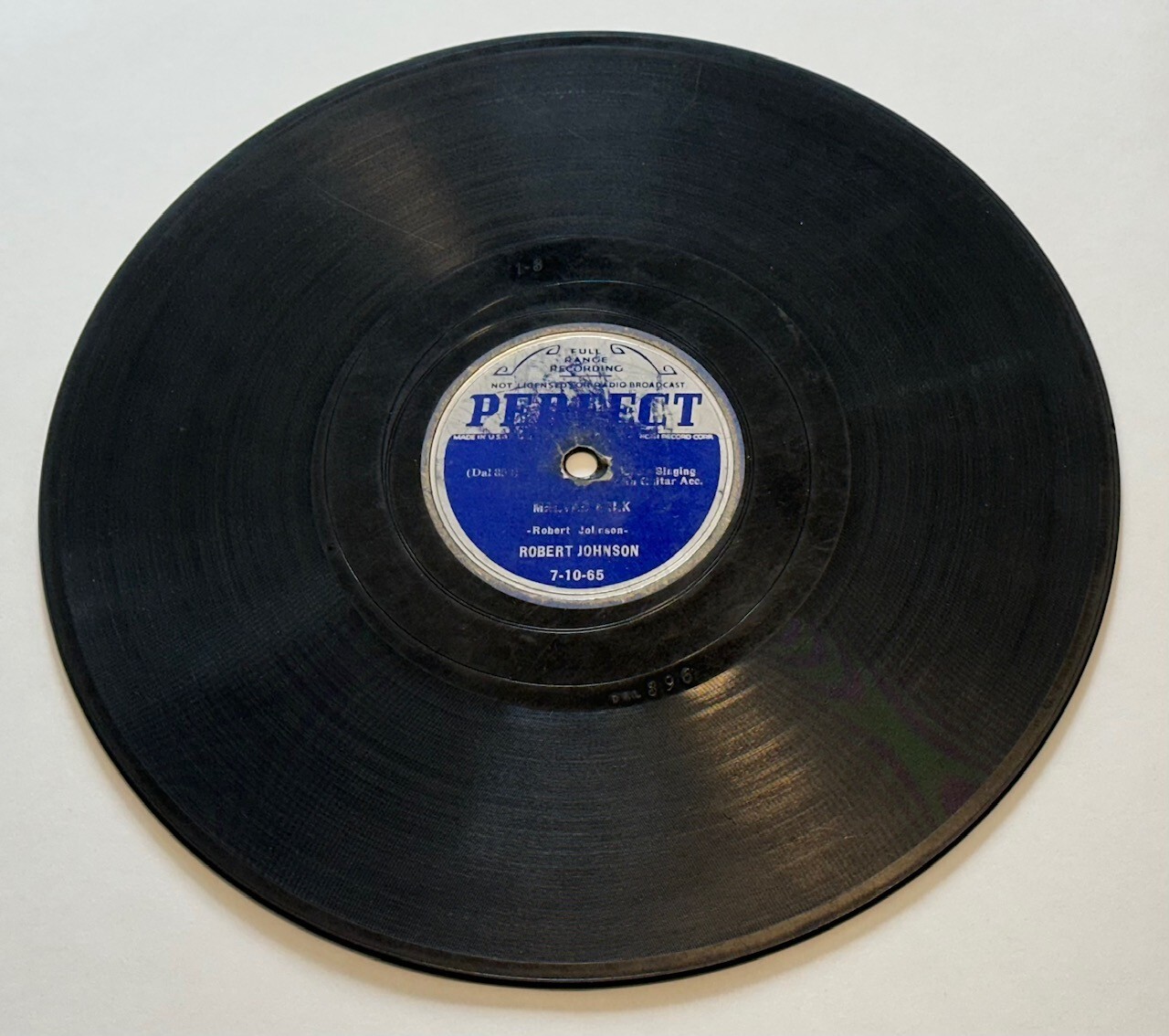
ULTRA RARE! Estate find. I am not a record collector and do not have the means to test this vintage record or adequately grade it. It is being sold AS-IS as a vintage collectable piece of history. The record has typical imperfections - scratches, scuffs, label fading, etc... please view all photos to fully gauge condition. Shellac records are fragile in nature, and as such, I would expect this record to have surface noise. Includes a generic paper sleeve. This is a very rare piece from 1937 - only 400 copies are believed to have been pressed!
Details about Malted Milk / Milkcow's Calf Blues
The "Malted Milk / Milkcow's Calf Blues" 78rpm record by Robert Johnson, released under the Perfect Records catalog number 7-10-65, is a significant artifact in the history of American blues music. This two-sided shellac disc encapsulates the raw emotion, technical prowess, and lyrical ingenuity of Robert Johnson, one of the most influential Delta blues musicians of the 20th century. Below is a detailed description of this record, covering its recording, release, content, physical characteristics, and historical context. Recording Details The tracks "Malted Milk" and "Milkcow's Calf Blues" were recorded on Sunday, June 20, 1937, during Johnson’s second and final recording session, held in Dallas, Texas. This session took place in a makeshift studio set up in an unused storage area on the third floor of the former Vitagraph and Warner Bros. building. Overseen by Art Satherley, a producer for the American Record Corporation (ARC) and its subsidiary Vocalion Records, Johnson performed solo, accompanying himself on acoustic guitar. The session followed his earlier recordings in San Antonio, Texas, in November 1936, which had yielded his first hit, "Terraplane Blues." The Dallas recordings, including these two songs, represent some of Johnson’s last documented performances before his mysterious death in August 1938.
- Matrix Information: The A-side, "Malted Milk," bears the matrix number DAL 396, while the B-side, "Milkcow's Calf Blues," is identified as DAL 403. These numbers are etched into the runout grooves of the shellac disc, providing a unique identifier for each recording take.
- Takes: "Milkcow's Calf Blues" was recorded in three takes during the session, though only one was selected for release on the Perfect 7-10-65 pressing. "Malted Milk" appears to have been captured in a single take deemed suitable for release.
- Perfect Records Context: Perfect Records was one of ARC’s subsidiaries, alongside Oriole, Romeo, and Conqueror, designed to offer affordable records during the Great Depression. Priced lower than Vocalion’s premium releases, Perfect 78s were pressed in smaller quantities and aimed at rural and working-class buyers, particularly in the American South, where Johnson’s music resonated deeply.
- Physical Characteristics: The Perfect 7-10-65 disc is a 10-inch, 78rpm shellac record, typical of the era’s blues and jazz releases. Shellac, a brittle resin-based material, was the standard medium for 78s, offering durability for jukebox play but susceptibility to cracking. The label features the Perfect Records logo—a simple, bold design with the catalog number, song titles, and artist credit: "Robert Johnson – Blues Singing with Guitar Acc." The A-side and B-side designations are clearly marked, with matrix numbers etched in the runout.
- "Malted Milk" (A-side):
- Style: A slow, introspective blues tune, "Malted Milk" features Johnson’s fingerpicked guitar in standard tuning, delivering a mournful melody that complements the song’s melancholic theme.
- Lyrics: The song is often interpreted as a lament about personal despair, possibly tied to Johnson’s rumored struggles with alcohol or heartbreak. Lines like “I’m cryin’ out my malted milk, mama, please don’t treat me so unkind” evoke a sense of longing and vulnerability. The title may reference malted milk whiskey, a popular drink in the 1930s South, adding a layer of cultural context.
- Performance: Johnson’s voice carries a raw, pleading quality, while his guitar provides a steady, understated accompaniment, emphasizing mood over virtuosity.
- "Milkcow's Calf Blues" (B-side):
- Style: This track stands out for its use of Open G tuning (often called Spanish tuning) and bottleneck slide guitar, techniques Johnson likely learned from mentors like Son House, Charley Patton, and Willie Brown. The slide adds a haunting, expressive quality to the song, aligning it with classic Delta blues traditions.
- Lyrics: Adapted from Sleepy John Estes’ earlier "Milk Cow Blues," Johnson’s version transforms the song into a playful yet poignant narrative. The lyrics—“Tell me, milkcow, what on earth is wrong with you? / Now you have a little new calf, and your milk is turnin’ blue”—use the metaphor of a wayward milk cow to explore themes of infidelity or abandonment, laced with subtle humor and sexual undertones. The repetition of “hoo hoo” adds a rhythmic, almost conversational feel.
- Performance: Johnson’s slide work is precise yet soulful, with sweeping chords and sharp accents that mirror the calf’s hunger and the singer’s frustration. His vocal delivery shifts between urgency and resignation, showcasing his ability to convey complex emotions.
- Influence: "Milkcow's Calf Blues" influenced later artists, from Bob Dylan (who recorded an unreleased version in 1962) to Elvis Presley (whose 1954 "Milkcow Blues Boogie" drew from the song’s lineage). "Malted Milk" has been covered by artists like Eric Clapton, cementing its place in blues history.
- Rarity: While exact pressing numbers for Perfect 7-10-65 are unavailable (believed to be only 400 copies), 78rpm records from this era are scarce today due to shellac’s fragility and the shift to vinyl LPs post-World War II. Surviving copies are prized by collectors, often showing wear from heavy play in jukeboxes or homes.
Details about Robert Johnson
Robert Leroy Johnson (May 8, 1911 – August 16, 1938) is widely regarded as one of the most influential musicians in the history of American blues and a foundational figure in the development of modern popular music. A Delta blues guitarist, singer, and songwriter, Johnson’s brief life and small recorded output—29 songs across two sessions—belie his outsized impact. His haunting voice, intricate guitar playing, and evocative lyrics have inspired generations of artists, from Muddy Waters to Eric Clapton, while his enigmatic life story, shrouded in myth and mystery, has cemented his status as a cultural legend. Below is a detailed account of his life, career, and legacy. Early Life Robert Johnson was born on May 8, 1911, in Hazlehurst, Mississippi, to Julia Major Dodds and Noah Johnson, a laborer with whom Julia had a brief relationship. Julia was married to Charles Dodds, a landowner and carpenter, but after a violent dispute forced Dodds to flee to Memphis, she gave birth to Robert out of wedlock. Robert spent his early years in the Mississippi Delta region, a fertile cotton-producing area known for its harsh racial and economic conditions—and its rich musical heritage.
- Family and Upbringing: As a child, Robert lived with his mother and her new husband, Willie "Dusty" Willis, a sharecropper, in Robinsonville (now Tunica Resorts), Mississippi. The family’s itinerant lifestyle, moving between labor camps and towns, exposed young Robert to the Delta’s oral traditions and music. He was one of 11 children in his mother’s blended family, though he had little contact with his biological father.
- Education and Early Interests: Johnson attended school sporadically, learning to read and write, but his formal education was limited by the demands of sharecropping life. He showed an early aptitude for music, initially playing the harmonica and jaw harp (a simple metal instrument) before turning to the guitar in his teens.
- The Crossroads Myth: Around 1930-31, Johnson disappeared from Robinsonville for several months, possibly traveling to Hazlehurst or elsewhere in Mississippi. Upon his return, his skill had dramatically improved, leading to the legend that he sold his soul to the devil at a Delta crossroads (often cited as the intersection of Highways 61 and 49 in Clarksdale) in exchange for musical prowess. While likely a blend of local superstition and Johnson’s own song "Cross Road Blues," this tale amplified his mystique.
- Influences and Style: Johnson absorbed techniques from mentors like House (slide guitar in open tunings), Patton (rhythmic complexity), and Brown (song structure), as well as from records by Blind Lemon Jefferson, Lonnie Johnson, and Leroy Carr. He developed a distinctive style: fingerpicking and slide guitar in open tunings (like Open G and D), a walking bass line, and a voice that shifted between mournful wails and sharp, conversational tones.
- Reputation: Known for his charisma and sharp dressing—favoring pinstripe suits and Stetson hats—Johnson was a ladies’ man who charmed women across the Delta. His lifestyle, however, made him a target for jealousy and conflict, a recurring theme in his eventual demise.
- First Session (November 23-27, 1936): Held in Room 414 of the Gunter Hotel in San Antonio, Texas, Johnson recorded 16 tracks, including "Terraplane Blues," a minor hit that sold around 5,000-10,000 copies—a significant number for a regional blues artist. Other songs included "Cross Road Blues," "Come On in My Kitchen," and "Kind Hearted Woman Blues." He played facing a corner to enhance acoustics, a technique that captured his guitar’s resonance and his voice’s raw power.
- Second Session (June 19-20, 1937): In a makeshift studio in Dallas, Texas, Johnson cut 13 more tracks, such as "Hell Hound on My Trail," "Me and the Devil Blues," "Malted Milk," and "Milkcow’s Calf Blues." These sessions showcased his evolution, with tighter arrangements and darker, introspective themes.
- Burial: His grave’s exact location is disputed, with three possible sites near Greenwood: Little Zion Church, Payne Chapel, and Mount Zion Missionary Baptist Church. Each has a marker, reflecting the uncertainty of his final resting place.
- Death Certificate: Discovered decades later, it lists his death date and cause as "No Doctor," underscoring the neglect faced by Black musicians in the Jim Crow South.
- Reissues: Columbia Records’ King of the Delta Blues Singers (1961), compiled by John Hammond, introduced Johnson to white audiences and rock musicians. A second volume followed in 1970, and the 1990 Complete Recordings box set sold over a million copies, earning a Grammy.
- Influence: Artists like Muddy Waters, Elmore James, Bob Dylan, The Rolling Stones, Led Zeppelin, and Eric Clapton drew heavily from Johnson’s catalog. Clapton called him “the most important blues musician who ever lived,” covering songs like "Crossroads" and "Malted Milk."
- Cultural Impact: Johnson’s “27 Club” status—dying at the same age as later icons like Hendrix and Joplin—enhanced his mythos. His lyrics, blending the mundane and the supernatural (e.g., "Hell Hound on My Trail"), resonate as poetic archetypes.
price rating