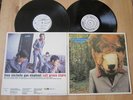
ROBBIE BASHO - Basho sings, Takoma Rec US Original 1967
€
31
$
35


Favourite Auctions
To save auctions to your favourites, please login
If you don't have an account, please register
Description
ROBBIE BASHO - Basho sings, Takoma Records 1967, Printed in USA, Mint in original Folie/ Plastic, with original sticker from "Adelphi Studios & Dist."
Basho sings
-Salangadou
a Cajun lament - the song of the mother having lost her child
-Baskets full of Dragons
12 String -A quasi-Oriental Blues -owing to the fact that women generally never know what comes out of their mouths.
-Katari Takawaitha
A story hymn to Katari Takawaitha - The Lilly of the Mohawks known also in my personal nomenclature as Fara (?) Americanus (For the benefit of the Song - Takawaitha is mispronounced Takawaitha obeisande to B. ST. M.
-Aons au Ball
A black Gumbo Song by Godar (?) Chalrin.
a) Cajun - French Acadians forced out of Canada by the British -settled in Louisiana Bayous.
b) Creole -Remrants of Spanish & French Aristocracy mixed with prevailing Indian & Negro bloods (According to some Hobbits it can be quite a nasty ego-trip)
c) Gumbo - Solid French speaking Negros of the back country. Hearing these people talk is all charm.
-Sololoquy
Apprehension - Death -Rebirth -Gone (?)
-Black -Gold -Clear
Like a Sumi painting, the Guitar follows the voice & mood spontaneously. We tried it twice and the 2nd one worked
-Tibetan Bach
A short experiment wich should get longer in the future & when the author learns not to run out of the breath.
-Basho's Blues
A goup of pictures backed by guitar in the manner of Skip James.
Dance Calinda
Cajun Dance tune, a friendly voodoo for having a good time.
-Black Mare Moan
For me music is another form of keeping in touch with friends - past & present - This song is full of it.
-New Llhasa New Year's Chorale
12 String - Sometimes maybe I no ask questions - I just sings what comes out. No snow in Berkeley, a Tibetan Sleigh Ride wouldn't hurt.---THWAP---Supplied by Scooter Woodriff - harp guitar.
Who was Robbie Basho?
Born in 1940 in Baltimore, Maryland, he became an orphan in his early childhood and got adopted by Dr Donald R.Robinson and his wife and grew up as Daniel R.Robinson jr.with a very typical middle-class childhood and youth. He spent his early years, up through high school, in Baltimore attending catholic schools run by nuns. At the high school level, he went to a military school and then on to the University of Maryland, where he was a premed student. He was athletic -playing lacrosse, doing weight lifting and other sports; he sang in school choirs and played the trumpet. After his junior year at the Univercity of Maryland he bought his century-aged mexican 12string from a sailor for $200 and discovered every possible music, classical music, bluegrass, oriental, improvisations on Bing Crosby... He became a beatnik, became interested in Japanese literature, began to write his own poetry, dabbled in painting and guitar. After discovering the most famous Japanese haiku poet Matsuo Basho he changed his name into Robbie Basho, the musician. Guitar became his main creative outlet and he came into the steelstring after meeting John Fahey in Washington, DC, in the early 60s.He entered the upcoming musical scene of Washington within a few month. Max Ochs (can be heard on Takomas 1st guitar sampler “Contemporary Guitar”) introduced him to folk music. Robbie began playing and singing blues and a mixture of foreign protest songs. The young Leo Kottke heard him perform: “It was the first 12string I heard and he was the first player I heard who was doing something with his fingers that was his own,...I was mesmerized by him.”
In 1962 Robbie heard sitarist Ravi Shankar and “nothing was like before”. “I got Shankar´s records and just laid in a dark room and listened for hours...I dropped blues when I came into the raga thing.” He began to use open C (CGCGCE) and a lot of more exotic tunings, developed his `Esoteric Doctrine of Color & Mood for 12&6 string guitar´ and talked about “Zen-Buddhist-Cowboysongs”. Like Fahey he decided “to present the acoustic steelstring guitar as a concert instrument”.
After a time full of trouble, experiences he settled in Berkeley. The Bay Area became his home. He became a follower of Meher Baba and studied with sarod master Ali Akbar Khan. Until 1971 he recorded 6 LP´s for Fahey´s TAKOMA Label (and the amazing, nearly forgotten 16 minutes tour de force “The Thousand Incarnations of the Rose” on “Contemporary Guitar”, which was inspired by the Berkeley Rose Garden, not so far from his home) and one for Blue Thumb. After 2 LP´s recorded for Vanguard (1972, 1974) it took 4 years to find a record company again. The 2 LP´s for Windham Hill, the Label, founded by William Ackerman, who calls him one of his main influences, made him touring across different countries. “From the standpoint of my guitar playing, nobody has influenced me more,” says Ackerman, “That 4/4 pick he called the running Himalayan rondo formed the basis of all my early writing.” The look and feel of Windham Hill was influenced by Robbie´s self-image and vision.
After an album on Silver Label Recordings he couldn´t find a new label for his album projects again until his death, but he published cassette- editions by himdelf. Robbie Basho never made a very good living at his playing, but just before his unfortunately death he had new plans, new ideas for projects. Over the years he had studied classical composition and harmony. “The ideas got too big for the guitar -I had to learn piano to stretch them out.” These works include a score for a self-described Sufi symphony -seven years in the writing- and one for piano and orchestra, dealing with “the Spanish culture and the Christ-force coming to America, that took four years.
Robbie Basho´s albums span everything from classical European artistry to songs of the Old West -he wove his Hindu, Chinese and Japanese scales and moods and Persian, Arabic or American Indian themes. He was sometimes criticized for taking too seriously the ragas that he offered up to the Beloved Higher Mind, but he also saw the lighter side of his musical cloud-tripping. “If you do it with reverence, it´s not as much of an insult to the Hindu gods,”he once joked in a Guitar Player interview.
Achtung: Bin zur Zeit im Ausland. Bisher sind alle meine letzten Auktionen von hier aus problemlos verlaufen - siehe meine letzten Bewertungen!
price rating