ROCKABILLY 78 George Jones Thumper Dixie 517 One Woman Man 1957 6 songs
$
29


Favourite Auctions
To save auctions to your favourites, please login
If you don't have an account, please register
Description
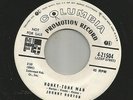
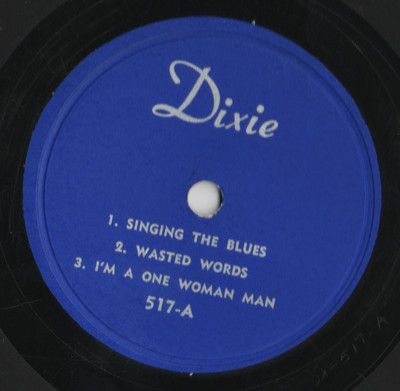
Dixie Rockabilly EP – George Jones, Thumper Jones 1956
Singing the Blues / Wasted Words / I’m A One Woman Man b/w Gonna Come Get You / Yearning / Before I Met You
#517
Thumper Jones (aka George Jones) doing Johnny Horton’s ‘One Woman Man,’ ‘Singing the Blues,’ ‘Wasted Words.’ And three others. Includes ‘Before I Met You,’ the great Carl Smith tune, by Jones. Rare and Great tunes! 1956.
Very RARE EP from Pappy Daily and Don Pierce of Starday Records.
VG+
My Grading Key: (records are visually graded)
Everybody tends to grade differently so here’s what my abbreviations mean:
G – rough copy. May have scratches, or has some flaw that affects playability or causes skipping
VG – record may play with some noise, and has some visual marks on record, but should play without skips
VG+ – a very clean record with only a few light surface marks here and there
VG++ – same as NM. Looks almost like a new record with lots of shine and no scratches
Please note that shipping is not $4. eBay does not allow shipping to be higher on records, but I cannot afford shipping and packing materials in the US for $4. US shipping will be $8. International rates are available. Payment by Paypal.
For years I worked at an archive here in Indiana and once a year our librarian weeded through the collections and sorted out the duplicates. We then held a sale, which I attended two years ago (this is not likely to happen ever again, btw). I usually collect 45s and LPs, with an emphasis on honky-tonk and rockabilly music, but the archive’s sales are usually dominated by 78s. At the last sale, I was blown away by what I found. No country, but some amazing music. In the first box I found dozens of early jazz, hot jazz (whatever you want to call it) 78s on Victor, Puritan, Okeh, Paramount, Vocalion, Blue Note, Folkways, Asch, Bluebird, Columbia, Brunswick as well as numerous one-offs and smaller independent labels. I was stunned! In that first box were 78s by Charlie Johnson and his Paradise Band, King Oliver and his Orchestra, Connie’s Inn Orchestra, Clarence Williams’ Blue Five, Jelly Roll Morton’s Red Hot Peppers, Ma Rainey, New Orleans Rhythm Kings, the Louisiana Sugar Babes, Dixieland Jug Blowers, Napoleon’s Emperors, Ed Lang, Bessie Smith, etc. There were also numerous blues 78s by Blind Willie Johnson, T-Bone Walker, Leadbelly, Big Bill Broonzy and even “atomic” gospel recordings by the Golden Gate Quartet. Then of course there were the amazing recordings of the usual early jazz suspects: Duke Ellington and his Cotton Club Orchestra, Benny Goodman, Oran “Hot Lips” Page, Original Dixieland Jazz Band, Fats Waller, Hoagy Carmichael (our local hero), Fletcher Henderson, Johnny Dodds’ Black Bottom Stompers, Louis Armstrong and his Orchestra and also with his Hot Five. In later boxes I even found some Blue Note 78s, some Folkways recordings as well as some field recordings by John A. Lomax.
The sad news? I couldn’t buy it all. The great news? I bought a lot of it. The sadder news? I’m broke and have to sell it. A few amazing things about these records: 1.) Since their arrival in the archive (usually a donation from a well-known jazz collector), they have been stored in upright position, in sleeves, in a temperature-controlled environment (I believe in the 60 degrees range). 2.) Once in control of the archive, these records are never played more than once (to transfer the files digitally), using the most up-to-date audio equipment to meet preservation standards. 3.) Most of these records, because they were donated by serious collectors.
I do not own a proper needle to play these and thus, the 78s listed here are visually graded. Records will be carefully packaged and bounded by cardboard for padding and safe shipping. Due to the fragility of 78s, insurance is required. After the auction closes I will inform you of the insurance price (whatever the USPS charges) based on your total purchase price. Please do not pay for your item until you have received an invoice from me. I do offer combined shipping for multiple purchases. For overseas bidders, please ask for shipping quotes before bidding. Payment by Paypal only…Domestic USPS Media Mail is $8.00 and $1.00 for each additional item purchased (plus insurance).
Please also see my other auctions as I am also selling many more Jazz 78s.
more on the George Jones
George Glenn Jones (born September 12, 1931) is an American country music singer known for his long list of hit records, his distinctive voice and phrasing, and his marriage to Tammy Wynette.
Over the past 20 years, Jones has frequently been referred to as the greatest living country singer.[2][3] Country music scholar Bill C. Malone writes, "For the two or three minutes consumed by a song, Jones immerses himself so completely in its lyrics, and in the mood it conveys, that the listener can scarcely avoid becoming similarly involved."
Throughout his long career, Jones made headlines often as much for tales of his drinking, stormy relationships with women, and violent rages as for his prolific career of making records and touring. His wild lifestyle led to Jones missing many performances, earning him the nickname "No Show Jones."[1] With the help of his fourth wife, Nancy, he has been sober for over 10 years. Jones has had more than 150 hits during his career, both as a solo artist and in duets with other artists. The shape of his nose and facial features have given Jones the nickname "The Possum." Jones said in an interview that he has chosen to tour only about 60 dates a year.
Early life
George Glenn Jones was born on September 12, 1931 in Saratoga, Texas, and was raised in Vidor, Texas, with his brother and five sisters.[4] When he was seven, his parents bought a radio and he heard country music for the first time. Given a guitar when he was nine, Jones was soon busking for money on the streets of Beaumont.
He left home at 16 and went to Jasper, Texas, where he sang and played on the radio station. He married his first wife Dorothy when he was 19, but they divorced within a year. The Korean War was underway, and he enlisted in the United States Marine Corps. He was stationed in California for his entire service. Not long after his discharge, his music career took off.[5]
[edit] Wild years
Jones's identity was closely tied to his alcoholism. One of the best known stories of Jones' drinking days happened when he was married to his second wife, Shirley Corley. Jones recalled Shirley making it physically impossible for him to travel to Beaumont, located 8 miles away, and buy liquor. Because Jones would not walk that far, she would hide the keys to each of their cars they owned before leaving. She, however, did not hide the keys to the lawn mower. Jones recollects being upset at not being able to find any keys before looking out the window and at a light that shone over their property. He then described his thoughts, saying: "There, gleaming in the glow, was that ten-horsepower rotary engine under a seat. A key glistening in the ignition. I imagine the top speed for that old mower was five miles per hour. It might have taken an hour and a half or more for me to get to the liquor store, but get there I did."[6]
In her 1979 autobiography, former wife Tammy Wynette recalled waking at 1 AM to find her husband gone: "I got into the car and drove to the nearest bar 10 miles away. When I pulled into the parking lot there sat our rider-mower right by the entrance. He'd driven that mower right down a main highway. He looked up and saw me and said, `Well, fellas, here she is now. My little wife, I told you she'd come after me.'"[7]
Jones later jokingly sang of the lawn mower incident in his 1996 single "Honky Tonk Song", and parodied his arrest in the music video.
In the 1970s, a manager introduced Jones to cocaine before a show, because he was too tired to perform. His self-destructive behavior brought him close to death and he was in an Alabama psychiatric hospital by the end of the decade. Celebrated by some of his fans as the hard-drinkin', fast-livin' spiritual-son of his idol, Hank Williams, Jones missed so many engagements that he gained the nickname of "No-Show Jones." (The song "No-Show Jones" makes fun of Jones and other country singers.) He was often penniless and admits that Waylon Jennings and Johnny Cash came to his financial aid during this time.
Poking fun at his past, three country music videos would feature Jones arriving on a riding lawn mower. The first was Hank Williams, Jr's "All My Rowdy Friends Are Coming Over Tonight" in 1984 while the second was Vince Gill's "One More Last Chance" in 1993. Gill's song mentioned the mower with the lines "She might have took my car keys, but she forgot about my old John Deere." At the end of Gill's video, he is leaving the golf course on a John Deere tractor and greets Jones with "Hey, possum." Jones, arriving at the golf course driving a John Deere riding lawn mower with a set of golf clubs mounted behind him, replies to Gill "Hey, sweet pea." The third is John Rich's "Country Done Come to Town" and shows George mowing grass on the rooftop on a zero turn mower
price rating