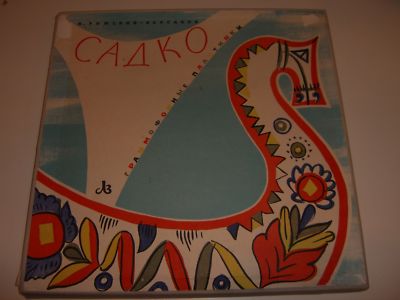
????? Rimsky-Korsakov Sadko 1950 Melodiya 01480 four record set
$
44


Favourite Auctions
To save auctions to your favourites, please login
If you don't have an account, please register
Description
Four record set, from Melodiya.
The box is VG++ and kind of odd in that everything was pasted on (Soviet quality).
The four records are good pressings (I checked them) and don't look to have been played more than once. I'd rate seven sides as Mint and one side as VG++ with one short non-feelable hairline.
Nikolai Golovanov (conductor), USSR Bolshoi Theatre Soloists, Chorus and Orchestra, Georgi Nalepp (Sadko), Vera Davydova (wife), Sergei Krasovsky (King of the Sea), Yelizaveta Shumskaya (Princess), Yelizaveta Antonova (gusli-player), Sergei Koltypin (Buffoon 1), Alexei Peregudov (Buffoon 2), Tikhon Chernyakov (Novgorod head), Stephan Nikolau (voyvode), Mark Reizen (Viking merchant), Ivan Kozlovsky (Indian merchant), Pavel Lisitsian (Venetian merchant), Ilya Bogdanov (Mighty Old Man). (Melodiya LP M10 01480, 4 records)
About the opera, From Wiki:
http://en.wikipedia.org/wiki/Sadko_%28opera%29
Sadko (opera)
From Wikipedia, the free encyclopedia Operas by Nikolai Rimsky-KorsakovThe Maid of Pskov (1872)
May Night (1879)
The Snow Maiden (1881)
Mlada (1890)
Christmas Eve (1895)
Sadko (1896)
Mozart and Salieri (1897)
The Noblewoman Vera Sheloga (1898)
The Tsar's Bride (1898)
The Tale of Tsar Saltan (1900)
Servilia (1901)
Kashchey the Deathless (1902)
Pan Voyevoda (1903)
The Invisible City of Kitezh (1905)
The Golden Cockerel (1907)
- v
- d
- e
Sadko (Russian: ?????, the name of the main character) is an opera in seven scenes by Nikolai Rimsky-Korsakov. The libretto was written by the composer, with assistance from Vladimir Belsky, Vladimir Stasov, and others. Rimsky-Korsakov was first inspired by the bylina of Sadko in 1867, when he completed a tone poem on the subject, his Op. 5. After finishing his second revision of this work in 1892, he decided to turn it into a dramatic work. The opera was completed in 1896.
The music is highly evocative, and Rimsky-Korsakov's famed powers of orchestration are abundantly in evidence throughout the score.
Contents
- 1 Performance history
- 2 Roles
- 3 Synopsis
- 4 Principal Arias and Numbers
- 5 Recordings
- 5.1 Video
- 6 Related works
- 7 Adaptations
- 8 Media
- 9 References
Performance history
The world premiere took place on 7 January 1898 (O.S. 26 December 1897) presented by the Russian Private Opera at the Solodovnikov Theatre in Moscow. Its conductor was Michele Esposito and scenic designers Konstantin Korovin and Sergey Malyutin. The St. Petersburg premiere followed 26 January 1901 at the Mariinsky Theatre conducted by Eduard Nápravník with scenic design by Apollinary Vasnetsov.
In 1906, the opera was presented at the Bolshoy Theatre in Moscow conducted by Vyacheslav Suk with scenic design by Konstantin Korovin. The first US performance occurred at the Metropolitan Opera in New York on 25 January 1930, followed a year later by the first performance in London in June 1931.[1]
While Sadko is rarely performed today, the opera database, Operabase.com, reports performances at the Mariinsky Theatre between January and March 2011.[2]
Roles
Role Voice type Premiere castMoscow, 7 January 1898 Premiere cast
St. Petersburg, 26 January 1901 Foma Nazarich, doyen, elder of Novgorod tenor
Luka Zinovich, governor, elder of Novgorod bass
Vladimir Mayboroda Sadko, gusli-player and singer in Novgorod tenor Anton Sekar-Rozhansky Aleksandr Davïdov Lyubava Buslayevna, his young wife mezzo-soprano Aleksandra Rostovtseva Nina Fride Nezhata, young gusli-player from Kiev contralto Varvara Strakhova Mariya Dolina Duda, skomorokh bass Aleksandr Brevi
Sopel, skomorokh tenor
The Varangian, overseas guest bass I. Aleksanov Aleksandr Antonovsky The Indian, overseas guest tenor Yekab Karklin Mitrofan Chuprïnnikov The Venetian, overseas guest baritone I. Petrov Aleksandr Smirnov Ocean-Sea, the Sea King bass Anton Bedlevich Konstantin Serebryakov Volkhova, the beautiful princess; his youngest, favorite daughter soprano Emilia Negrin-Shmidt (Schmidt) Adelaida Bolska The Apparition, a mythic mighty warrior in the guise of a pilgrim baritone
Chorus, silent roles: Merchants of Novgorod, wandering minstrels, sailors, maidens, inhabitants of the undersea kingdom, people
Synopsis
Feodor Chaliapin as the Varangian Guest(Russian Private Opera, 1897) Time: Place:
(Note: Instead of traditional acts, Sadko is divided in seven scenes, and, as that type of structure would suggest, is more loosely constructed than a traditional opera. The opera is usually performed in three or five acts, depending on how the scenes are grouped:
- Three acts – 1-2, 3-4, 5-6-7 or 1-2-3, 4, 5-6-7
- Five acts – 1, 2-3, 4, 5-6, 7)
The opera tells the story of Sadko, a gusli player (guslar), who leaves his wife, Lubava, and home in Novgorod and eventually returns a wealthy man. During his years of travel he amasses a fortune, weds the daughter of the King and Queen of the Ocean and has other adventures. Upon his return, the city and Lubava rejoice.
Principal Arias and Numbers
Sadko in the Underwater Kingdom, a painting by Ilya Repin (1876)- Three arias fit into the plot as replies by foreign merchants to questions about what their respective countries are like.
- Song of the Varangian Guest (????? ?????????? ?????), a.k.a "Song of the Viking Guest"
- Song of the Indian Guest (????? ?????????? ?????), a.k.a. "Song of India" (Tommy Dorsey's 1938 instrumental arrangement of it is a jazz classic, compiled on This Is Tommy Dorsey & His Orchestra, Vol. 1.)
- Song of the Venetian Guest (????? ??????????? ?????)
- Volkhova's Lullaby (??????????? ???????)
Recordings
- 1950, Nikolai Golovanov (conductor), USSR Bolshoi Theatre Soloists, Chorus and Orchestra, Georgi Nalepp (Sadko), Vera Davydova (wife), Sergei Krasovsky (King of the Sea), Yelizaveta Shumskaya (Princess), Yelizaveta Antonova (gusli-player), Sergei Koltypin (Buffoon 1), Alexei Peregudov (Buffoon 2), Tikhon Chernyakov (Novgorod head), Stephan Nikolau (voyvode), Mark Reizen (Viking merchant), Ivan Kozlovsky (Indian merchant), Pavel Lisitsian (Venetian merchant), Ilya Bogdanov (Mighty Old Man). (Melodiya LP M10 01480, 4 records) (Preiser Mono 90655, 3 CD).
- 1994, Valery Gergiev (conductor), Kirov Orchestra and Chorus of the Marijinski Theater, St. Petersburg, Vladimir Galusin (Sadko), Marianna Tarassova (Lyubava), etc. (Philips CD 442 138-2, 3 discs).
Video
- 1994, Valery Gergiev (conductor), Kirov Orchestra and Chorus of the Marijinski Theater
- 2010 DVD, [Bolshoi Opera 1980 live performance]. Yuri Siminov (conductor), Orchestra & Chorus of the Bolshoi Theatre. Vladimir Atlantov (Sadko), Irina Arkhipova (Lyubava), Tamara Milashkina (Volkhova) etc. Subtitles in English, Spanish, French, Italian, and Russian. Mono. 173 minutes. (VAI 4512)
Related works
- Rimsky-Korsakov's earlier symphonic poem Sadko, Op. 5 (1867), may be regarded as a precursor to the opera, as it is based on the same story. There are three versions:
- Episode from the Bïlina of Sadko (1867)
- Musical Tableau–Sadko (1869)
- Musical Tableau–Sadko (1892)
Adaptations
In 1922 the English composer Kaikhosru Shapurji Sorabji wrote a pastiche on the "Hindu Merchant's Song" as the third of his Three Pastiches for Piano. In 1953, a Russian film directed by Aleksandr Ptushko entitled Sadko based on the opera and featuring Rimsky-Korsakov's music was released.
Media
The Song of the Indian Guest 1929 recording of transcription for violin and piano, featuring violinist Váša P?íhoda Problems listening to this file? See media help.References
Notes- ^ Holden, p. 752
- ^ Operabase.com
- Abraham, Gerald (1936). "XI.-- Sadko". Studies in Russian Music. London: William Reeves / The New Temple Press. pp. 221–245.
- Holden, Amanda (Ed.), The New Penguin Opera Guide, New York: Penguin Putnam, 2001. ISBN 0-140-29312-4
- Warrack, John and West, Ewan, The Oxford Dictionary of Opera New York: OUP: 1992 ISBN 0-19-869164-5
price rating