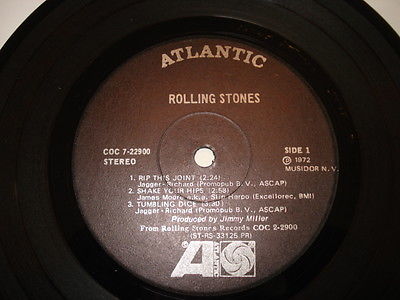
Rolling Stones 7" 5 Song EP Exile On Main Street Good COC 7-22900, LLP #199
$
90


$ 90
Sold For
Sep 24, 2015
Sold Date
Sep 13, 2015
Start Date
1
Number Of Bids
USA
Country Of Seller
eBay
Sold at
Favourite Auctions
To save auctions to your favourites, please login
If you don't have an account, please register
Description
- This Rare 1972 5 song EP has songs from the Rolling Stones' album "Exile On Main Street"
- It was made by Little LP's Unlimited for juke boxes
- It is in GOOD Condition. It will look great in your collection and sound good on your player, or make a fun GIFT
- You want it
- You deserve it
- It will make you happy
- It's on ONE HUNDRED BUCKS
- The sooner you click on "Buy It Now" The sooner it will be in your hands
- I’ll pack it safe and ship it the next business day. Take a look at my positive reviews.
Rolling Stones, The ?– Exile On Main Street Label: Atlantic ?– COC 7-22900, Little LP's Unlimited ?– LLP #199 Format: Vinyl, 7", 33 ? RPM, Jukebox Country: US Released: 1972 Genre: Rock, Blues Style: Blues Rock
Tracklist .
A1 Rip This Joint 2:24 A2 Shake Your Hips 2:58 A3 Tumbling Dice 3:30 B1 Rocks Off 4:33 B2 Sweet Virginia 4:25
Credits
Written-By – Jagger-Richards (tracks: A1, A3 to B2), James Moore (tracks: A2)
Notes
Although this release has a Rolling Stones Records catalogue number, it was released on a black Atlantic Records label. This was the case for Stones' "Little LPs" (this one has a number of 199) and EPs once the band formed Rolling Stones Records.
Little LP's Unlimited released 7" records for the jukebox market usually with 4 or more tracks. Founded by Richard Prutting in early 1970, they were based in Danbury, CT.
Record is in GOOD Condition, light scratches and scuffs
Buy More Records and other Items
Visit My eBay Store: The Sultans Treasure Vault
Join my Facebook Group “The Sultan’s Treasure Vault”
After Garwin Sales abandoned the distribution of Little LPs in 1969, there was a period of about a year when there was nobody actively churning out Little LPs for jukebox operators. Occasional Little LP producers like Thunderbird, Juke, and Bomar couldn't hope to deal with all the major labels. So most of 1969 and the start of 1970 were essentially dead as far as Little LPs went.
In early 1970, a small — essentially one-man — company started up in Northfield, Illinois, a Chicago suburb. It was started and run by Richard Prutting, and called itself "Little LPs Unlimited." We recently had a chance to talk with Richard about the company and the whole Little LP scene.
Prutting's father, Bill Prutting, was a clarinet player and musical conductor who had grown up on the shores of Connecticut, and had his own band called the Kings Men before World War II. When the war started, Bill was drafted, and Uncle Sam shipped him to Miami along with a lot of other musicians to be in the Special Services. There he became the conductor of the Army/Airforce Orchestra. (Richard was born in Miami, second of four sons, during the war.)
When the War ended, Bill went looking for a job. When he interviewed at General Mills, he was interviewed by Jack Gordon, a music lover, who told him, "Hey, I know you. You're Bill Prutting of the Kings Men." They hit it off immediately, and Gordon hired him. They became close friends, and when Gordon left to work for Seeburg in the jukebox business (where he eventually became President), he took Bill Prutting with him, a natural job for both, given their mutual love of music. Seeburg was located in Chicago.
Richard Prutting grew up in the Chicago area spending a significant amount of time learning about the jukebox business from his father. By the late 1950s, Seeburg had become the dominant company in the jukebox field due to superior technology. Concerning Seeburg's take on Little LPs in the mid-sixties, Richard told us, "The Seeburg jukeboxes had these big speakers and they really sounded great. Seeburg wanted to promote the Little LP jukebox as a discotheque machine, with continuous, non-stop music. With the machines that used 45s, a song would end, and there'd be this long pause as the machine changed records. The Little LPs could play three songs in a row without stopping. Seeburg not only had the record labels letting them produce little LPs, but they recorded their own Little LPs so that they could play non-stop music. David Carroll recorded some things for Seeburg at Universal in Chicago, and they got other musicians to record things for them, too, in Atlanta, Nashville, and other places. They would demo their jukeboxes in a big van, with the colorful lights and big stereo speakers, and it sounded really great.
"Seeburg tried to convince the record companies that Little LPs would help promote their sales for their regular records. Some, like Decca, thought it was a good idea, while others didn't, and it was tough to get them to participate." Eventually, Seeburg tired of all the work involved in selecting songs, getting records pressed, getting covers made, getting jukebox title strips made, keeping and reordering inventory, selling the idea to one-stops and operators, and all the other little details. They passed off this work to Garwin Sales in 1967, who also quickly tired of it, so that by 1969, no one was making Little LPs anymore.
By that time, Richard Prutting was in his mid-20s and had seen all these details first hand. He decided to start his own company and put out Little LPs. Richard recalled, "At times I would have my wife Margret helping out, but basically it was a one-man company. Record companies would send me albums and I would pick the songs for Little LPs I wanted to put out. Then they would press the records for me and just send the pressed discs to me. I then had to get cover artwork and have the covers printed. Getting title strips was done through yet another company. Eventually, I would put all this into the covers by hand, and ship out the records to the one-stops. Some of the one-stops really understood Little LPs and did a good job of stocking them, and others didn't. Some jukebox operators really appreciated Little LPs, especially getting a "greatest hits" package, but others didn't spend much time on them. Like any other business, some operators were more aggressive and really did well, while others just parked the machine somewhere and waited to collect the money. The Little LPs really did well with the older clientele, mom and pop places in rural areas, for example. It was a niche market.
"Occasionally, I would get pushback from the record companies on the songs I wanted on the Little LPs. If the songs were too long, it wouldn't work for me, since I had a limit of about 8 minutes per side. When I came out with "Stairway to Heaven" by Led Zeppelin on a Little LP, which just barely made it at 7:55, everybody seemed to want that one, since it hadn't been issued on a single and was otherwise unavailable for jukeboxes. I had to have that repressed several times, until Atlantic wouldn't make any more for me for some reason. And one time, after I picked the songs for Carole King's Tapestry album, I got a letter from [label owner] Lou Adler saying I couldn't use the songs I wanted, but he wanted to choose the songs himself. But by the time I got the letter, they had already pressed the records and I had sent them out."
From a collector's standpoint, Prutting did something that made it easy to put together a list of his releases: he numbered them consecutively, starting with LLP #101 in 1970 and running to LLP #278, which was probably the last one, in 1975. "Actually," Prutting recalled, "That was done for inventory purposes, so I could keep track of which ones to reorder." By the time Prutting had put out a dozen or so albums, he started putting the LLP numbers on the back of the cover, which had traditionally been blank. Before that time, for at least the first nine albums, the only place to find the LLP number was on the top of the sheet of juke box title strips that was included with each package (as shown at right for LLP #106).
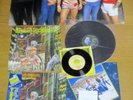
Prutting believed, with some justification after listening to jukebox operators, that full-color reproductions of the full parent album were not necessary for the Little LPs. Instead, he used "monochrome" covers — that is, single color ink, usually black, on a cover that used various color paper for a two-color effect. Prutting's early Little LP covers were also different from LP jackets in another way. They were essentially envelopes that contained the record, the juke box title strip sheet, and several small mini-LP covers (see photo below). Prutting told Billboard, "Operators who want Little LPs have told me they would take them even if they were shipped in a paper bag." But economics were the main reason. He told us, "Full color covers were very expensive, and if I had done them all in full color, they would have been too expensive to sell. There was a fine line to make them economically viable."
Prutting was also fairly consistent in his release schedule. He would put out new albums every other month or so, sometimes as few as four or as many as ten at a time, but mostly staying with four or six. In the early years, these were covered in various ways in Billboard, either through interviews, sidebar stories, or as part of the column called "Programmer's Potpourri." Prutting's releases were also unlike regular record companies, who often schedule albums then release them whenever they're ready, leading to release dates being out of sequence with the catalog numbers. With one exception (The Harvest album, which had problems with the printer), Prutting's releases were issued in order, allowing dates of release to be estimated with about a one-month accuracy.
So many years have gone by, and so many moves and consolidations have taken place, that Prutting doesn't think he still has a list of all the albums he put out. But because of his fairly regular release schedule and fairly good coverage in the trade press, we have been able to put together the discography below.
The first five releases are the most difficult to number, since there was no markings on the cover or record themselves, just a number on the top of the title strips, a part that often was taken apart at the perforations and the scrap (including the LLP number) thrown away. Three of the first five were done for Decca, as noted below. We believe the gaps in the discography correspond to actual releases, not unreleased items; we just haven't found those numbers yet.
Prutting moved the Little LPs Unlimited company to Danbury, Connecticut about May, 1972. Why the move, we asked? "Well, I got married," was the straightforward answer, and moving a one-man company wasn't that difficult. By that time, he had plans to get into releasing quadraphonic Little LPs, which he accomplished a bit later. "For those jukeboxes with quad setups, with all the speakers placed well, the sound was really, really good," Prutting recalled. "But again, those were the more aggressive operators. Others didn't bother. But the quad discs were compatible stereo and played on non-quad boxes just as well."
Unfortunately, the jukebox business just grew more and more indifferent to Little LPs, and by 1975, as he put it, "it just faded away. But from time to time I'll still hear some of the songs I selected for those Little LPs years ago. They really were the best songs on the albums."
Prutting became a jukebox operator himself, and after a number of years doing that, moved on into real estate and was certified as a tennis instructor. He eventually moved to Florida, where he still works at both real estate and teaching tennis. "I'm back in Florida where I started," he summed up, "and still married to the same woman after 42 years."
Kind of amazing what one person can do.
price rating
![Lindsey Buckingham - Solo Anthology: The Best Of Lindsey Buckingham [VINYL LP]](https://www.popsike.net/php/thumbnail.php?url=https://www.popsike.pics/pix/20190504/254219608003.jpg)