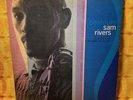
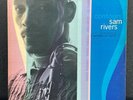
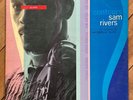
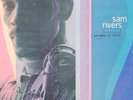
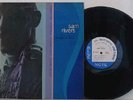
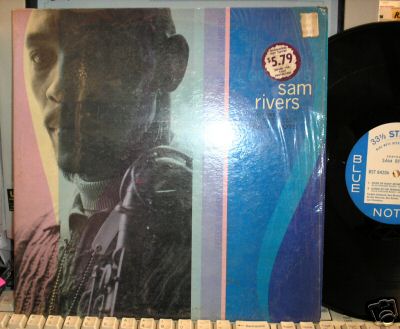
SAM RIVERS"Contours"LP BLUE NOTE NY USA Van Gelder
$
171


Favourite Auctions
To save auctions to your favourites, please login
If you don't have an account, please register
Description
BLUE NOTE ST 84206
Condition: Cover/ NM-M (shrink wrap intact). LP/ NM to M (Visual Grade ) VAN GELDER stamped in runoff groove.
Record cleaned on a VPI record cleaning machine.
AMG Biography
by Chris Kelsey
Few, if any, free jazz saxophonists have approached music with the same degree of intellectual rigor as Sam Rivers; just as few have managed to maintain a high level of creativity over a long life. Rivers plays with remarkable technical precision and a manifest knowledge of his materials. His sound is hard and extraordinarily well-centered, his articulation sharp, and his command of the tenor saxophone complete. Rivers' playing sometimes has an unremitting seriousness that can be extremely demanding, even off-putting. Nevertheless, the depth of his artistry is considerable. Rivers is as substantial a player as avant-garde jazz has produced.
Rivers' father was a church musician, touring with a gospel quartet. Rivers was raised in Chicago and then Little Rock, AR, where his mother taught music and sociology at Shorter College. He began taking piano and violin lessons at about the age of five. He later played trombone, before finally settling on the tenor. Early favorites were Don Byas, Coleman Hawkins, Lester Young, and Buddy Tate. Rivers moved to Boston in 1947, where he studied at the Boston Conservatory of Music and, later, Boston University. There, he played in Herb Pomeroy's little big band, who, in the early '50s, also featured such players as Jaki Byard, Nat Pierce, Quincy Jones, and Serge Chaloff. Rivers left school in 1952. He moved to Florida for a time, then returned to Boston in 1958, where he again played with Pomeroy. Rivers became active in the local scene. He formed his own quartet with pianist Hal Galper, and played on his first Blue Note recording session with pianist/composer Tadd Dameron. In 1959, he began playing with 13-year-old Tony Williams. It was about this time that Rivers became involved in the avant-garde. He developed a free improvisation group with Williams. Perhaps befitting his educational background, Rivers approached free jazz from more of a classical perspective, in contrast to the style of his contemporary, Ornette Coleman, who came out of the blues. In the early '60s, Rivers became involved with Archie Shepp, Bill Dixon, Paul Bley, and Cecil Taylor, all members of the Jazz Composer's Guild. In 1964, Rivers moved to New York. That July, Miles Davis hired Rivers on Tony Williams' recommendation. The group played three concerts in Japan; one was recorded and the results released on an LP. In August of 1964, following the brief experience with Davis, Rivers played on Lifetime (Blue Note), Williams' first album as a leader. Later that year, Rivers led his own session for Blue Note, Fuchsia Swing Song, which documented his inside/outside approach. Rivers led four more dates for Blue Note in the '60s. In the middle part of the decade, he also recorded with Larry Young, Bobby Hutcherson, and Andrew Hill. In 1969, he toured Europe with Cecil Taylor in a band that also included Andrew Cyrille and Jimmy Lyons. In 1970, Rivers — along with his wife, Bea — opened a studio in Harlem where he held music and dance rehearsals. The space relocated to a warehouse in the Soho section of New York City. Named Studio Rivbea, the space became one of the most well-known venues for the presentation of new jazz. Rivers' own Rivbea Orchestra rehearsed and performed there, as did his trio and his Winds of Change woodwind ensemble. Rivers' trio of the time was a free improvisation ensemble in the purest sense. The group used no written music whatsoever, relying instead on a stream-of-consciousness approach that differed structurally from the head-solo-head style that still dominated free jazz. Much of this early- to mid-'70s music was documented on the Impulse! label.
In 1976, Rivers began an association with bassist Dave Holland. The duo recorded enough music for two albums, both of which were released on the Improvising Artists label. Opportunities to record became more scarce for Rivers in the late '70s, though he did record occasionally, notably for ECM; his Contrasts album for the label was a highlight of his post-Blue Note work. In the '80s, Rivers relocated to Orlando, FL, where he created a scene of his own. Rivers formed a new version of his Rivbea Orchestra, using local musicians who made their living playing in the area's theme parks and myriad tourist attractions. The '80s and '90s found Rivers recording albums on his own Rivbea Sound label, as well as a pair of critically acclaimed big band albums for RCA.
AMG Review
by Stephen Thomas Erlewine
On Contours, his second Blue Note album, tenor saxophonist Sam Rivers fully embraced the avant-garde, but presented his music in a way that wouldn't be upsetting or confusing to hard bop loyalists. Rivers leads a quintet featuring trumpeter Freddie Hubbard, pianist Herbie Hancock, bassist Ron Carter, and drummer Joe Chambers through a set of originals that walk a fine line between probing, contemplative post-bop and densely dissonant avant-jazz. Each musician is able to play the extremes equally well while remaining sensitive to the compositional subtleties. Rarely is Contours anything less than enthralling, and it remains one of the high watermarks of the mid-'60s avant-garde movement. .
Shipping & Handling: US $7.00 Priority or $4.00 Media Rate. Canada $7.00. Western Europe: $13.50 (Airmail), $7.50 (Surface- 4 - 6 Weeks) . Eastern Europe, Japan and Austrailia: $14.50 (Airmail), $8.00 (Surface- 4 - 6 Weeks).
All others, please write.
Insurance and / or Delivery confirmation is extra.
We are not responsible for items lost in the Mail.
GOLDMINE GRADING
MINT ---- It should appear to be perfect. No scuffs or scratches, blotches or stains, labels or writing, tears or splits. Mint means perfect.
NEAR MINT ---- Otherwise mint but has one or two tiny inconsequential flaws that do not affect play. Covers should be close to perfect with minor signs of wear or age just becoming evident: slight ring-wear, minor denting to a corner, or writing on the cover should all be noted properly.
VERY GOOD PLUS ---- The record has been handled and played infrequently or very carefully. Not too far from perfect. On a disc, there may be light paper scuffs from sliding in and out of a sleeve or the vinyl or some of the original luster may be lost. A slight scratch that did not affect play would be acceptably VG+ for most collectors.
VERY GOOD ---- Record displays visible signs of handling and playing, such as loss of vinyl luster, light surface scratches, groove wear and spindle trails. Some audible surface noise, but should not overwhelm the musical experience. Usually a cover is VG when one or two of these problems are evident: ring wear, seam splits, bent corners, loss of gloss, stains, etc.
GOOD ---- Well played with little luster and significant surface noise. Despite defects, record should still play all the way through without skipping. Several cover flaws will be apparent, but should not obliterate the artwork.
POOR ---- Any record or cover that does not qualify for the above "Good" grading should be seen as Poor. Several cover flaws.
![Pink Floyd Animals Japan LP [84792ER]](https://www.popsike.net/php/thumbnail.php?url=https://www.popsike.pics/pix/20250401/356727466386.jpg)