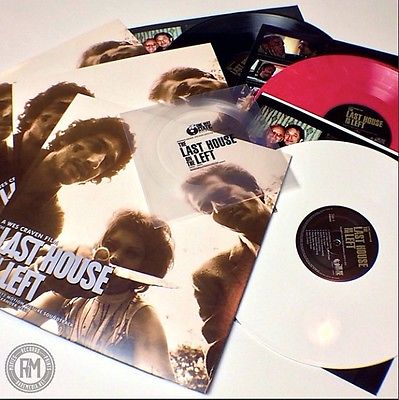
SEALED DAVID HESS THE LAST HOUSE ON THE LEFT LIMITED EDITION COLOR LP w/FLEXI
$
80


Favourite Auctions
To save auctions to your favourites, please login
If you don't have an account, please register
Description
Artist
DAVID ALEXANDER HESS
Title
THE LAST HOUSE ON THE LEFT Original 1972 Motion Picture Soundtrack Format
17-track 12" vinyl LP
Date of Release
October 21, 2013
Country of Manufacture
Belgium
Label
One Way Static Records Catalog OWS01 Condition New, mint, original factory sealed condition
Info
SOLD OUT new/sealed, limited edition, hand-numbered pressing packaged in gatefold tip-on jacket with printed inner sleeve containing extensive and exclusive liner notes.
Color vinyl variants were inserted randomly.
Comes with a bonus flexi disc containing four 1972 radio spots for the movie.
LIMITED EDITION COLOR VINYL packaged in a deluxe gatefold old school tip-on jacket and printed inner-sleeve. AVAILABLE ON RED & WHITE VINYL (inserted randomly). The colors are limited to #300 copies each worldwide and come hand numbered (#142). The release also comes with a bonus FLEXI DISC containing the original 1972 radio spots for the movie (this bonus disc is exclusive to the limited edition and is not included with the regular black vinyl version).
Comes with extensive and exclusive liner notes from:
RUGGERO DEODATO (Cannibal Holocaust, The House On The Edge Of The Park) ULLI LOMMEL (The Boogey Man, Zodiac Killer) FRANCO NERO (Django, Django Unchained, Die Hard 2) GIOVANNI LOMBARDO RADICE (The House On The Edge Of The Park, Cannibal Ferox, City Of The Living Dead) MARC SHEFFLER (Happy Days, Who's The Boss?, Charles In Charge)
… and many more
TRACK LISTING
Side A
1 Intro / Opening Credits 1:26
2 Little Cows Lookin' For Some Grass 1:08
3 Wait For The Rain 2:39
4 Baddies' Theme (Instrumental) 1:01
5 Mari's Birthday Surprise 1:43
6 Water Music / Sadie And Krug 2:50
7 Phyllis Spills Her Guts 1:56
8 Now You're All Alone 2:20
9 Ada's Chickens 0:30
Side B
1 The Chase 2:38
2 Daddy, Put Your Coat Of Many Colors On 2:14
3 Mayhem Montage 2:39
4 Ice Cream Song 1:36
5 Urban Snatch 1:01
6 Blow Your Brains Out 2:18
7 Etude For Chainsaw / Goodbye Dick 1:55
8 Aftermath / End Credits 2:00
REVIEWS
In addition to creating some of the most sinister and memorable characters within the murky world of horror movies leading man David Hess was also a highly skilled musician and songwriter. His work contained some truly beautiful songs, the discovery of which, for some, may be in stark contrast to the brutal displays of sadism and violence for which he was known to purvey onscreen. The fact that Hess could perform as both the poet, and the monster, is a testament to his skill as an artist. The soundtrack to Last House On The Left is a brilliantly unique and diverse mixture of farcical comedy, poignant, reflective folk music and instrumental experimentalism. Hess constructed a wonderful counterbalancing entity, which serves only to accentuate the impact of the movie. Zombiehamster.com
It’s a truly wonderful soundtrack. The music divides people who watch the film, perhaps, the upbeat jolliness of some scenes completely at odds with the grimy, low-key feel to others. The soundtrack brings the many facets of the film together, and it includes some of Hess’ wonderful original songs for the film. They are without doubt something to be agreed upon – they’re utterly lovely. Brutalashell.com
I absolutely love Wes Craven’s The Last House on the Left, and I still believe the film stands up strong. One of the many reasons why I love the original is because of the late David Hess’ music which he composed for the film. Sadly it has been extremely hard to get a copy of the original soundtrack, but thankfully someone has heard the call. Horror-movies.ca
Hess' music is a real trip, with a sense of trying to hold on to the hippy dream as destroyed by Charles Manson, along with an awesome Joplinesque ragtime song about the murderers and their exploits. Lostinthemultiplex.com
Even as a kid one of the things that stayed with me was the music, done by lead actor David Alexander Hess. I couldn’t understand how the same guy who was raping and carving up the girls on screen was singing these peaceful almost hippy-like folk ballads that underscored the horror. I remember reading the credits, thinking I’d misread it, that David Hess wrote and performed all the music. Sitting in that theater, where I had gone by myself, and knew no one, I felt this overwhelming feeling of nostalgia. I just missed those songs, and I missed when songs like that were commonplace in horror. (Romero’s “The Crazies" and later “My Bloody Valentine" are other examples.) Often the lyrics of the songs reflected what the characters were going through, and the tone was somewhere between Harry Nilsson and Simon & Garfunkel. I will be forever grateful for what David did, and for all the memorable performances and everlasting music he gave us. Thanks in big part to David Hess, my road lead to somewhere. Eli Roth
Pressing Information:
#300 Hand-numbered Red Vinyl + Flexi
#300 Hand-numbered White Vinyl + Flexi
Credits:
Acoustic Guitar – David Hess, Tom Chapin
Artwork – Victor Moreno Design
Bass – Steve Chapin
Composed By – David Hess, Steve Chapin (tracks: 1, 2, 5 to 7, 9, 10, 12 to 17)
Design – Silver Ferox Design
Drums – Cash Monet
Electric Guitar – Doug Walker
English Horn – Romeo Penque
Executive-Producer – David Hess
Flute – Romeo Penque
Kazoo – Steve Chapin
Lyrics By – David Hess
Percussion – Specs Powell
Piano – Steve Chapin
Producer – Steve Chapin
Producer [Associate Producer] – David A. Szulkin
Recorder – Steve Chapin
Reissue Producer – Sebastiaan Putseys
Synthesizer [Moog, Arp Synthesizers] – Manny Vardi*
Viola – Manny Vardi*
Vocals – David Hess, Steve Chapin, Tom Chapin Payment & Shipping PayPal is the preferred method of payment.
All items are packed with individual care in sturdy protective mailers and shipped promptly upon receipt of payment.
100% positive feedback rated seller since 1998.
With ManhattanMusic, you can bid with confidence!
Be sure to check out ManhattanMusic's other items currently available for your consideration.
Bio
The Last House on the Left is a 1972 American exploitation-horror film written, edited, and directed by Wes Craven and produced by Sean S. Cunningham. The story is inspired by the 1960 Swedish film The Virgin Spring, directed by Ingmar Bergman, which in turn is based on the 13th-century Swedish ballad "Töres döttrar i Wänge". It is the directorial debut from Craven.
The film was remade into a 2009 film of the same name.
Mari Collingwood plans to attend a concert with her friend, Phyllis Stone, for her 17th birthday. Her parents, Estelle and John, express concern both at the band and Mari's friendship with Phyllis, but let her go after giving their daughter a peace symbol necklace.
Phyllis and Mari go to the city for the concert. On the way, they hear a news report on the car radio of a recent prison escape, involving criminals Krug Stillo, a rapist and serial killer, his son Junior, Sadie, a promiscuous psychopath and sadist, and Fred "Weasel" Podowski, a child molester, peeping tom, and murderer.
Before the concert, Mari and Phyllis stroll the streets, seeking someone who might sell them marijuana. They find Junior, who leads them back to an apartment, where they are immediately trapped by the criminals. Phyllis tries to escape, then tries to reason with the criminals, but fails and is gang-raped by Krug, Weasel and Sadie.
Meanwhile, Mari's unsuspecting parents prepare a surprise party for her.
Both Mari and Phyllis are transported to the woods by the criminals. Mari recognizes that the road is near her home. Mari and Phyllis are forced to have sex with each other and then Sadie performs oral sex on a weeping Mari. Phyllis runs away to distract the kidnappers and offer Mari an opportunity to escape, but is chased by Sadie and Weasel, while Junior stays behind to guard Mari.
While the two criminals chase Phyllis, Mari tries gaining Junior's trust by giving him her necklace as a symbol of her trust and naming him "Willow".
Phyllis manages to hit Sadie in the face and runs, but is then cornered and stabbed to death by Weasel. Sadie reaches into Phyllis's wounds and pulls out the insides.
Mari eventually convinces Junior to let her go, but they are immediately halted by Krug. Sadie and Weasel present Phyllis' severed hand and half forearm and Krug proceeds to carve his name into Mari's chest. As Mari screams in pain, Krug then rapes her. Soon after this act, Mari vomits. She then quietly says a prayer, and walks into a nearby lake to clean herself. Krug fatally shoots her, leaving her body floating on the top of the lake. Krug, Sadie, and Weasel wash and change out of their bloody clothes.
In their new attire, the gang go to the Collingwoods' home, masquerading as travelling salesmen. Mari's parents agree to let them stay overnight. Junior exposes their identity when Mari's mother, Estelle, sees Mari's peace symbol necklace dangling around his neck. Later that night she listens in to the gang while they are spending the night in Mari's bedroom and finds blood-soaked clothing in their luggage. She and Dr. Collingwood rush out into the woods, where they find Mari's body on the bank of the lake. They carry Mari's body back into the house then exact revenge against the crooks.
Outside, Estelle seduces Weasel and then performs fellatio on him which turns deadly when she bites off his penis and leaves him to bleed to death. Inside the house, Dr. Collingwood carries his shotgun into his daughter's bedroom, where two of the criminals are sleeping.
Krug escapes into the living room and overpowers the doctor, but the criminal is then confronted by Junior, who now brandishes a firearm and threatens to kill him. However, his father is able to manipulate him and Junior commits suicide.
Sadie rushes outside where she is tackled by Estelle. The two of them wrestle and fight on the ground. In the process, Estelle eventually is able to slit Sadie's throat with a knife. Dr. Collingwood wields a chainsaw at Krug; the Sheriff comes to try and stop the Dr., but ends up killing Krug with the chainsaw. After the bloodbath, the couple meets in the living room as the police arrive.
Cast:
Sandra Cassel as Mari Collingwood
Lucy Grantham as Phyllis Stone
David A. Hess as Krug Stillo
Fred Lincoln as Fred "Weasel" Podowski
Jeramie Rain as Sadie
Marc Sheffler as Junior Stillo
Cynthia Carr as Estelle Collingwood
Gaylord St. James as Dr. John Collingwood
Marshall Anker as Sheriff
Martin Kove as Deputy
Ada Washington as Ada
Steve Miner (uncredited) as Hippie-taunting deputy
Production:
Sean S. Cunningham made his directorial debut with the white coater film, The Art of Marriage. His film grossed $100,000 and attracted the company Hallmark Releasing (unaffiliated with Hallmark Cards Inc.). Cunningham made the film Together as a "better version" of film. Wes Craven, who had no money, was put on the job of synchronizing dailies for Cunningham's four-day re-shoot. He soon began editing the film with Cunningham and they became good friends. Hallmark Releasing bought the film for $10,000 and it was considered a "hit". Hallmark Releasing wanted them to do another film with a bigger budget and gave them $90,000 to shoot a horror film.
Cunningham served as producer and Craven served as writer and director.
Written by Craven in 1971, the original script was intended to be a graphic 'Hardcore' film, with all actors and crew being committed to filming it as such. However, after shooting began, the hard decision was made to edit down to a much softer film. This script, written as Night of Vengeance has never been released; only a brief glimpse is visible in the featurette Celluloid Crime of the Century, and a sample is available in the UK DVD release.
Music:
The film's soundtrack was written—and partially sung—by David Hess, who also played the main antagonist Krug. It is particularly notable for being heavily contrasted with the events on screen. For example, as the gang drives the two girls out into the countryside, the upbeat, almost comical, tune "Baddies Theme" plays and, after the rape scene, a soothing ballad plays. This counterpointing was also used elsewhere in the film, with the slapstick antics of the two police officers occurring in between scenes of torture. The soundtrack was released commercially around the same time as the film. In 1999 the soundtrack was re-released on compact disc by David himself on Rock Bottom Rules Records. In 2013 the soundtrack had a re-release on vinyl, compact disc, cassette and digital download on One Way Static Records.
Marketing:
One of the more memorable aspects of the film is the advertising campaign. The film underwent many name changes, including Sex Crime of the Century (from the characters' dialogue in the car ride scene), Krug and Company (a version included on the DVD release), and The Men's Room (simply because one poster showed a men's bathroom). None of these names were particularly successful. Someone then came up with the title The Last House on the Left, along with the infamous "To avoid fainting, keep repeating 'It's only a movie'..." advertising campaign. (In actuality, it had been used twice before: first for gore-meister H.G. Lewis's 1964 splatter film Color Me Blood Red, and then for William Castle's Strait-Jacket the following year.) The film under the Last House... title proved to be a massive hit. Stories as to where the advertising campaign originated vary somewhat. Sean Cunningham claims that the person who gave the idea for it was watching a cut of the film with his wife, who continually covered her eyes, prompting him to tell her that it was "only a movie". Other origins have been suggested, however. The tagline was so successful that many other exploitation films later used it, sometimes with their own spin. The title was sometimes imitated, as in the case of Last House on Dead End Street.
Reception:
The film received generally positive reviews. The film currently has a 63% rating at Rotten Tomatoes. Roger Ebert gave the film three and a half stars out of four, and described it as "about four times as good as you'd expect" and maintained that opinion until at least the mid-80s when he supported his positive comments again on a special episode of "Siskel & Ebert" called "Hidden Horror." However, he later hinted in his review of the 2009 remake that he no longer held the film so highly: I wrote that original "Last House" review 37 years ago. I am not the same person. I am uninterested in being "consistent."
Chicago Tribune critic Gene Siskel gave the film a very negative review upon the its release in 1972. However, in 1979, on a special episode of "Sneak Previews" called “Guilty Pleasures” his negative opinion seemed to have lightened after Ebert gave it favorable remarks on the show. Siskel stated, “In my review, I dumped all over the picture. I hated it, I thought it luxuriated in its violence and it’s sort of sick in its own way for that reason. Yet, I hear what [Ebert] is saying, it’s treated real and done well - a rotten subject, but done well. I don’t think it’s necessarily a bad movie.” Nine years later in 1988 on the “Hidden Horror” episode of “Siskel & Ebert”, Siskel turned back to his original negative stance, saying: “I thought the film went over-the-top. I was repulsed by it.”
The film was nominated for AFI's 100 Years...100 Thrills.
English film critic Mark Kermode opined that while the film is shoddily made, its subject matter "horrible, grim, and nasty," and its perceived notion that "violence begets violence" comes off as "obnoxious," it stands as a "very, very important work in the evolution of American horror cinema" because of the events influencing and surrounding its creation and release, namely television footage of the Vietnam War.
Controversy:
The film was censored in many countries, and was particularly controversial in the United Kingdom. The film was refused a certificate for cinema release by the BBFC in 1974 due to scenes of sadism and violence. During the early 1980s home video boom, the film was released uncut (save for an incidental, gore-free scene with the comedy cops, and the end credit roll) as a video that did not fall under their remit at the time. This changed when the "video nasty" scare which started in 1982 led to the Video Recordings Act 1984. This in turn banned the film as one of the Department of Public Prosecutions list of "video nasties."
The film remained banned throughout the remainder of the 1980s and into the 1990s. However it had built a cult reputation in the UK, plus critics such as Mark Kermode began to laud the film as an important piece of work. In 2000, the film was again presented to the BBFC for certification and it was again refused. Blue Underground toured an uncut print around Britain without a BBFC certificate, with Southampton City Council granting the uncut version its own 18 certificate. It was granted a license for a one-off showing in Leicester in June 2000, after which the BBFC again declared that the film would not receive any form of certification.
In June 2002 the BBFC won against an appeal made to the Video Appeals Committee by video distributor Blue Underground Limited. The BBFC had required 16 seconds of cuts to scenes of sexual violence before the video could be given an ‘18’ certificate. Blue Underground Limited refused to make the cuts, and the BBFC therefore rejected the video. The distributor then appealed to the VAC, who upheld the BBFC's decision. During the appeal, film critic Mark Kermode was called in as a horror expert to make a case for the film's historical importance. However, after his report, the committee not only upheld the cuts but doubled them.
The film was eventually given an 18 certificate with 31 seconds of cuts on July 17, 2002 and was released in the UK on DVD in May 2003. The cut scenes were viewable as a slideshow extra on the disc, and there was a weblink to a website where the cut scenes could be viewed.
The BBFC classified the film uncut for video release on March 17, 2008.
Some small cuts from the original, completely uncut, 91-minute film are still rare today and many different versions exists on both DVD and VHS releases with different cuts in many of them from different countries. To get a completely uncut version is difficult as even some cinema machinists themselves cut scenes out from the movie before showing it in theaters and drive-ins during the 1970s; many copies were cut or "hacked to pieces" and because of this some scenes have become rarities.
According to Wes Craven, some people who were offended by the movie even stole copies of the original film and burned them.
In popular culture:
The Riptides recorded and released an instrumental song entitled "Last House on the Left", inspired by the original film.
The Dangerfields recorded a song entitled "Last House on the Left" on their 2005 album, Born to Rock. Written by drummer/vocalist Andrew Griswold, it references events and lyrics from the original film, while the CD booklet features a pastiche of the movie poster.
Deathcore band Last House on the Left draws their name from the film.
In 1980s, Vestron Pictures hired Danny Steinmann to write and direct a sequel, though the film fell apart in pre-production due to rights issues.
- wikipedia
* * * * *
Born in 1936 in New York City, David Hess began his career when he recorded the original version of the Otis Blackwell composition “All Shook Up” under the stage name Dave Hill in 1956. The song became a Number 1 hit for Elvis Presley a year later and Hess became a songwriter at Shalimar Music. David went on to compose “Start Movin’” for Sal Mineo and “Rockin’ Shoes” for the Ames Brothers. He continued to write songs for Elvis throughout the ‘50s and ’60s, (including the Presley hit “I Got Stung” that was later covered by The Beatles). Other Hess tunes performed by The King include “Come Along,” and "Make Me Know You’re Mine" (first performed by Conway Twitty). “Your Hand, Your Heart, Your Love” became a 60s hit when it was performed by Andy Williams. In 1963 David wrote and recorded “Speedy Gonzalez,” which became a number one single for Pat Boone, selling more than eight million copies worldwide. David then recorded two solo albums for Kapp Records, again topping the charts, this time with a Top Ten folk hit called “Two Brothers.”
After a career as a record company executive, including becoming head of A&R at Mercury Records (where he co-wrote the Grammy award winning 1970 rock opera ‘The Naked Carmen’) in New York and working with PolyGram Records’ German affiliate in the 1970s, Hess took on the role of actor, writer, director and producer in the movie industry.
Writing the English language shooting scripts for such German directors as Rainer Werner Fassbinder, ReinhardHauff, Peter Schamoni,… and directing the 1980 slasher “To All A Good Night” were only a few of his many accomplishments.
Most of us will remember him as Krug Stillo, an unrepentant serial killer and leader of a gang in Wes Craven’s classic 1972 cult shocker “The Last House On The Left” (inspired by Ingmar Bergman’s ‘The Virgin Spring’), as well as portraying the villains in RuggeroDeodato’s “House on the Edge of the Park” (1980) and Wes Craven’s “Swamp Thing” (1982). Other movie roles include ’21 Hours At Munich’, ‘Hitch-Hike’, ‘White Star’, ‘Body Count’ and ‘Zodiac Killer’. David Hess also appeared regularly on the TV screen with appearances in shows such as ‘Knight Rider’, ‘The A-Team’, ‘The Fall Guy’ & ‘Royal Pains’.
Throughout his film career Hess’ love for music never waned. He continued to produce music, including several albums (“Caught Up In The Moment” and “Live & Unplugged in Hollywood, 2002.”). Some of his music can also be heard on more recent soundtracks, such as ‘Cabin Fever’ (2002) and ‘Manhunt’ (2008).
On October 7, 2011, just two years after his role in the 2009 horror epic “Smash Cut” starring Sasha Grey, David Hess sadly passed away at the age of 75. He will forever be in our hearts.
David Hess composed the soundtrack for ‘Last House on the Left’ in collaboration with Steve Chapin (Let Time Go Lightly).
David’s work here contains some truly beautiful songs, the discovery of which, for some, may be in stark contrast to the brutal displays of sadism and violence for which he was known to purvey onscreen. The fact that Hess could perform as both the poet, and the monster, is a testament to his skill as an artist. The soundtrack to Last House On The Left is a brilliantly unique and diverse mixture of farcical comedy, poignant, reflective folk music and instrumental experimentalism. Hess constructed a wonderful counterbalancing entity, which serves only to accentuate the impact of the movie.
price rating