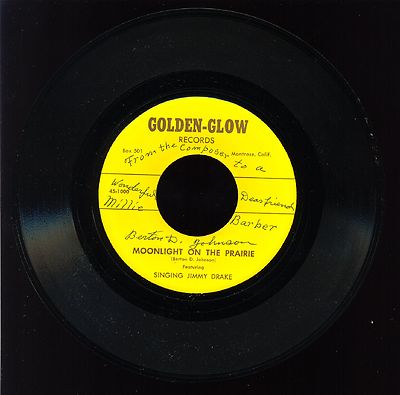
SINGING JIMMY DRAKE (Nervous Norvus) - Moonlight o/t Prairie - Song-Poem 45 rare
$
50


Favourite Auctions
To save auctions to your favourites, please login
If you don't have an account, please register
Description
This item is one original pressing 45 rpm vinyl record -
Record Details:
Artists: Singing Jimmy Drake / Jeff Samson
Label: Golden-Glow Records, Box 501, Montrose, Calif.
Issue: 45-1000 / 45-1001
Matrix: 45-1000-GG / 45-1001-GG
Date: 1959?
Format: 7" 45rpm
Track Artist: Singing Jimmy Drake Title: Moonlight On The Prairie
A
Composer: Berton D. Johnson Producer: n/a
Track Artist: Jeff Samson Title: Walkie Talkie Doll
B
Composer: Gerald "Red" Colwell Producer: n/a
Visual condition: Side A: Very Fine or better, light use only.
Side B: Fine or better, one small scratch, essentially close to new.
Play grading: Excellent or better, no distractions.
Jeff Samson sounds like a fugitive from Bob Wills' Texas Playboys, or possibly Hank Thompson, and the song has very good steel guitar and some fiddle.
The main tune is surprisingly not so bad! It is a long song, with a whistling intro, lots of odd rhyming, almost humorous - and a very good-natured song.
Above all is the chance to again hear that voice, known and loved by Nervous Norvus fans the world over.
The Golden-Glow label is from California, but it is unknown if they had any other releases. In this case, it is a song-poem release.
The man who wrote the "A" side has inscribed the label in ball-point pen:
"From the Composer to a Wonderful Dear friend, Millie Barber, Berton D. Johnson"
Johnson was born in 1898, but was still going late in life, because on July 21, 1980, he registered a piece of sheet music:
Date of Creation: 1980
Title: Around the bay / by Berton D. Johnson.
Description: 1 page
Copyright Claimant: Berton David Johnson
Authorship on Application: words & music: Berton David Johnson.
The man who wrote the "B" side, Gerald "Red" Colwell, had his own label in 1959, G-R-C Records of Ohio, and a few other small label productions.
But by far, the most surprising thing to be learned about this record, was that Singing Jimmy Davis is also the well-remembered novelty song artist, 'Nervous' Norvus!
BACKGROUND [from facts gathered by Phil Milstein]:
The early life of James William Drake was a knockabout one. He was born in 1912 in Memphis, and lived for a few years in Ripley, Tennessee, near the Arkansas border. A chronic asthma condition led Drake's family to move him to California when he was seven, first to the Bay Area, then soon afterwards settling in Los Angeles. Like everyone else, the Drakes suffered hard through the Depression.
He served a year-long hitch with the Civilian Conservation Corps, a New Deal program charged with make-work tasks such as forest maintenance, then spent the pre-War years hoboing around the country. He moved back to the Bay Area in 1941, settling, finally, in Oakland, in a modest house on West Grand which he would occupy for the rest of his life. He got married the following year, although little is known about his wife. A heart condition kept Drake out of the military; he spent the War years working in shipyards instead. At some point after the War he took a job as a truck driver, the occupation that would sustain him until the success of "Transfusion."
By 1953, the 41-year-old truck-driver was fishing around for a way to get off the roads, and set his sights on a career as a songwriter. His first move was to buy a reel-to-reel tape recorder and a cheap second-hand piano. Next, he signed up for a correspondence course in musical notation. "There were 96 lessons," he said in the Tribune interview. "I learned to read music in the first ten and quit. I haven't looked at the other 86." He then bought his king-sized uke, more properly known as a baritone ukulele.
Drake developed a sideline business recording inexpensive demos for the hapless hopefuls of America's amateur songwriting underground. Drake purchased a half-page ad in a 1953 issue of the amateur tipsheet Songwriter's Review, announcing himself as a songwriter. The ad had an unintended effect: instead of garnering responses from music industry professionals, it was answered by his fellow amateur songwriters, who offered to pay him to record demos of their material. He accepted, and began supplementing his truck driving income with these demo recordings. Capitalizing on some successful song placements, as well as on his low fee structure (one song for $7, two for $11), Drake's demo business grew in prominence within the lower rungs of the songwriting industry. By April 1956 he claimed, in another tipsheet ad, to have recorded some 3000 of the suckers. He was just getting started.
In 1955 radio personality Red Blanchard had a morning show on KPOP in Los Angeles. Drake sent Blanchard a demo tape of a new song he'd written. Jimmy Drake aspired strictly to songwriting success, and had no inclination to be a performer himself. Rather, he hoped that Blanchard would record his own version of "Transfusion." But Blanchard was so struck by the uniqueness of Drake's voice that he could hear no one but Drake doing it. "He had that very unusual voice," Blanchard said. "So, egad, there was nothing I could do with those demo records except put 'em on the air, instead of trying to sing 'em myself."
Working on a whim, Blanchard pulled a 78 from the Standard Sound Effects series out of KPOP's record library, cued it to "Auto Skids And Crashes," and played the brief track repeatedly to punctuate each mini-tale of reckless driving that form the song's verses. Blanchard put the pastiched "Transfusion" on the air, where it was an immediate hit with his listeners. Suddenly finding himself a performing artist, Drake chose to shield his identity behind a character name, and so invented Nervous Norvus.
Dot released "Transfusion" in May 1956, flipped with another brilliant novelty, the jaunty and equally hep "Dig" (Dot 15470). The record was unlike anything America had ever heard, and the country responded by making it an out-of-the-box sensation, reportedly snapping up a half-million copies within two weeks of its release, and going on to double that number before its run was through.
Once "Transfusion" hit, his market value among this music biz song poem world shot up substantially. His success not only enhanced his name recognition within this twilit milieu, but also provided a ray of hope to its striving inhabitants. During his peak weeks he'd kept his demo customers idling as he hustled between his home in Oakland and Dot's headquarters in L.A., but it wouldn't be long before he'd come to view them as his bread-and-butter. In the October 1957 issue of Songwriter's Review, the amateur songwriting world's Billboard, Drake reported that Dot had renewed his contract for another year, adding, with hope of his own, "I'm gonna try and produce another hit." A fourth single was planned, and beyond that perhaps an album, but neither ever came to pass. In fact his three singles on Dot would be the only records Drake would ever place with an important label.
With the success of "Transfusion," Drake was able to quit his trucking job and turn to making music full-time. His demo orders continued to roll in, but they would have to wait, as he spent the latter half of 1956 traveling frequently between Oakland and Hollywood, where Dot had recently relocated from their own Tennessee origins. Soon enough, of course, he would return to grinding out cheap demos for amateur songwriters. Alas, if only they had been half as good as his Nervous Norvus recordings.
~~~ from the internet
==========================================================================================




![Aerosmith Aerosmith's Greatest Hits Album SEALED [LP] 2019 Columbia Records](https://www.popsike.net/php/thumbnail.php?url=https://www.popsike.pics/pix/20210515/184839284150.jpg)