STARDAY CUSTOM Rev. Campbell Hollywood 1036 BLUES
$
99


Favourite Auctions
To save auctions to your favourites, please login
If you don't have an account, please register
Description
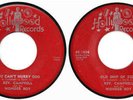
Rev. Campbell with the Wonder Boy – You Can’t Hurry God b/w Old Ship of Zion
Hollywood 1036 (Golden State BMI)
An original pressing, pressed at Coast Records (2528 West Pico Blvd in Hollywood, CA).
Graded somewhere between a conservative VG and VG+, with VG++ labels (no stickers or writing). The record has some light surface scratches, nothing deep.
I would like to thank Nate Gibson author of The Starday Story Of Country Music for the following information on this very rare and important title:
"As many of you probably know, this rare southern gospel record is the missing link between Starday Records and the legendary Motown label. In 1953 Don Pierce became the President and co-founder of the Starday record label. He brought with him an understanding of custom record pressings (a service he ran while working at 4 Star and took with him to Starday). For $85 an artist could send in their own records to Starday who would then press up 300 copies and send them back to the artist. As Starday was a country music label, most of the Starday customs (or Dixie) pressings were country, honky tonk, western swing, or rockabilly (This was how Starday issued Willie Nelson’s first record and many great rockabilly 45s). A few tapes, however, were sent in by African-American gospel artists. Such was the case with Rev. Campbell with the Wonder Boy (aka J. Smith, Jr.) from South Carolina. Pierce pressed the records on the custom Hoyt’s label (for more information on this release, which I’ve only seen on 78, see below). He was impressed enough by the tune, however, that he also immediately released it as a 45 on his new Hollywood label (which also released many collectable ‘50s rhythm and blues recordings by Linda Hayes, Johnny Fuller, Frankie Ervin, Frank Motley, Jesse Belvin, the Pyramids, McBurney and the Four Jacks, and many more). The Hollywood label was formerly run by John Dolphin as Recorded in Hollywood. Pierce bought it in either late ’53 or early ’54 and changed the name to Hollywood Records. John Dolphin continued to produce most of the material, with the exception of this release, until his untimely murder.
This record, sold regionally in the LA area (in addition to the 300 copies sold or given away in South Carolina), inspired Dorothy Love Coates and her Gospel Harmonettes to cover the A-side. She, however, changed the name to ‘You Can’t Hurry God (He’s Right On Time).’ A close inspection of the lyrics, shows, …
Rev. Campbell’s version:
“Well, you can’t hurry god, you just have to wait.
You have to trust him and give him time, no matter how long it takes.
Well, I know he’s a god you can’t hurry; He’ll be there just don’t worry.
Well, he may not come when you want him, but he’s right on time.”
And Dorothy Love Coates’ version:
“You can’t hurry god, you just have to wait.
You have to trust him and give him time, child, no matter how long it takes.
You know he’s a god you can’t hurry; He’ll be there don’t worry.
You know he may not come when you want him, but he’s right on time.”
… proves conclusively that it was the same song and lyric.
The more obvious comparison, of course, is often made between Dorothy Love Coates’ version for Art Rupe’s Specialty label and the Supremes 1966 Motown classic, “You Can’t Hurry Love.” The latter tune is credited to the songwriting team of Holland/Dozier/Holland, but directly draws on the lyrics credited here to Rev. Campbell and J. Smith, Jr. in 1953/54…
The Supremes #1 hit version from 1966:
“You can’t hurry love, no, you just have to wait.
She said love don’t come easy, it’s a game of give and take.
How long must I wait, how much more can I take
You gotta trust, give it time, no matter how long it takes.”
Not only does this great record link the Starday and Motown labels, but more importantly, this record is one of the finest examples of the direct correlation between gospel music and rhythm and blues in the early 1950s. "
Needless to say bid to win on this one as it likely will be a very long wait until another surfaces.
.Thanks for looking and good luck...George (proton).
- Mint (M) Absolutely perfect in every way. Certainly never been played, possibly even still sealed.
- Near Mint (NM or M-) A nearly perfect record. Many dealers won't give a grade higher than this. The record should show no obvious signs of wear. A 45 RPM or EP sleeve should have no more than the most minor defects, such as almost invisible ring wear or other signs of slight handling. An LP jacket should have no creases, folds, seam splits or other noticeable similar defects. No cut-out holes, either. And of course, the same should be true of any other inserts, such as posters, lyric sleeves and the like. Basically, an LP in near mint condition looks as if you just got it home from a new record store and removed the shrink wrap.
- Very Good Plus (VG+) A Very Good Plus record will show some signs that it was played and otherwise handled by a previous owner who took good care of it. Record surfaces may show some signs of wear and may have slight scuffs or very light scratches that don't affect one's listening experiences. Slight warps that do not affect the sound are "OK". The label may have some ring wear or discoloration, but it should be barely noticeable. The center hole will not have been misshapen by repeated play. Picture sleeves and LP inner sleeves will have some slight wear, lightly turned up corners, or a slight seam split. An LP jacket may have slight signs of wear also and may be marred by a cut-out hole, indentation or corner indicating it was taken out of print and sold at a discount. In general, if not for a couple things wrong with it, this would be Near Mint.
- Very Good (VG) Many of the defects found in a VG+ record will be more pronounced in a VG disc. Surface noise will be evident upon playing, especially in soft passages and during a song's intro and fade, but will not overpower the music otherwise. Groove wear will start to be noticeable, as with light scratches (deep enough to feel with a fingernail) that will affect the sound. Labels may be marred by writing, or have tape or stickers (or their residue) attached. The same will be true of picture sleeves or LP covers. However, it will not have all of these problems at the same time, only two or three of them.
- Good (G), Good Plus (G+) Good does not mean Bad! A record in Good or Good Plus condition can be put onto a turntable and will play through without skipping. But it will have significant surface noise and scratches and visible groove wear (on a styrene record, the groove will be starting to turn white). A jacket or sleeve will have seam splits, especially at the bottom or on the spine. Tape, writing, ring wear or other defects will start to overwhelm the object.
price rating