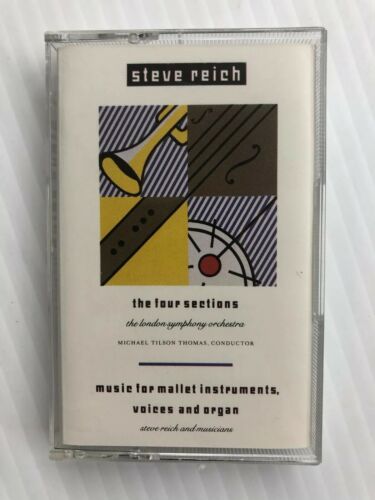
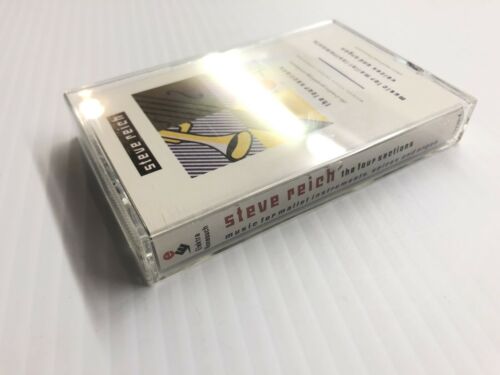
STEVE REICH The Four Sections 1990 Chrome Dioxide Cassette Tape Dolby HX Pro
$
38


Favourite Auctions
To save auctions to your favourites, please login
If you don't have an account, please register
Description
Artist or Various Artists
Title And Subtitles
Defining and special characteristics
Item Description:
Tracklist
The Four Sections
Conductor – Michael Tilson Thomas
Orchestra – The London Symphony Orchestra
Percussion – Bob Becker, Garry Kvistad, James Preiss, Russell Hartenberger*
Piano – Edmund Niemann, Nurit Tillis*
(26:00)
1 I. Strings (With Winds And Brass) ? = 80 11:25
2 II. Percussion ? = 80 2:29
3 III. Winds And Brass (With Strings) ? = 120 5:55
4 IV. Full Orchestra ? = 180 6:11
5 Music For Mallet Instruments, Voices And Organ
Ensemble – Steve Reich And Musicians
Glockenspiel – Garry Kvistad, Thad Wheeler
Marimba – Bob Becker, Russell Hartenberger*, Steve Reich, Tim Ferchen*
Organ [Electric] – Nurit Tillis*
Vibraphone – James Preiss
Voice – Pamela Wood Ambush
Voice [Long Tones] – Rebecca Armstrong
Voice [Melodic Patterns] – Jay Clayton
16:47
Companies, etc.
Recorded At – CTS Studios
Edited At – New York Digital Recording, Inc.
Mixed At – New York Digital Recording, Inc.
Phonographic Copyright (p) – Elektra Entertainment
Copyright (c) – Elektra Entertainment
Published By – Hendon Music, Inc.
Credits
Art Direction, Design – John William Costa
Artwork [Cover] – Roy Lichtenstein
Composed By, Edited By, Mixed By, Liner Notes – Steve Reich
Engineer – Dick Lewzey
Executive-Producer – Robert Hurwitz
Producer, Edited By, Mixed By – Judith Sherman
Notes
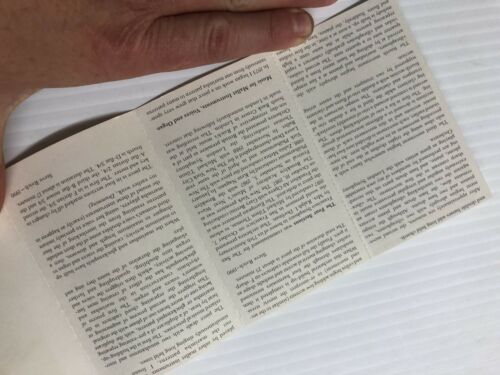
The Four Sections was commissioned for The San Francisco Symphony in honor of its 7th Anniversary by Mrs. Ralph I. Dorfman.
Recorded November 1988 at CTS Studios, London
Edited and mixed at New York Digital Recording, Inc. New York City.
Michael Tilson Thomas appears courtesy of Sony Classical.
Dolby HX Pro, Chromium Dioxide cassette.
Artist Biography by Chris Morrison
A highly influential avant-garde composer and one of the key founders of the minimalist school of music, Reich has embraced a wide variety of musical styles and interests, forging from them a unique synthesis.
Reich took piano lessons as a youngster, but his first big musical revelations came at 14, when he encountered the music of Bach and Stravinsky. He also had his first exposure to bebop, and immediately started learning drums and playing in a jazz band with friends. He played on weekends while studying at Cornell, which he entered at age 16 and where he received a degree in philosophy, specializing in the work of Wittgenstein. In 1957, he entered Juilliard, studying with William Bergsma and Vincent Persichetti (and meeting fellow student Philip Glass). Here Reich first heard 12-tone music; he got a further dose of it during graduate studies at Mills College in Oakland, working with Luciano Berio and Darius Milhaud, and eventually earning his master's degree.
At about that time Reich met Terry Riley, who was in the process of writing In C (1964). Reich played in its premiere, and In C's tonal approach and use of repeating patterns had a big influence on Reich's own music. In turn, Reich suggested the use of the eighth note pulse, which is now standard in performance of the piece. Reich had been experimenting with tapes, creating loops of speech and layering them, allowing the layers to move in and out of sync with one another. His early works It's Gonna Rain (1965) and Come Out (1966) led to similar experiments with live performers, the first of which was Piano Phase for two pianos (1967). Back in New York, Reich and Glass formed an ensemble to perform their music (1968-1971). Several of those players later formed Steve Reich and Musicians, which has toured the world many times over.
In 1970, Reich studied for several weeks at the University of Ghana. His encounter with Ghanaian music and dance inspired his ambitious work Drumming (1970). Encounters with Indonesian gamelan music in 1973-1974 at Seattle and Berkeley were equally significant, and broadened Reich's rhythmic and timbral palette. His most significant composition of the time was Music for 18 Musicians (1974-1976), a large and colorful work which brought Reich worldwide recognition.
In the mid-'70s, Reich started taking Torah classes with his future wife, video artist Beryl Korot. He also studied traditional Jewish cantillation and incorporated it into his psalm settings, Tehillim (1981). Several chamber and orchestral works followed in the 1980s. For Different Trains (1988, a Grammy winner), Reich used a digital sampler to record speaking voices and derived the rhythmic and melodic ideas of the piece from those voices. Reich knew that Different Trains was going to lead to some kind of new documentary form incorporating both video and music. Collaborating with his wife for the first time, the two completed their theater work The Cave in 1993. They continued to explore the combination of music and video with Three Tales (1998-2002).
Music for 18 Musicians [Nonesuch 1998] By the end of the 21st century's first decade, the lasting significance of Reich's music was being recognized worldwide. After 1998's new recording of Music for 18 Musicians won a Grammy, Reich received honorary doctorates and awards from Juilliard, Budapest's Franz Liszt Academy and other schools; the 2007 Polar Music Prize; the 2009 Pulitzer Prize for Music (for Double Sextet); and, in 2012, an American Academy of Arts and Letters Gold Medal for Music.
In 2016, as Reich celebrated his 80th birthday, he continued to debut new material -- Pulse, a composition for winds, strings, piano, and electric bass, premiered at New York's Carnegie Hall as part of a special birthday concert on November 1, 2016, while Runner, a dance piece for winds, percussion, pianos, and strings, was introduced by London's Royal Ballet less than two weeks later, on November 10.
Jacket Condition: EX+
Excellent Plus condition, in great shape (see pictures).
Vinyl Condition: EX
Excellent condition, minor scuffs in two places (see pictures).
Our Policies:
We stand behind our grading and item descriptions.
Buyer must pay all shipping costs.
If the item is not found to be as described, it may be returned for a refund.
Refunds are acceptable within 30 days.
Best Offer
Please do not use the "message" feature for negotiating shipping costs or other special conditions as this is discouraged by eBay. We cannot modify the shipping cost when accepting a Best Offer. If you'd like to make a special request on an item please send us a message about it directly.
Shipping cost is based on USPS Media Mail. If you have any specific shipping requirements (or if you are an international buyer), please contact us and we will be happy to accommodate you.
Combined Shipping:
Domestic (US): Weights will be combined in calculated price.
International: Calculated.
***INTERNATIONAL BUYERS: We are not responsible for any additional taxes or charges that your customs office may charge.
All payments must be made via PayPal, accepting all major credit cards.
If you have any questions at all or would like to request additional information or photos, please contact us and we will be happy to respond as soon as possible.
Thank you for checking out this listing by Cactus Records and Gifts in Bozeman, MTFor more rare and hard to find CDs and vinyl, be sure to check out the rest of our listings!
price rating