Scriabin THE POEM OF ECSTASY Classic Records 45rpm CLARITY Test Pressings MINT
$
95


$ 95
Sold For
Jul 11, 2025
Sold Date
Mar 9, 2025
Start Date
1
Number Of Bids
USA
Country Of Seller
eBay
Sold at
Favourite Auctions
To save auctions to your favourites, please login
If you don't have an account, please register
Description
Scriabin THE POEM OF ECSTASY Classic Records SDBR 3032-45 (A1 / A2) 45rpm CLARITY Test Pressings MINT
Label:
Classic Records – SDBR 3032-45Format:
2 x Single-Sided Vinyl, LP, Album, 45rpm, Test Pressing, Stereo, 200 gramCountry:
USReleased:
2007Genre:
ClassicalStyle:
Modern, RomanticTracklist
A1
A2 The Poem Of Ecstasy, Op. 54 (19:16)
The Poem Of Ecstasy, Op. 54 (continued)
- Manufactured By – Classic Records, Inc.
- Mastered At – Bernie Grundman Mastering
- Lacquer cut by Bernie Grundman
- Recorded At – Houston Civic Center
- Composed By – Scriabin
- Conductor – Leopold Stokowski
- Liner Notes – Paul Affelder
- Orchestra – The Houston Symphony Orchestra
- Recording Supervisor – Bert Whyte
Notes
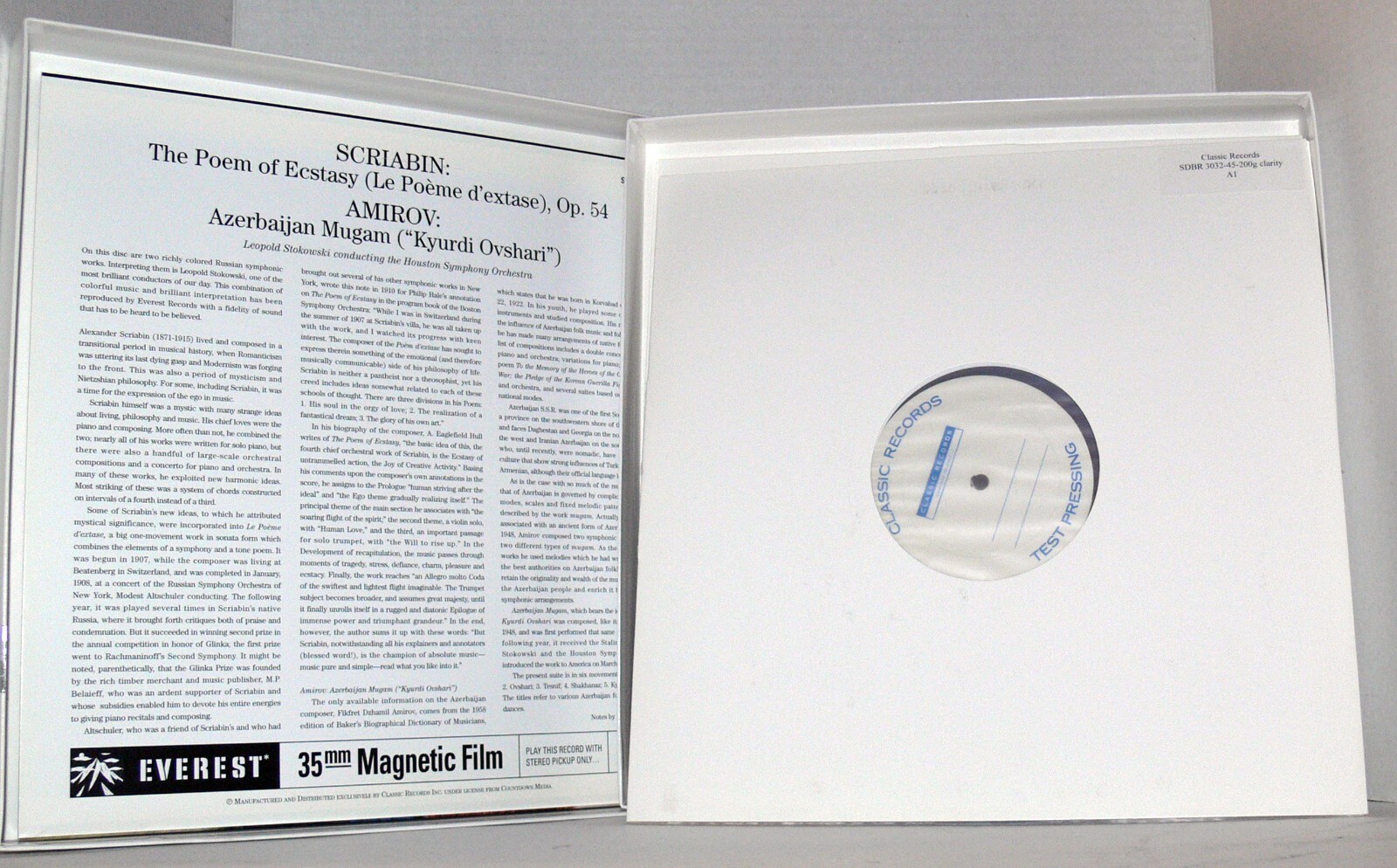
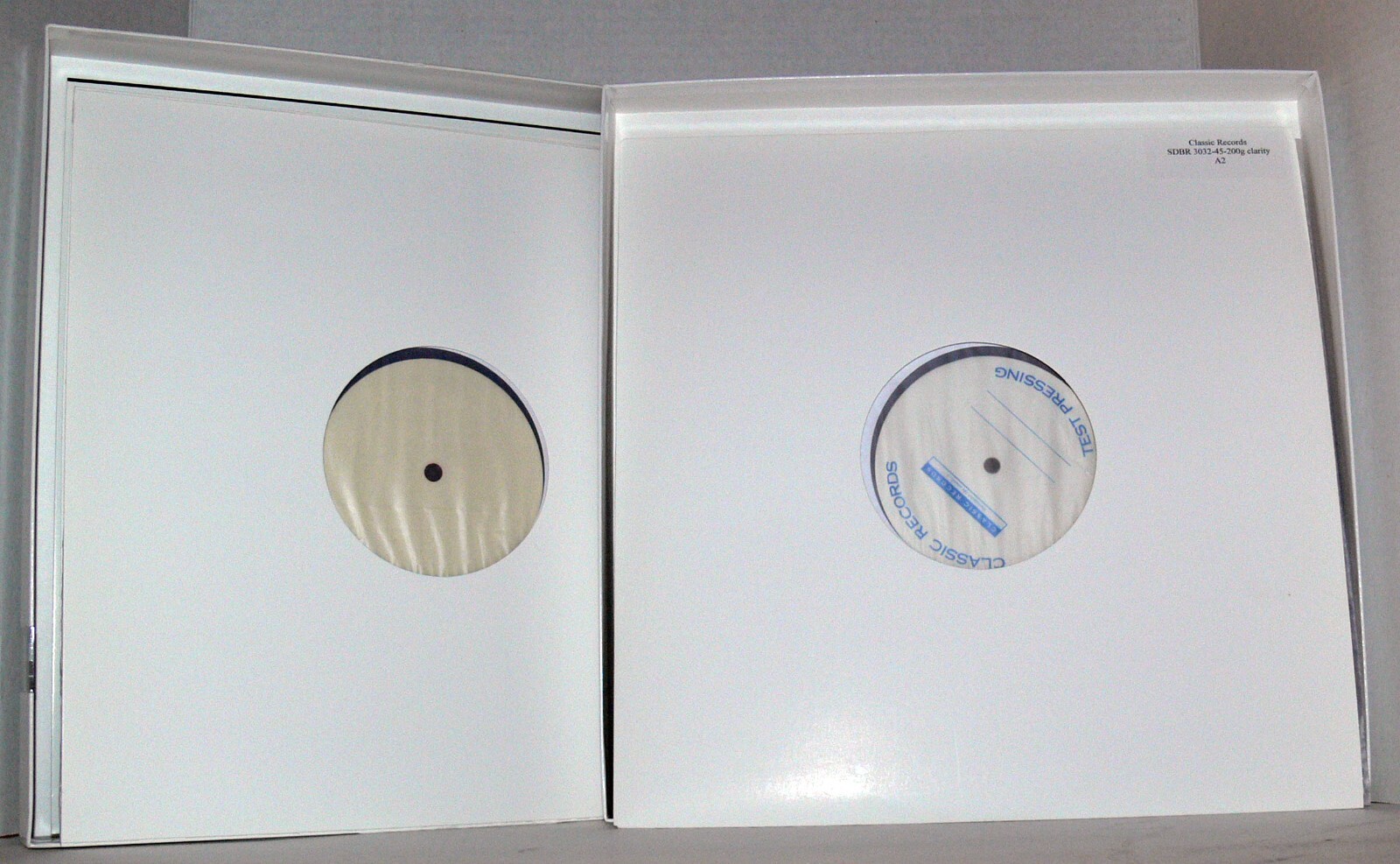
45rpm 2LP CLARITY Test Pressing Box Set. This set consists of 2 single-sided discs, for optimal sound performance, of the Classic Records 200 gram reissue of "Scriabin The Poem Of Ecstasy, Op. 54". This title was planned, but never released as a 45rpm set or on clarity vinyl. This release is the Clarity SV-P II Test Pressing from the Michael Hobson Archive, which was never commercially released.Lacquer cut directly from original 35mm magnetic tape on a vintage Westrex 1551 tape machine.
Pressed on 200 gram Clarity SV-P II QUIEX Super Vinyl Profile. Matrix / Runout (Side A1 runout etched): SDBR 3032-A1-45 Bernie Grundman (signature) Matrix / Runout (Side A2 runout etched): SDBR 3032-A2-45 Bernie Grundman (signature)
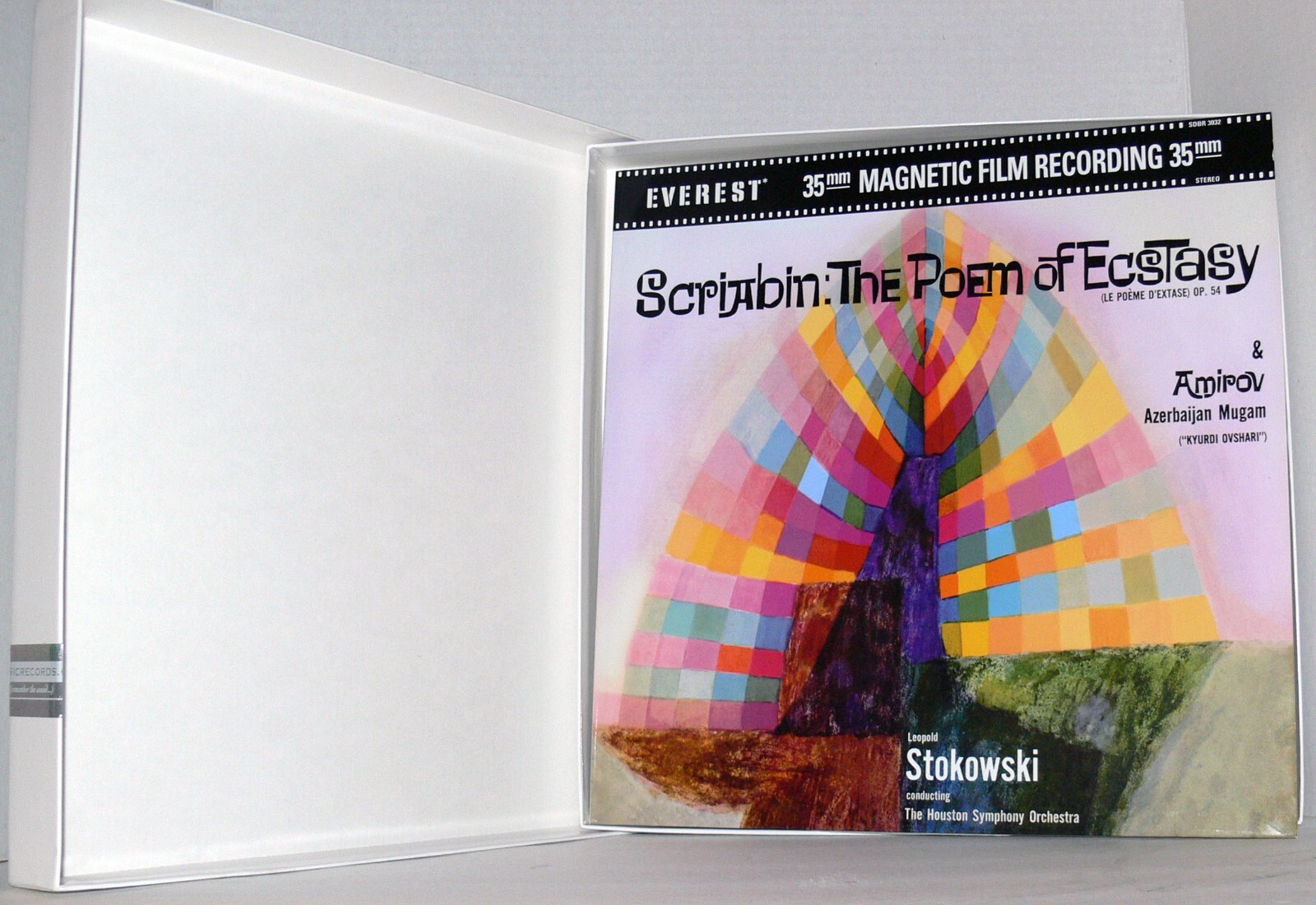
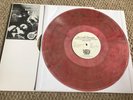
This is a MINT/Near Mint, NUMBERED 20 of 20, 45rpm 2LP Single-Sided CLARITY Test Pressing Box Set. The set consists of 2 single sided discs, for optimal sound performance, of the Classic Records 200gram reissue of "Scriabin The Poem Of Ecstasy, Op. 54". This title was planned, but never released as a 45rpm set or on Clarity vinyl, thereby making this an ultra collectible set. These highly collectible test pressings are from the first stamper. Test pressings reflect the closest you can get to the lacquers and hence have a special collectible value and store of value. Only a very small number of these unreleased sets exist and thus this is a special opportunity to hear your favorite title on Classic's 200g Super Vinyl Profile on Clarity Vinyl at 45 rpm - it doesn't get any better than this! This set is packaged in a white special edition box and each test pressing comes in a white jacket and sleeve. Original Everest/Classic Record jacket is also included as a bonus. 45 rpm records have long been recognized as providing a higher fidelity musical experience resulting purely from the cartridge being able to extract more of the nuance from the complex vertical and horizontal groove modulations in stereo LP’s. Further, Classic Records 45 rpm “single sided” pressings dramatically reduce the mechanical resonances created by the cartridge during playback by allowing these resonances to be more fully transmitted to and absorbed by the turntable platter. Classic Records Clarity Vinyl 45 rpm pressings are designed and manufactured to provide the “LOWEST DISTORTION” in every aspect of LP playback resulting in putting the listener as close to the music as possible. With only 20 copies of this definitive reissue, this issue is sure to be highly collectable.
On this disc is a richly colored Russian symphonic work. Interpreting it is Leopold Stokowski, one of the most brilliant conductors of our day. This colorful music and brilliant interpretation has been reproduced by Everest Records with a fidelity of sound that has to be heard to be believed. Alexander Scriabin (1871-1915) lived and composed in a transitional period in musical history, when Romanticism was uttering its last dying gasp and Modernism was forging to the front. This was also a period of mysticism and Nietzschian philosophy. For some, including Scriabin, it was a time for the expression of the ego in music. Scriabin himself was a mystic with many strange ideas about living, philosophy and music. His chief loves were the piano and composing. More often than not, he combined the two; nearly all of his works were written for solo piano, but there were also a handful of large-scale orchestral compositions and a concerto for piano and orchestra. In many of these works, he exploited new harmonic ideas. Most striking of these was a system of chords constructed on intervals of a fourth instead of a third. Some of Scriabin’s new ideas, to which he attributed mystical significance, were incorporated into Le Poeme d’extase, a big one-movement work in sonata form which combines the elements of a symphony and a tone poem. It was begun in 1907, while the composer was living at Beatenberg in Switzerland, and was completed in January, 1908. It received its initial per- formance on December 10, 1908, at a concert of the Russian Symphony Orchestra of New York, Modest Altschuler conducting. The following year, it was played several times in Scriabin’s native Russia, where it brought forth critiques both of praise and condemnation. But it succeeded in winning second prize in the annual competition in honor of Glinka; the first prize went to Rachmaninoff’s Second Sym- phony. It might be noted, parenthetically, that the Glinka Prize was founded by the rich timber merchant and music publisher, M. P. Belaieff, who was an ardent supporter of Scriabin and whose subsidies enabled him to devote his entire energies to giving piano recitals and composing. Altschuler, who was a friend of Scriabin’s and who had brought out several of his other symphonic works in New York, wrote this note in 1910 for Philip Hale’s annotation on The Poem of Ecstasy in the program book of the Boston Symphony Orchestra: “While I was in Switzerland during the summer of 1907 at Scriabin’s villa, he was all taken up with the work, and I watched its progress with keen interest. The composer of the Poeme d’extase has sought to express therein something of the emotional (and therefore musically communicable) side of his philosophy of life. Scriabin is neither a pantheist nor a theosophist, yet his creed includes ideas somewhat related to each of these schools of thought. There are three divisions in his Poem: 1. His soul in the orgy of love; 2. The realization of a fantastical dream; 3. The glory of his own art.” In his biography of the composer, A. Eaglefield Hull writes of The Poem of Ecstasy, “The basic idea of this, the fourth chief orchestral work of Scriabin, is the Ecstasy of untrammelled action, the Joy in Creative Activity.” Basing his comments upon the composer’s own annotations in the score, he assigns to the Prologue “human striving after the ideal” and “the Ego theme gradually realizing itself.” The principal theme of the main section he associates with “the soaring flight of the spirit;” the second theme, a violin solo, with “Human Love,” and the third, an important passage for solo trumpet, with “the Will to rise up.” In the Development and Recapitulation, the music passes through moments of tragedy, stress, defiance, charm, pleasure and ecstasy. Finally, the work reaches “an Allegro molto Coda of the swiftest and lightest flight imaginable. The Trumpet subject becomes broader, and assumes great majesty, until it finally unrolls itself in a rugged and diatonic Epilogue of immense power and triumphant grandeur.” In the end, however, the author sums it up with these words: “But Scriabin, notwithstanding all his explainers and annotators (blessed word!), is the champion of absolute music— music pure and simple— read what you like into it.” (from the liner notes)
The master of this recording was recorded on 35mm magnetic film using especially designed Westrex equipment. Standard Westrex 35mm equipment is in use today in the motion picture industry since it is the finest method of capturing and reproducing the widest frequency response with the least amount of distortion. Harry Belock, founder and president of Everest, and an eminent authority on sound, drew upon his rich experience in motion pic¬ ture recording in his desire to produce the finest sound on records. Realizing the advantages of recording for Stereophonic or Monophonic reproduction on a film 35mm wide, as against one-half inch tape, he ordered the manufacture of especially designed Westrex 35mm equipment for both permanent studio use, and also in portable equipment for location use. Simply stated these advantages are: 1) wider master tracks; 2) thicker base than tape, 1 eliminating "print through"; 3) greater deposit of magnetic film oxide is better able to accept high intensity signals and to maintain the lowest signal to noise ratio in the industry; 4) sprocket holes in film to allow smoother transport and eliminate "wow & flutter.” The use of this advanced equipment, the finest Telefunken & AKG microphones, especially designed stereo-mixing consoles, Belock modified Westrex stereo disc-cutters, and the painstaking care taken in preparation by Everest's engineering staff, has resulted in the recording herein contained. It has unrestricted dynamics, a frequency response from 20 to 20,000 cycles and no audible distortion throughout this entire frequency range. We feel sure that you will be as pleased listening to Everest Sound as we are to be able to produce it for you.
price rating













![Anamanaguchi - [USA] // Vinyl LP limited on Electric Blue/Bone Yellow](https://www.popsike.net/php/thumbnail.php?url=https://www.popsike.pics/pix/20190830/283598603260.jpg)