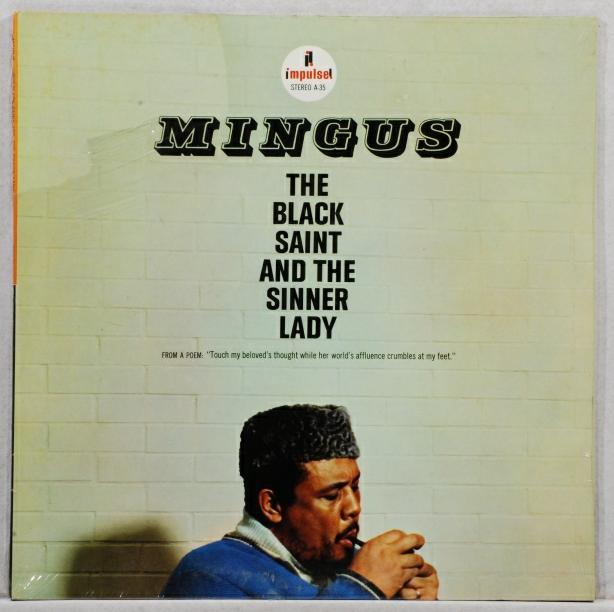
Sealed LP: Charles Mingus: The Black Saint And The Sinn
$
27


$ 27
Sold For
May 31, 2010
Sold Date
May 24, 2010
Start Date
$ 25
Start price
3
Number Of Bids
USA
Country Of Seller
eBay
Auctioned at
Favourite Auctions
To save auctions to your favourites, please login
If you don't have an account, please register
Description
Charles Mingus: The Black Saint And The Sinner
FACTORY SEALED LP
Format: Sealed LPRecord Company/Release Number: ABC/Impulse!: A-35
Bar Code: NONE
Original release date: 1963
Country: U.S.A.
Condition of the cover: Mint
Condition of the record: Sealed - Assumed Mint
Shipping Weight: 1 pounds, 5 ounces
Opening bid: 24.99
Inventory number: 209321
Notes: Minor shelf wear to the shrink wrap on the upper left corner of the cover. Please contact me if you have any difficulty viewing the photos.
Songs:
- Track A - Solo Dancer
- Track B - Duet Solo Dancers
- Track C – Group Dancers
- Mode D - Trio and Group Dancers/Mode E - Single Solos and Group Dance: Mode D-Trio And Group Dancers: Stop! Look! And Sing Songs Of Revolutions / Mode E-Single Solos And Group Dance: Saint And Sinner Join In Merriment On Battle Front / Mode F-Group A
- Charles Mingus: Bass, Piano, Leader
- Jerome Richardson: Soprano, Baritone Saxophones, Flute
- Charlie Mariano: Alto Saxophone
- Dick Hafer: Tenor Saxophone, Flute
- Rolf Ericson: Trumpet
- Richard Williams: Trumpet
- Quentin Jackson: Trombone
- Don Butterfield: Tuba, Contrabass Trombone
- Jaki Byard: Piano
- Jay Berliner: Acoustic Guitar
- Dannie Richmond: Drums
- Bob Simpson: Recording Engineer
- Irascible, demanding, bullying, and probably a genius, Charles Mingus cut himself a uniquely iconoclastic path through jazz in the middle of the 20th century, creating a legacy that became universally lauded only after he was no longer around to bug people. As a bassist, he knew few peers, blessed with a powerful tone and pulsating sense of rhythm, capable of elevating the instrument into the front line of a band. But had he been just a string player, few would know his name today. Rather, he was the greatest bass-playing leader/composer jazz has ever known, one who always kept his ears and fingers on the pulse, spirit, spontaneity, and ferocious expressive power of jazz.
- Intensely ambitious yet often earthy in expression, simultaneously radical and deeply traditional, Mingus' music took elements from everything he had experienced -- from gospel and blues through New Orleans jazz, swing, bop, Latin music, modern classical music, even the jazz avant-garde. His touchstone was Duke Ellington, but Mingus took the sonic blend and harmonies of Ellingtonia much further, throwing in abrasive dissonances and abrupt changes in meter and tempo, introducing tremendously exhilarating accelerations that generated a momentum of their own. While his early works were written out in a classical fashion, by the mid-'50s, he had worked out a new way of getting his unconventional visions across, dictating the parts to his musicians while allowing plenty of room for the players' own musical personalities and ideas. He was also a formidable pianist, fully capable of taking that role in a group -- which he did in his 1961-62 bands, hiring another bassist to fill in for him.
- Along the way, Mingus made a lot of enemies, causing sometimes violent confrontations on and off the bandstand. A big man physically, he used his bulk as a weapon of intimidation, and he was not above halting concerts to chew out inattentive audiences or errant sidemen, even cashiering a musician now and then on the spot. At one of his concerts in Philadelphia -- and a memorial to a dead colleague at that -- he broke up the show by slamming the piano lid down, nearly smashing his pianist's hands, and then punched trombonist Jimmy Knepper in the mouth. For a savage physical portrait of the emotions that seethed within him, check out the photo on the cover of Duke Ellington's Money Jungle; Mingus looks as if he is about to kill someone. But he could also be a gentle giant as his moods permitted, and that quality can be felt in some of his music.
- Mingus felt the lash of racial prejudice very intensely -- which, combined with the frustrations of making it in the music business on his own terms, found its outlet in music. Indeed, some of his bizarre titles were political in nature, such as Fables of Faubus (referring to the Arkansas governor who tried to keep Little Rock schools segregated), "Oh Lord, Don't Let Them Drop That Atomic Bomb on Me" or "Remember Rockefeller at Attica." But he could also be wildly humorous, the most notorious example being "If Charlie Parker Was a Gunslinger, There'd Be a Whole Lot of Dead Copycats" (later shortened to "Gunslinging Bird").
- Born in a Nogales Army camp, Mingus was shortly thereafter taken to the Watts district of Los Angeles, where he grew up. The first music he heard was that of the church -- the only music his stepmother allowed around the house -- but one day, despite the threat of punishment, he tuned in Duke Ellington's "East St. Louis Toodle-Oo" on his father's crystal set, his first exposure to jazz. He tried to learn the trombone at six and then the cello, but he became fed up with incompetent teachers and ended up on the double bass by the time he reached high school. His early teachers were Red Callender and an ex-New York Philharmonic bassist named Herman Rheinschagen, and he also studied composition with Lloyd Reese. A proto-third stream composition written by Mingus in 1940-41, "Half-Mast Inhibition" (recorded in 1960), reveals an extraordinary timbral imagination for a teenager.
- As a bass prodigy, Mingus performed with Kid Ory in Barney Bigard's group in 1942 and went on the road with Louis Armstrong the following year. He would gravitate toward the R&B side of the road later in the '40s, working with the Lionel Hampton band in 1947-48, backing R&B and jazz performers, and leading ensembles in various idioms under the name Baron Von Mingus. He began to attract real national attention as a bassist for Red Norvo's trio with Tal Farlow in 1950-51, and after leaving that group, he moved to New York and began working with several stellar jazz performers, including Billy Taylor, Stan Getz and Art Tatum. He was the bassist in the famous 1953 Massey Hall concert in Toronto with Charlie Parker, Dizzy Gillespie, Bud Powell and Max Roach, and he briefly joined his idol Ellington, where he had the dubious distinction of being the only man Duke ever personally fired from his band.
- Around this time, Mingus tried to make himself into a rallying point for the jazz community. He founded Debut Records in partnership with his then-wife Celia and Roach in 1952, seeing to it that the label recorded a wide variety of jazz from bebop to experimental music until its demise in 1957. Among Debut's most notable releases were the Massey Hall concert, an album by Miles Davis, and several Mingus sessions that traced the development of his ideas. He also contributed composed works to the Jazz Composers' Workshop from 1953 to 1955, and later in '55, he founded his own Jazz Workshop repertory group that found him moving away from strict notation toward his looser, dictated manner of composing.
- By 1956, with the release of Pithecanthropus Erectus (Atlantic), Mingus had clearly found himself as a composer and leader, creating pulsating, ever-shifting compendiums of jazz's past and present, feeling his way into the free jazz of the future. For the next decade, he would pour forth an extraordinary body of work for several labels, including key albums like The Clown, New Tijuana Moods, Mingus Ah Um, Blues and Roots and Oh Yeah; standards like "Goodbye Pork Pie Hat," "Better Git It in Your Soul," "Haitian Fight Song" and "Wednesday Night Prayer Meeting," and extended works like Meditations on Integration and Epitaph. Through ensembles ranging in size from a quartet to an 11-piece big band, a procession of noted sidemen like Eric Dolphy, Jackie McLean, J.R. Monterose, Jimmy Knepper, Roland Kirk, Booker Ervin, and John Handy would pass, with Mingus' commanding bass and volatile personality pushing his musicians further than some of them might have liked to go. The groups with the great Dolphy (heard live on Mingus at Antibes) in the early '60s might have been his most dynamic, and The Black Saint and the Sinner Lady (1963), an extended ballet for big band that captures the anguished/joyful split Mingus personality in full, passionately wild cry -- may be his masterpiece.
- However, Mingus' obsessive efforts to free himself from the economic hazards and larceny of the music business nearly undermined his sanity in the 1960s (indeed, some of the liner notes for The Black Saint album were written by his psychologist, Dr. Edmund Pollock). He tried to compete with the Newport festivals by organizing his own Jazz Artists Guild in 1960 that purported to give musicians more control over their work, but that collapsed with the by-now-routine rancor that accompanied so many Mingus ventures. A calamitous, self-presented New York Town Hall concert in 1962; another, shorter-lived recording venture, Charles Mingus Records, in 1964-65; the failure to find a publisher for his autobiography Beneath the Underdog, and other setbacks broke his bank account and ultimately his spirit. He quit music almost entirely from 1966 until 1969, resuming performances in June 1969 only because he desperately needed money.
- Financial angels in the forms of a Guggenheim Fellowship in composition, the publication of Beneath the Underdog in 1971, and the purchase of his Debut masters by Fantasy boosted Mingus' spirits, and a new stimulating Columbia album Let My Children Hear Music thrust him back into public attention. By 1974, he had formed a new young quintet, anchored by his loyal drummer Dannie Richmond and featuring Jack Walrath, Don Pullen and George Adams, and more compositions came forth, including the massive, kaleidoscopic, Colombian-based "Cumbia and Jazz Fusion" that began its life as a film score.
- Respect was growing, but time, alas, was running out, for in fall 1977, Mingus was diagnosed with amyotrophic lateral sclerosis (Lou Gehrig's disease), and by the following year, he was unable to play the bass. Though confined to a wheelchair, he nevertheless carried on, leading recording sessions, and receiving honors at a White House concert on June 18, 1978. His last project was a collaboration, Mingus with folk-rock singer Joni Mitchell, who wrote lyrics to Mingus' music and included samples of Mingus' voice on the record.
- Since his death, Mingus' importance and fame increased remarkably, thanks in large part to the determined efforts of Sue Mingus, his widow. A posthumous repertory group, Mingus Dynasty, was formed almost immediately after his death, and that concept was expanded in 1991 into the exciting Mingus Big Band, which has resurrected many of Mingus' most challenging scores. Epitaph was finally reconstructed, performed and recorded in 1989 to general acclaim, and several box sets of portions of Mingus' output have been issued by Rhino/Atlantic, Mosaic and Fantasy. Beyond re-creations, the Mingus influence can be heard on Branford Marsalis' early Scenes in the City album, and especially in the big band writing of his brother Wynton. The Mingus blend of wildly colorful eclecticism solidly rooted in jazz history should serve his legacy well in a future increasingly populated by young conservatives who want to pay their respects to tradition and try something different.
FINE PRINT
- All pictures are of the exact item being sold.
- This record came from a record store called "Phantasmagoria" which was located in Allentown, Pennsylvania. Phantasmagoria went out of business in 1978. I purchased most of their leftover inventory some years later when I owned a new & used record store in Catasauqua called "Music Madness".
- Phantasmagoria used round colored stickers to indicate the price of the albums. They had a sign on the wall with the color sticker combinations for the customers to use so they knew the price of the albums. Most of the albums still have these stickers on them, and in some rare cases, the stickers are written on. Some of the records have prices on them. This is the price you would have paid for the record in 1978 if you would have bought it at Phantasmagoria. Please don't confuse these prices with their current value.
- Your item(s) will be shipped within two business days after I receive your payment.
- I always leave feedback before your item ships. Please consider leaving feedback for me after you have had a chance to inspect and enjoy this record.
- Please avoid questions on the last day of the auction. I might not have enough time to give you an answer before the auction ends.
- Payment by PayPal is preferred. Other payment methods can be discussed. Local pick-ups will require cash at the time of pick-up.
- Almost all album reviews, credits and artist biographies are from All Music Guide. If you haven't been to their web site, you should check it out. It's one of the most comprehensive music references on the internet. In some cases, the above credits may include reissue (CD) information. Obviously any credits referenced to CDs do not apply to these album releases.
- All sealed albums are being sold as collector's items and cannot be returned due to manufacturer's defects. It may be almost impossible to replace many of the sealed albums that I am selling.
I DO NOT END ANY OF MY AUCTIONS EARLY. PLEASE DON'T ASK (unless you are willing to offer enough to pay off my mortgage).
IT IS NOT MY INTENTION TO MAKE A PROFIT ON THE POSTAGE. ANY ACCIDENTAL OVERCHARGE GREATER THAN $1 WILL BE REFUNDED TO YOU. (I've been know to refund less than $1 overcharges too.)
Shipping
Domestic (U.S.A.) buyers:- Priority Mail will be the only option available if you are the winning bidder. If you want your purchase shipped by Media Mail, you will have the option to request a revised invoice.
- Priority Mail: Buyer pays the actual USPS cost.
- Pick-up is fine with me. Just be prepared to pay by cash. No shipping fees apply. E-mail me to setup a time that is convenient for the both of us.
- All uninsured and underinsured shipments are the responsibility of the buyer.
- Foreign buyers must pay with US dollars through PayPal only. Please do not send cash - it's too risky.
- SHIPPING: I will send an invoice with options for the cost of shipping after the auction ends. You will have the choice of the following two options:
- USPS First Class International: Estimated delivery time to most countries is about 10-30 days. (Customs may delay delivery)
- USPS Priority Mail International: Estimated delivery time to most countries is about 6-10 days. (Customs may delay delivery)
- All uninsured and underinsured shipments are the responsibility of the buyer.
- The buyer is responsible for all customs regulations and fees in their own country.
- I will value all records at $5 on the Customs Form. Please let me know if you want the actual winning bid price listed on the Customs Form.
If you also collect Grand Funk, let me know if you have anything that you might want to sell or trade. I am always looking to add something new to my collection.
price rating