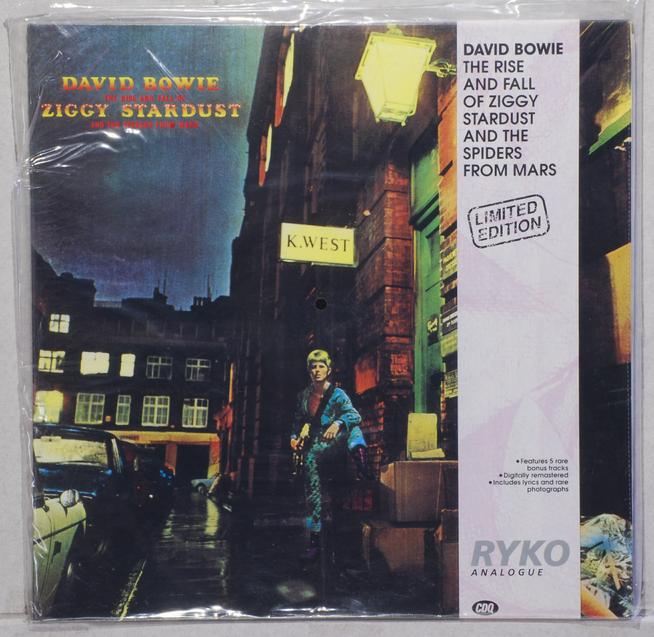
Sealed LP: David Bowie: Ziggy Stardust (Ryko)
$
105


$ 105
Sold For
Apr 17, 2010
Sold Date
Apr 10, 2010
Start Date
$ 50
Start price
6
Number Of Bids
USA
Country Of Seller
eBay
Auctioned at
Favourite Auctions
To save auctions to your favourites, please login
If you don't have an account, please register
Description
David Bowie: Ziggy Stardust (Ryko)
FACTORY SEALED LP
Format: Sealed LPRecord Company/Release Number: Rykodisc: RALP 0134-2
Barcode: NONE
Original release date: 1990
Country: U.S.A.
Condition of the cover: Mint
Condition of the record: Sealed - Assumed Mint
Shipping Weight: 1 pounds, 7 ounces
Opening bid: 49.99
Inventory number: 208342
Notes: 2 LPs in a gatefold cover. The records were pressed on clear virgin vinyl. Please contact me if you have any difficulty viewing the photos.
Songs:
- Five Years
- Soul Love
- Moonage Daydream
- Starman
- It Ain't Easy
- Lady Stardust
- Star
- Hang Onto Yourself
- Ziggy Stardust
- Suffragette City
- Rock 'N' Roll Suicide
- John, I'm Only Dancing [#]
- Velvet Goldmine [*]
- Sweet Head [#]
- Ziggy Stardust [#/demo version]
- Lady Stardust [#/demo version]
- Trevor Bolder: Bass
- David Bowie: Guitar, Arranger, Keyboards, Saxophone, Vocals, Producer
- Dana Gillespie: Vocals (bckgr)
- Peter Mew: Remastering
- Terry Pastor: Artwork
- Nigel Reeve: Remastering
- Mick Rock: Photography
- Mick Ronson: Guitar, Piano, Arranger, Vocals
- Ken Scott: Producer
- Rick Wakeman: Keyboards
- Brian Ward: Photography
- Mick "Woody" Woodmansey: Drums
- Borrowing heavily from Marc Bolan's glam rock and the future shock of A Clockwork Orange, David Bowie reached back to the heavy rock of The Man Who Sold the World for The Rise & Fall of Ziggy Stardust and the Spiders From Mars. Constructed as a loose concept album about an androgynous alien rock star named Ziggy Stardust, the story falls apart quickly, yet Bowie's fractured, paranoid lyrics are evocative of a decadent, decaying future, and the music echoes an apocalyptic, nuclear dread. Fleshing out the off-kilter metallic mix with fatter guitars, genuine pop songs, string sections, keyboards, and a cinematic flourish, Ziggy Stardust is a glitzy array of riffs, hooks, melodrama, and style and the logical culmination of glam. Mick Ronson plays with a maverick flair that invigorates rockers like "Suffragette City," "Moonage Daydream," and "Hang Onto Yourself," while "Lady Stardust," "Five Years," and "Rock 'n' Roll Suicide" have a grand sense of staged drama previously unheard of in rock & roll. And that self-conscious sense of theater is part of the reason why Ziggy Stardust sounds so foreign. Bowie succeeds not in spite of his pretensions but because of them, and Ziggy Stardust -- familiar in structure, but alien in performance -- is the first time his vision and execution met in such a grand, sweeping fashion. [The 1990 edition features five bonus tracks: "John, I'm Only Dancing," "Velvet Goldmine," "Sweet Head," "Ziggy Stardust," and "Lady Stardust."]
- The cliché about David Bowie says he's a musical chameleon, adapting himself according to fashion and trends. While such a criticism is too glib, there's no denying that Bowie demonstrated remarkable skill for perceiving musical trends at his peak in the '70s. After spending several years in the late '60s as a mod and as an all-around music-hall entertainer, Bowie reinvented himself as a hippie singer/songwriter. Prior to his breakthrough in 1972, he recorded a proto-metal record and a pop/rock album, eventually redefining glam rock with his ambiguously sexy Ziggy Stardust persona. Ziggy made Bowie an international star, yet he wasn't content to continue to churn out glitter rock. By the mid-'70s, he developed an effete, sophisticated version of Philly soul that he dubbed "plastic soul," which eventually morphed into the eerie avant-pop of 1976's Station to Station. Shortly afterward, he relocated to Berlin, where he recorded three experimental electronic albums with Brian Eno. At the dawn of the '80s, Bowie was still at the height of his powers, yet following his blockbuster dance-pop album Let's Dance in 1983, he slowly sank into mediocrity before salvaging his career in the early '90s. Even when he was out of fashion in the '80s and '90s, it was clear that Bowie was one of the most influential musicians in rock, for better and for worse. Each one of his phases in the '70s sparked a number of subgenres, including punk, new wave, goth rock, the new romantics, and electronica. Few rockers ever had such lasting impact.
- David Jones began performing music when he was 13 years old, learning the saxophone while he was at Bromley Technical High School; another pivotal event happened at the school, when his left pupil became permanently dilated in a schoolyard fight. Following his graduation at 16, he worked as a commercial artist while playing saxophone in a number of mod bands, including the King Bees, the Manish Boys (which also featured Jimmy Page as a session man), and Davey Jones & the Lower Third. All three of those bands released singles, which were generally ignored, yet he continued performing, changing his name to David Bowie in 1966 after the Monkees' Davy Jones became an international star. Over the course of 1966, he released three mod singles on Pye Records, which were all ignored. The following year, he signed with Deram, releasing the music hall, Anthony Newley-styled David Bowie that year. Upon completing the record, he spent several weeks in a Scottish Buddhist monastery. Once he left the monastery, he studied with Lindsay Kemp's mime troupe, forming his own mime company, the Feathers, in 1969. The Feathers were short-lived, and he formed the experimental art group Beckenham Arts Lab in 1969.
- Bowie needed to finance the Arts Lab, so he signed with Mercury Records that year and released Man of Words, Man of Music, a trippy singer/songwriter album featuring "Space Oddity." The song was released as a single and became a major hit in the U.K., convincing Bowie to concentrate on music. Hooking up with his old friend Marc Bolan, he began miming at some of Bolan's T. Rex concerts, eventually touring with Bolan, bassist/producer Tony Visconti, guitarist Mick Ronson, and drummer Cambridge as Hype. The band quickly fell apart, yet Bowie and Ronson remained close, working on the material that formed Bowie's next album, The Man Who Sold the World, as well as recruiting Michael "Woody" Woodmansey as their drummer. Produced by Tony Visconti, who also played bass, The Man Who Sold the World was a heavy guitar rock album that failed to gain much attention. Bowie followed the album in late 1971 with the pop/rock Hunky Dory, an album that featured Ronson and keyboardist Rick Wakeman.
- Following the release of Hunky Dory, Bowie began to develop his most famous incarnation, Ziggy Stardust: an androgynous, bisexual rock star from another planet. Before he unveiled Ziggy, Bowie claimed in a January 1972 interview with the Melody Maker that he was gay, helping to stir interest in his forthcoming album. Taking cues from Bolan's stylish glam rock, Bowie dyed his hair orange and began wearing women's clothing. He began calling himself Ziggy Stardust, and his backing band -- Ronson, Woodmansey, and bassist Trevor Bolder -- were the Spiders from Mars. The Rise & Fall of Ziggy Stardust and the Spiders from Mars was released with much fanfare in England in late 1972. The album and its lavish, theatrical concerts became a sensation throughout England, and it helped him become the only glam rocker to carve out a niche in America. Ziggy Stardust became a word-of-mouth hit in the U.S., and the re-released "Space Oddity" -- which was now also the title of the re-released Man of Words, Man of Music -- reached the American Top 20. Bowie quickly followed Ziggy with Aladdin Sane later in 1973. Not only did he record a new album that year, but he also produced Lou Reed's Transformer, the Stooges' Raw Power, and Mott the Hoople's comeback All the Young Dudes, for which he also wrote the title track.
- Given the amount of work Bowie packed into 1972 and 1973, it wasn't surprising that his relentless schedule began to catch up with him. After recording the all-covers Pin-Ups with the Spiders from Mars, he unexpectedly announced the band's breakup, as well as his retirement from live performances, during the group's final show that year. He retreated from the spotlight to work on a musical adaptation of George Orwell's -1984, but once he was denied the rights to the novel, he transformed the work into Diamond Dogs. The album was released to generally poor reviews in 1974, yet it generated the hit single "Rebel Rebel," and he supported the album with an elaborate and expensive American tour. As the tour progressed, Bowie became fascinated with soul music, eventually redesigning the entire show to reflect his new "plastic soul." Hiring guitarist Carlos Alomar as the band's leader, Bowie refashioned his group into a Philly soul band and recostumed himself in sophisticated, stylish fashions. The change took fans by surprise, as did the double-album David Live, which featured material recorded on the 1974 tour.
- Young Americans, released in 1975, was the culmination of Bowie's soul obsession, and it became his first major crossover hit, peaking in the American Top Ten and generating his first U.S. number one hit in "Fame," a song he co-wrote with John Lennon and Alomar. Bowie relocated to Los Angeles, where he earned his first movie role in Nicolas Roeg's The Man Who Fell to Earth (1976). While in L.A., he recorded Station to Station, which took the plastic soul of Young Americans into darker, avant-garde-tinged directions, yet was also a huge hit, generating the Top Ten single "Golden Years." The album inaugurated Bowie's persona of the elegant "Thin White Duke," and it reflected Bowie's growing cocaine-fueled paranoia. Soon, he decided Los Angeles was too boring and returned to England; shortly after arriving back in London, he gave the awaiting crowd a Nazi salute, a signal of his growing, drug-addled detachment from reality. The incident caused enormous controversy, and Bowie left the country to settle in Berlin, where he lived and worked with Brian Eno.
- Once in Berlin, Bowie sobered up and began painting, as well as studying art. He also developed a fascination with German electronic music, which Eno helped him fulfill on their first album together, Low. Released early in 1977, Low was a startling mixture of electronics, pop, and avant-garde technique. While it was greeted with mixed reviews at the time, it proved to be one of the most influential albums of the late '70s, as did its follow-up, Heroes, which followed that year. Not only did Bowie record two solo albums in 1977, but he also helmed Iggy Pop's comeback records The Idiot and Lust for Life, and toured anonymously as Pop's keyboardist. He resumed his acting career in 1977, appearing in Just A Gigolo with Marlene Dietrich and Kim Novak, as well as narrating Eugene Ormandy's version of Peter and the Wolf. Bowie returned to the stage in 1978, launching an international tour that was captured on the double-album Stage. During 1979, Bowie and Eno recorded Lodger in New York, Switzerland, and Berlin, releasing the album at the end of the year. Lodger was supported with several innovative videos, as was 1980's Scary Monsters, and these videos -- "DJ," "Fashion," "Ashes to Ashes" -- became staples on early MTV.
- Scary Monsters was Bowie's last album for RCA, and it wrapped up his most innovative, productive period. Later in 1980, he performed the title role in stage production of +The Elephant Man, including several shows on Broadway. Over the next two years, he took an extended break from recording, appearing in Christine F (1982) and the vampire movie The Hunger (1982), returning to the studio only for his 1981 collaboration with Queen, "Under Pressure," and the theme for Paul Schrader's remake of Cat People. In 1983, he signed an expensive contract with EMI Records and released Let's Dance. Bowie had recruited Chic guitarist Nile Rodgers to produce the album, giving the record a sleek, funky foundation, and hired the unknown Stevie Ray Vaughan as lead guitarist. Let's Dance became his most successful record, thanks to stylish, innovative videos for "Let's Dance" and "China Girl," which turned both songs into Top Ten hits. Bowie supported the record with the sold-out arena tour Serious Moonlight.
- Greeted with massive success for the first time, Bowie wasn't quite sure how to react, and he eventually decided to replicate Let's Dance with 1984's Tonight. While the album sold well, producing the Top Ten hit "Blue Jean," it received poor reviews and ultimately was a commercial disappointment. He stalled in 1985, recording a duet of Martha & the Vandellas' "Dancing in the Street" with Mick Jagger for Live Aid. He also spent more time jet-setting, appearing at celebrity events across the globe, and appeared in several movies -- Into the Night (1985), Absolute Beginners (1986), Labyrinth (1986) -- that turned out to be bombs. Bowie returned to recording in 1987 with the widely panned Never Let Me Down, supporting the album with the Glass Spider tour, which also received poor reviews. In 1989, he remastered his RCA catalog with Rykodisc for CD release, kicking off the series with the three-disc box Sound + Vision. Bowie supported the discs with an accompanying tour of the same name, claming that he was retiring all of his older characters from performance following the tour. Sound + Vision was successful, and Ziggy Stardust re-charted amidst the hoopla.
- Sound + Vision may have been a success, but Bowie's next project was perhaps his most unsuccessful. Picking up on the abrasive, dissonant rock of Sonic Youth and the Pixies, Bowie formed his own guitar rock combo, Tin Machine, with guitarist Reeves Gabrels, bassist Hunt Sales, and his drummer brother Tony, who had previously worked on Iggy Pop's Lust for Life with Bowie. Tin Machine released an eponymous album to poor reviews that summer and supported it with a club tour, which was only moderately successful. Despite the poor reviews, Tin Machine released a second album, the appropriately titled Tin Machine II, in 1991, and it was completely ignored.
- Bowie returned to a solo career in 1993 with the sophisticated, soulful Black Tie White Noise, recording the album with Nile Rodgers and his now-permanent collaborator, Reeves Gabrels. The album was released on Savage, a subsidiary of RCA, and received positive reviews, but his new label went bankrupt shortly after its release, and the album disappeared. Black Tie White Noise was the first indication that Bowie was trying hard to resuscitate his career, as was the largely instrumental 1994 soundtrack The Buddha of Suburbia. In 1995, he reunited with Brian Eno for the wildly hyped, industrial rock-tinged Outside. Several critics hailed the album as a comeback, and Bowie supported it with a co-headlining tour with Nine Inch Nails in order to snag a younger, alternative audience, but his gambit failed; audiences left before Bowie's performance and Outside disappeared. He quickly returned to the studio in 1996, recording Earthling, an album heavily influenced by techno and drum'n'bass. Upon its early 1997 release, Earthling received generally positive reviews, yet the album failed to gain an audience, and many techno purists criticized Bowie for allegedly exploiting their subculture. hours... followed in 1999. For 2002, Bowie reunited with producerToni Visconti and released Heathen to very positive reviews. He continued on with Visconti for Reality in 2003.
FINE PRINT
- This item was from my personal David Bowie collection. I was collecting his music and memorabilia up to when he released the "White Tie, Whit Noise" album. Although I was still buying his music, I was no longer spending much of my time or money to collect his music and memorabilia. Now it's about time that I start selling most of what I have. I have many things that will be listed over the next few months. Unfortunately, I have quite a few live albums that I will not be able to sell here on eBay. The things in my collection range from very common to very rare.
- All pictures are of the exact item being sold.
- Your item(s) will be shipped the next business day after I receive your payment.
- I always leave feedback before your item ships. Please consider leaving feedback for me after you have had a chance to inspect and enjoy this item.
- Please avoid questions on the last day of the auction. I might not have enough time to give you an answer before the auction ends.
- Payment by PayPal only (except for items when local pick-up has been arranged).
- All album reviews, credits and artist biographies are from All Music Guide. If you haven't been to their web site, you have to check it out. It's one of the most comprehensive music references on the internet. In some cases, credits may include reissue (CD) information. Obviously any credits referenced to CDs do not apply to these album releases.
- All sealed albums are being sold as collector's items and cannot be returned due to manufacturer's defects. It may be almost impossible to replace many of the sealed albums that I am selling.
- IT IS NOT MY INTENTION TO MAKE A PROFIT ON THE POSTAGE. ANY ACCIDENTAL OVERCHARGE GREATER THAN $1 WILL BE REFUNDED TO YOU.
Shipping
Domestic (U.S.A.) buyers:- Pick-up is fine with me. Just be prepared to pay by cash. No shipping fees apply. E-mail me to setup a time that is convenient for the both of us.
- All uninsured and underinsured shipments are the responsibility of the buyer.
- I have started to add a $1.00 "handling fee" which is to help defray the cost of a new mailing box. This is approximately what I pay for them from BagsUnlimited. If you opt to have your record(s) shipped by Priority Mail, I will refund the dollar since the box from the Post Office is free. If don't chose Priority Mail and you feel that the dollar is unfair, let me know so I can refund it. Upon refunding your dollar, I will package your album(s) in an "almost new" mailer which was used to send a record to me.
- Foreign buyers must pay with US dollars through PayPal only. Please do not send cash - it's too risky.
- SHIPPING: I will send an invoice with options for the cost of shipping after the auction ends. You will have the choice of the following two options:
- USPS First Class International: Estimated delivery time to most countries is about 10-30 days. (Customs may delay delivery)
- USPS Priority Mail International: Estimated delivery time to most countries is about 6-10 days. (Customs may delay delivery)
- All uninsured and underinsured shipments are the responsibility of the buyer.
- I have started to add a $1.00 "handling fee" which is to help defray the cost of a new mailing box. This is approximately what I pay for them from BagsUnlimited. If you opt to have your record(s) shipped by Priority Mail, I will refund the dollar since the box from the Post Office is free. If don't chose Priority Mail and you feel that the dollar is unfair, let me know so I can refund it. Upon refunding your dollar, I will package your album(s) in an "almost new" mailer which was used to send a record to me.
- The buyer is responsible for all customs regulations and fees in their own country.
- You can go to the USPS International Postage Calculator to approximate the cost of your postage. The shipping weight for this record is listed near the beginning of this listing. If you are purchasing multiple records and need to manually calculate the postage, subtract 8 ounces for each additional record.
If you also collect Grand Funk, let me know if you have anything that you might want to sell or trade. I am always looking to add something new to my collection.
price rating