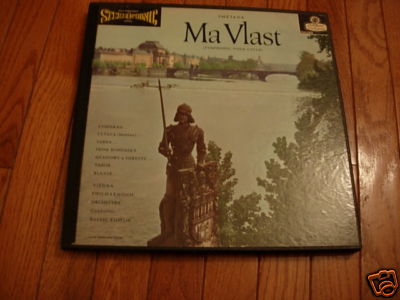
Smetana Ma Vlast Vienna Phil Orchestra Kubelik Blueback
$
35


Favourite Auctions
To save auctions to your favourites, please login
If you don't have an account, please register
Description
You are bidding on a Full Frequency Stereophonic Sound Double LP of the Vienna Philharmonic Orchestra with Conductor Rafael Kubelik performing Smetana Ma Vlast. This is on the London label. The London ffs long playing record was recorded stereophonically under an exclusive process and bears it's trademark on the front cover. Look for the London sign.Blue Back. It is your guarantee of the finest quality phonograph record available anywhere in the world. The records are in excellent condition and are ready for your listening pleasure. Below is an explanation of the Symphonic Poem Cycle.
Most composers disdain narrative as demeaning the power of their art. Despite its universality, and although much of the writing is so vivid as to speak for itself, Smetana wanted to be sure his specific intentions were understood and so in 1879 he sent his publisher detailed descriptions to be included in the score. The first two of its six movements were written in a matter of weeks at the very onset of his deafness. "Vyšehrad" is a rocky bluff overlooking Prague, where the Bohemian royal court had flourished in the eighth century under Queen Libuše, a seer whose prophecies of glory for her people Smetana also celebrated in a ceremonial opera. It opens with the unadorned harp of the bard Lumir, intoning a stately four-note motif that conjures past glory even while tinged with regret at the present ruin. The music rises in splendor to evoke a bygone bustle of activity, gleaming armor, war cries and celebrations of victory.
The most popular of the six movements, often heard on its own, is "Vlavta" ("The Moldau"), a vivid portrait of Bohemia's mighty river from source to end. Smetana conceived the seminal idea for the opening during an 1867 picnic at the conjunction of the two mountain brooks, which he depicts with flutes and clarinets, each gurgling in constant motion, as pizzicato strings highlight glints of sunlight on the rippling surface trickling over the rocks. The brooks coalesce into a swift stream whose lovely melody may sound familiar, as it's derived from the same folk source as "Hatikva," the Zionist, and now Israeli, national anthem. As the river swells and courses through the countryside, we hear hunting horns, a wedding dance, nocturnal nymphs, foaming rapids and a majestic flow past Prague before disappearing from sight as it joins the sea.
Having depicted history and the land, Smetana next turned to legend. "Šàrka" is the bloody tale of an Amazon maiden who massacres the men who betrayed her. It begins in blind rage, mellows as she seduces her unfaithful lover and lulls his soldiers to sleep and then snarls with fierce pride as she calls her troops to avenge her shame. After such violence, "Z cesýkch luhu a háju" ("From Bohemia's Meadows and Fields") is a pastoral interlude, a celebration of the splendor of Nature amid the scents and breezes of a summer day. Yet, the spirit of the people is ever-present, as snatches of songs and dances drift across the open countryside. Inspired by the infectious mood, the composer gets a bit giddy, tossing in a fugue and many false starts in different keys, the only touch of humor in the otherwise purposeful and thickly-orchestrated score.
After a break of four years Smetana returned to complete Má Vlast with a pair of related pieces. "Tábor" is a character portrait of Hussite warriors, fourteenth century religious zealot dissidents who founded a stronghold and defended it to the death. Their faith is symbolized with their hymn tune, robust, imposing and steadfast, that arises from the mists of time, infuses their fervent prayers, grim preparations for battle and tense uncertainty of their fate, and ultimately mourns their ultimate defeat. "Blaník" is the mountain where the warriors sleep until the day when they might again be summoned to rally and defend their people in time of need. The piece begins with the same defiant motif that ends "Tábor," but then, just as the land itself is now used as pasture, the theme is figuratively covered by a shepherd's idyll. Yet, underlying tension remains and surfaces with nervous vigor; in response to the people's suffering, the knights emerge with a new joyous hymn to triumph and restore peace. An apotheosis, guaranteed to bring any Czech audience (and most others) to its feet, begins as the Hussite hymns blaze with unfettered confidence and vigor, capped by the opening harp motif thundering out, as if the poet, gripped by Smetana's review of the history, character, land, pride and aspirations of the entire Czech people, beams with resounding approval. The work concludes with a brief, vibrant march, pointing the nation toward the glorious future Queen Libuše had foretold at the first flowering of its culture.
price rating