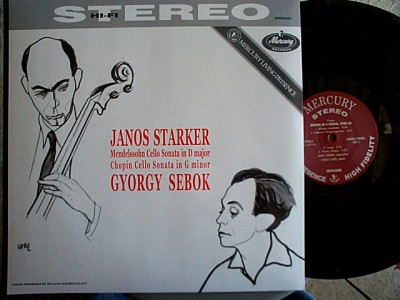
Starker & Sebok: Mendelssohn Cello Sonata Mercury NM LP
$
85


Favourite Auctions
To save auctions to your favourites, please login
If you don't have an account, please register
Description
recordvault store
Starker & Sebok: Mendelssohn Cello Sonata Mercury NM LP
The Division Bell
Specializing In Rare, Collectible, Common & Extraordinary Music Products Since 1999
ALWAYS FREE SHIPPING WITHIN THE USA
Format: 12" 33.3rpm
Label: Mercury SR-90320
Country Pressed: USA
Condition Of Record: Minty! Nearly Flawless
Condition Of Jacket: NM, stunning!
MENDELSSOHN Sonata for cello & piano No. 2 in D major, Op. 58
CHOPIN Sonata for cello & piano in G minor, Op. 65, CT. 204Mendelssohn was briefly between jobs when he wrote the second of his two cello sonatas; he was making the transition from handling musical matters for the King of Prussia to assuming the directorship of the new Leipzig Conservatory. The attendant stress of this period is hardly reflected in this sonata, which the composer wrote for his brother Paul, a cellist. The first movement, Allegro assai vivace, begins with a surging, confident melody for the cello, underpinned by a pressing piano accompaniment. The keyboard then presents its own statement of the theme, the cello now relegated to the background. The piano remains dominant during the introduction of the more lyrical but still impulsive second subject, but the cello eventually gets its turn at an extension of the tune. Unwary listeners might gather that Mendelssohn is here launching a third subject, but the cello is clearly playing the flowing outline of the melody the piano has just broached. Indeed, the instruments will be treated as equals throughout most of this sonata, and often each is allowed a virtuoso flourish. Mendelssohn develops his themes sequentially and neatly, with an almost circumspect ardor that never subordinates one instrument to the other.
The second movement, Allegretto scherzando, opens with a whimsical tune in the piano that is quickly taken up pizzicato by the cello. The melody becomes a bit more lyrical when played arco, but Mendelssohn reserves real songfulness for the second theme, which the cello sings out over a palpitating piano accompaniment. The movement continues with a repeat of the first section that turns uncharacteristically gruff before a brief reprise of the second theme, again in the cello. The instruments quietly slip away, playing fragments of both melodies.
The Adagio begins with graceful piano arpeggios that follow the chord structure of the aria "Es ist vollbracht" from Bach's St. John Passion, reflecting Mendelssohn's lifelong devotion to the music of the German Baroque master. The piano recedes into the background as the cello offers an aria of its own, which grows more ardent and recitative-like as it progresses. Before long, the cello is playing its aria over the piano's chorale-like arpeggios; at the very end, the piano offers its own treatment of the cello's theme. Cellist Coenraad Bloemendal has proposed reading this movement as "a programmatic representation of the competing religious forces that coexisted in Mendelssohn's mind" -- the "Lutheran" piano part overlapping and ultimately embracing what Bloemendal describes as the cello's "cantorial chant."
The extensive finale, Molto allegro e vivace, begins with hectic yet low-key material that recalls the composer's famous Spinning Song. All of this sonata-form movement's thematic elements are spun from the material of the first several measures. Mendelssohn does not vary or develop this material so much as use it to put the two instruments through accelerating, arduous runs, culminating in a final section that creates a dazzling effect without descending to vulgarity.
Chopin's cello sonata, Op. 65, was his last major work. Apart from the piano, the cello was the only instrument for which Chopin composed substantial amounts of music; in 1832 he had written the Grand Duo Concertant for the cellist Auguste Franchomme. In part because of the presence of the cello, and in greater part because of the formal characteristics of the piece, the composition of the cello sonata occupied Chopin for an unusually long period. He worked on it through 1845 and well into 1846, sketching and drafting as he had not done before, and at one point complaining to his sister, "I write a little and cross out a lot." Extant sketches show that Chopin did indeed discard an incredible amount of material and redrafted most of his ideas before deciding on the final form of the work. The piece was printed in Paris in 1847. Chopin and Franchomme premiered the sonata in Paris to great acclaim, in what was to be the last performance of Chopin's career.
Much of Chopin's anguish stemmed from his difficulties in the shaping the relationship between the two instruments. That he mostly composed the cello part first was perhaps at the heart of the matter, for Chopin was forced to curb his keyboard tendencies and remove himself from his natural idiom. It is no surprise that the piano part often sounds uncharacteristic of Chopin. Furthermore, because he chose to engage himself with the Germanic sonata idea, as he had in his piano sonatas, he had to set aside his predilection for ternary forms with codas and achieve contrast and develop logical structures in new and unfamiliar ways.
Chopin takes great care to distribute the material equally between the cello and piano, and he accomplishes this goal in a variety of ways. For instance, in the first group of themes in the first movement we hear passages of piano solo, piano with cello accompaniment, cello with a substantial piano counter-subject, cello with only light piano accompaniment, and counterpoint in which the two partners are equal. After the second group opens with rounded phrases for each instrument, a three-part invention involving both instruments ensues. The Germanic aspect of the movement becomes clear in Chopin's development of an integrated sonata form from a few related motives. Inversion and other transformations of motives from the first few measures occur even in the exposition. One of the cello's most important motives, a rising and falling half-step, comes not from the main theme but from prefatory material, and what seem like mere connective gestures evolve into parts of themes. It is not surprising that Chopin moves to the relative major (B flat), but what is striking is his path--a string of dominant-seventh harmonies--toward this goal. Throughout, Chopin diminishes the punctuating potential of his cadences by writing continuous melody over them, giving a sense of constant growth.
Chopin creates relationships among the four movements of the sonata through melodic references. The primary cello motive of the first movement, a rising and falling half-step, opens the lush second movement, the folksy scherzo, and the tarantella finale--further evidence that Chopin was consciously experimenting with German compositional methods. The clear divisions between cello and piano in the second movement contrast with the more integrated use of the instruments in the first movement, while the finale sounds, at times, like Mendelssohn. The end result is a unique, un-Chopinesque work.
FYI: WE NEVER GUARANTEE NOR IMPLY SEQUENCE OR ORIGINAL PRESSINGS FROM RE-ISSUES, ONLY IF WE ARE SURE WILL WE INDICATE 1st OR ORIGINALS, DO WE INDICATE SO. PLEASE ASK QUESTIONS AND WE ANSWER TO BEST OF OUR ABILITY
PAYMENT VIA PAYPAL ONLY
Shipping Handling Charges
USA SHIPPING IS FREE VIA MEDIA, BUY ONE OR A HUNDRED AND MEDIA IS STILL FREE. IF YOU WANT PRIORITY, IT IS CHARGED AS OUTLINED BELOWPLEASE, BE AWARE MEDIA SHIPPING AVERAGES 2-21 DAYS FOR ARRIVAL, DEPENDING ON YOUR LOCATION, SO PLEASE, IF YOU ARE IN A HURRY, PLEASE CHOOSE PRIORITY
- Priority Rate $9.00 - Add 1.00 for each additional Lp shipped together
- Free Delivery Confirmation Included
- Optional US Postal Insurance Rates apply
2 Lp Sets Count as 2 When Combined
- Canada $8.00, add $2.00 for each additional lp shipped in same package
- All other countries $16.00, add $5.00 for each additional lp shipped in same package
Payment Is Appreciated within 7 Days of end of Auction. We are reasonable so if you should need more time, please communicate with us. If we do not receive a reply within 7 days, the assumption will be that the buyer is not going to follow through with their commitment to buy. On the 8th day with no payment or contact from buyer, we begin the ebay process to receive loss credit from ebay and item is re-listed and that non paying buyer is blocked from future bidding on our auctions and receives unpaid strike from ebay. So, please just e-mail us if you have an issue. Thank You
International Bidders & Buyers Terms
These terms are non-negotiable
When item leaves the USA, we are not responsible for loss or damage in transit. Registered service is available "from" $10.50 PLUS shipping costs, at that point it is virtually guaranteed to arrive, and we will assist you in the claim should that occur....ALSO, ANY orders over $50 US Dollars will be required to purchase the Registered Service, NO Exceptions, e-mails requesting otherwise will be ignored and un-answered. We have a strict International Policy for yours & our protection. If you decide to return item, it will be TOTALLY at your expense and only purchase price will be refunded, shipping, to or from, will be NOT be refunded
Goldmine's Grading Guide
Mint (M): Absolutely perfect in every way - certainly never played, possibly even still sealed. (More on still sealed under "Other Considerations"). Should be used sparingly as a grade, if at all.
Near Mint (NM or M-): A nearly perfect record. Many dealers won't give a grade higher than this implying (perhaps correctly) that no record is ever truly perfect.
The record should show no obvious signs of wear. A 45 RPM or EP sleeve should have no more than the most minor defects, such as almost invisible wear or other signs of slight handling.
An LP jacket should have no creases, folds, seam splits or any other noticeable similar defect. No cut-out holes, either. And of course, the same should be true of any other inserts, such as posters, lyric sleeves and the like.
Basically, an LP in Near Mint condition looks as if you just got it home from a new record store and removed the shrink wrap.
Near Mint is the highest price listed in all GOLDMINE price guides. Anything that exceeds this grade, in the opinion of both buyer and seller, is worth significantly more than the highest GOLDMINE book value.
Very Good Plus (VG+): Generally worth 50 percent of the Near Mint value.
A Very Good Plus record will show some signs that it was played and otherwise handled by a previous owner who took good care of it.
Record surfaces may show some slight signs of wear and may have slight scuffs or very light scratches that don't affect one's listening experience. Slight warps that do not affect the sound are okay.
The label may have some ring wear or discoloration, but it should be barely noticeable. The center hole will not have been misshapen by repeated play.
Picture sleeves and LP inner sleeves will have some slight wear, lightly turned-up corners or a slight seam-split. An LP jacket may have slight signs of wear also and may be marred by a cut-out hole, indentation or corner indicating it was taken out of print and sold at a discount.
In general, if not for a couple of minor things wrong with it, this would be Near Mint. All but the most mint-crazy collectors will find a Very Good Plus record highly acceptable.
Very Good (VG): Generally worth 25 percent of the Near Mint value. Many of the defects found in a VG+ record will be more pronounced in a VG record. Surface noise will be evident upon playing, especially in soft passages and during a song's intro and fade, but will not overpower the music otherwise. Groove wear will start to be noticeable, as will light scratches (deep enough to feel with a fingernail) that will affect the sound.
Labels may be marred by writing, or have tape or stickers (or their residue) attached. The same will be true of picture sleeves or LP covers. However, it will not have all of these problems at the same time, only two or three of them.
GOLDMINE price guides with more than one price will list Very Good as the lowest price. This, not the Near Mint price, should be your guide when determining how much a record is worth, as that is the price a dealer will normally pay you for a Near Mint record.
Good (G), Good Plus (G+): Generally worth 10-15 percent of the Near Mint value. Good does not mean Bad! A record in Good or Good Plus condition can be put onto a turntable and will play through without skipping. But it will have significant surface noise and scratches and visible groove wear (on a styrene record, the groove will be starting to turn white).
A jacket or sleeve will have seam splits, especially at the bottom or on the spine. Tape, writing, ring wear or other defects will start to overwhelm the object.
If it's a common item, you'll probably find another copy in better shape eventually. Pass it up. But, if it's something you have been seeking for years, and the price is right, get it...but keep looking to upgrade.
Poor (P), Fair (F): Generally worth 0-5 percent of the Near Mint price. The record is cracked, badly warped, and won't play through without skipping or repeating. The picture sleeve is water damaged, split on all three seams and heavily marred by wear and writing. The LP jacket barely keeps the LP inside it. Inner sleeves are fully seam split, crinkled and written upon.
Except for impossibly rare records otherwise unattainable, records in this condition should be bought or sold for no more than a few cents each.
There is NO Perfect record, even sealed record may have flawsWE HAVE BEEN SELLING QUALITY RECORDS AND MEDIA PRODUCTS ON EBAY SINCE 1999. WE SELL ALL GENRES AND FORMATS. CUSTOMER SERVICE AND LOYALTY ARE OUR TOP PRIORITY.
PLEASE CONTACT US VIA THE EBAY'S MESSAGING SYSTEM ONLY, WE CHECK EMAILS, TWICE OR MORE EACH DAY MONDAY - FRIDAY AND WILL RESPOND IN ORDER OF CONTACTS MADE
WE ARE NOT ONLINE ON SATURDAY, SUNDAYS AND HOLIDAYS
Certain images and/or photos used in this template are the copyrighted property of JupiterImages and are being used with permission under license.
price rating




![MARTZY,Ida HAENDEL,WAND,MULLER-KRAY [ Brahms, Mozart, Mendelssohn ] 3LPs, ED1,SS](https://www.popsike.net/php/thumbnail.php?url=https://www.popsike.pics/pix/20170111/201780691408.jpg)
![Michael Jackson - Dangerous | [Black Vinyl LP] | Sony](https://www.popsike.net/php/thumbnail.php?url=https://www.popsike.pics/pix/20231124/395018954103.jpg)



![For Free ['Fruit Punch' Colored Vinyl] by David Crosby (Record, 2022)](https://www.popsike.net/php/thumbnail.php?url=https://www.popsike.pics/pix/20230121/385364907439.jpg)


![The Knife - The Knife [New Vinyl LP]](https://www.popsike.net/php/thumbnail.php?url=https://www.popsike.pics/pix/20220915/144717174047.jpg)


